Why Do Some Cars Have Door-Pull Loops Instead of Handles?
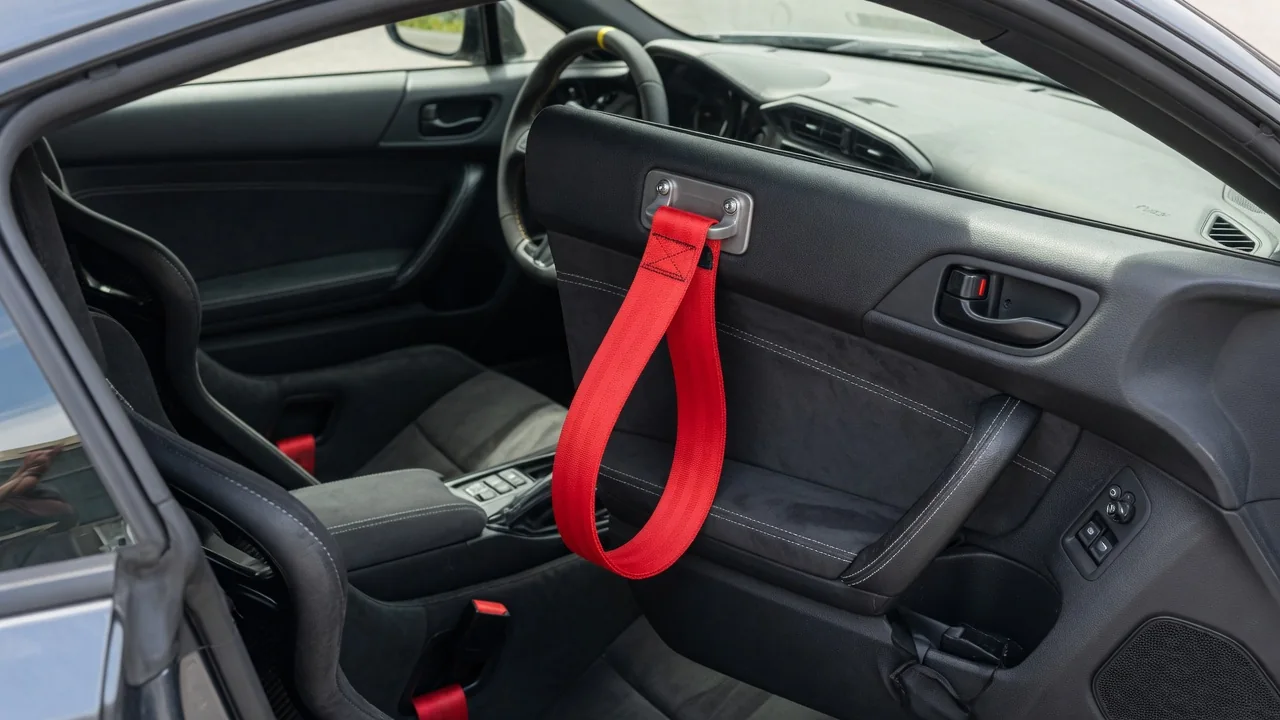
Some cars have a fabric, leather, or webbing loop on the inner door panel where you might expect a rigid pull handle or a molded armrest cup. Three design factors usually explain why some cars have door pull loops instead of handles: how much space the door can spare, which materials suit the pull and the cabin, and how a hand grips a flexible strap compared with a solid bar. These are general principles. Exact choices vary from vehicle to vehicle.
Packaging: Why a Loop Fits Where a Handle Won't
A car door is a crowded package. Between the outer skin and the interior trim panel, engineers typically fit the window glass and its regulator, guide channels, the latch and its linkage, wiring for switches and locks, often a speaker, and structural reinforcement intended to manage side impacts. The trim panel also has to leave room for the occupant's elbow, knee, and hip. A rigid handle or a deep armrest pull cup needs depth behind the panel, mounting bosses, and reinforcement so it can resist a firm pull without flexing the trim. Sometimes that depth isn't available, or the designer wants it for a storage pocket or a slimmer panel. In those cases a loop is an attractive option. It needs only a secure anchor point and a small footprint, and it can lie close to the panel surface when not in use.
Packaging also covers what the occupant sees and touches. A loop reads as a light, minimal element, which suits an interior design language built around clean, uninterrupted surfaces. Because it is flexible, it presents fewer hard edges and corners near the occupant than a protruding bar. Designers can also place a loop where a molded handle would be awkward, such as along a thin upper section of the panel or on a door with little or no armrest. Where reducing mass or part count is a priority, a strap can replace a heavier assembly, although the actual savings depend entirely on the specific design.
Materials: What Door-Pull Loops Are Made Of
Door-pull loops are commonly made from one of three things: • woven webbing similar in construction to seat-belt material; • genuine or synthetic leather; • fabric wrapped around a cord or a stiffening insert; Webbing is strong in tension, light, and easy to cut and sew to length, and its technical look fits sporty or utilitarian cabins. Leather and leather-like materials suit interiors that aim for a crafted or heritage feel. They often have visible stitching that ties the loop visually to the seats or steering wheel. Some loops include a semi-rigid core so they hold an open shape instead of hanging flat.
How the ends are attached matters more than what the strap is made of. A pull loop has to carry the force of closing a door. That force should travel into the door's inner structure, not only into the thin plastic of the trim panel. Typical solutions wrap the loop around a metal bracket, secure it with rivets or screws hidden under a trim cap, or clip it into a reinforced section of the panel. Each material also ages differently. Webbing can fray at cut edges and fade in sunlight. Leather may dry, stiffen, or crack without care. Stitching on any strap can loosen after years of repeated pulls. Rigid plastic or metal handles avoid some of these issues but have their own, such as scratched finishes or cracked mounting points.
User Grip: How a Loop Works in the Hand
A loop is used with a hook grip: the fingers pass through or curl around the strap and pull in tension. This is a natural motion for closing a door from inside. Because the strap flexes, it lines up with the direction of the pull instead of forcing the wrist into a fixed angle. A loop also suits a range of hand sizes, since the fingers simply take up as much of the opening as they need. A rigid handle, by contrast, supports a fuller power grip and gives a stable surface to push against as well as pull, which some occupants find more reassuring.
Grip also depends on finding the pull without looking. A loop that hangs flat can be harder to locate by feel, especially at night. That is one reason some designs use a stiffened strap or place the loop where the hand naturally falls. Placement affects effort, too. Because of basic leverage, a pull located farther from the door hinges takes less force to swing the door than one close to them. Designers therefore balance reach from the seat against mechanical advantage. The strap's width and thickness affect comfort as well. A narrow, thin loop can concentrate pressure on the fingers during a firm pull, while a wider or padded strap spreads it out.
Practical Implications and Limits
For owners, the main practical point is to treat a loop as a closing aid, not a structural handle. Avoid using it to: • hang heavy bags; • pull yourself into the seat; • yank the door hard against its open stop; These uses put loads on the anchor points that the design may not anticipate. If a loop starts to feel loose, check the anchor or its bracket first. This usually means removing the door trim panel using the procedure in that vehicle's service manual. Replacement parts are generally vehicle-specific because anchor style and length vary, so a generic strap may not fit correctly or carry the load safely.
Don't assume what a loop does. In many cars the pull is separate from the interior release lever that unlatches the door, but some designs build the release function into a strap or cord. The owner's manual is the reliable reference, and child safety locks and power-locking behavior also vary by vehicle. A loop is not, by itself, a sign of a cheaper car or a more performance-oriented one. It is a packaging, material, and ergonomic choice, and how well it works depends on how a particular design handles the anchor, the strap, and the placement. Clean it according to its material: a mild fabric cleaner for webbing, and a leather or synthetic-leather product where applicable.