Why Do Some Cars Have Adjustable Pedals?
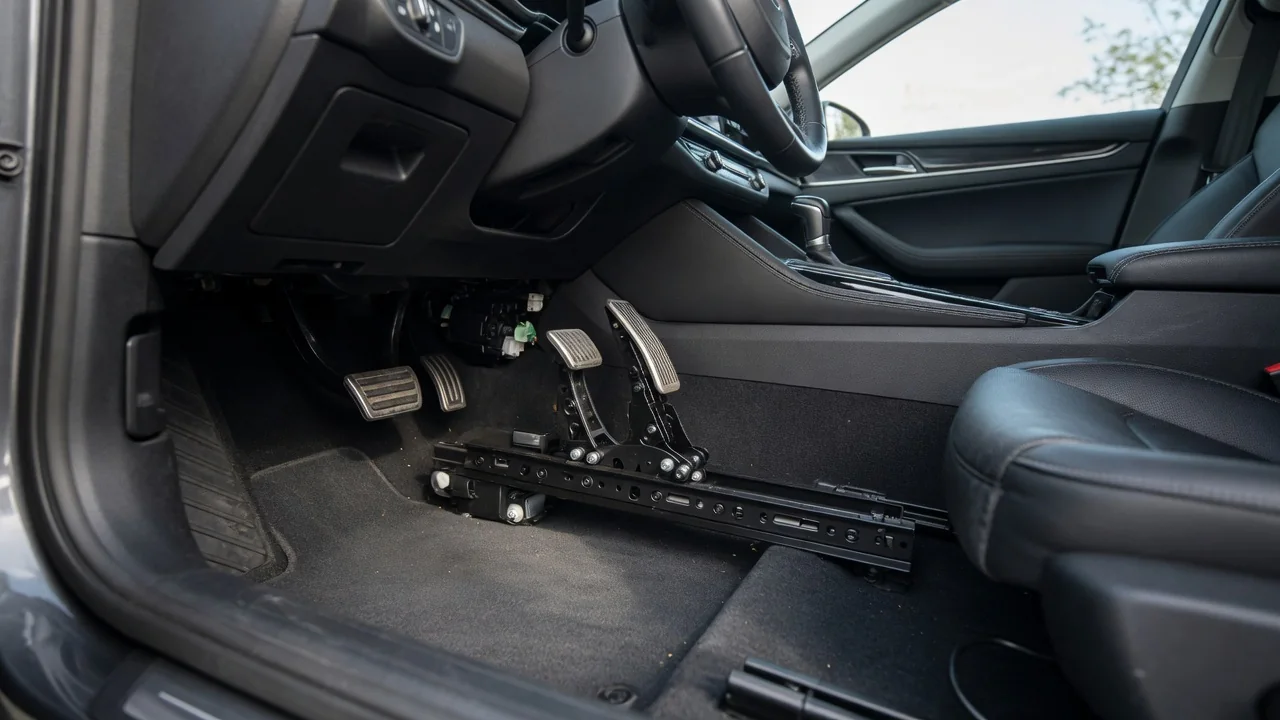
Most drivers adapt to a car by moving the seat and, where possible, the steering wheel. Adjustable pedals add a third option: the brake and accelerator, and in some cases the clutch, can be moved toward or away from the driver. The purpose of adjustable pedals is simple to state but has several consequences. They change how far the driver must reach with the feet, which affects where the seat can sit and how well the driving position fits people of different sizes.
Reach
Reach is the distance between the driver's body and each control. In a conventional layout the pedals are mounted at a fixed point on the vehicle structure, so the only way to bring them closer is to slide the seat forward. That works for the feet, but it ties leg reach to everything else the seat position determines. A driver with shorter legs may need to move the seat well forward to press the brake fully, while a driver with longer legs may run out of rearward seat travel before the knees feel comfortable.
Adjustable pedals separate foot reach from seat placement. Instead of moving the whole body to the pedals, the pedals move toward the feet. On vehicles that offer this feature, the brake and accelerator usually travel together along a short track, commonly driven by an electric motor and controlled by a switch near the driver. Moving them as a set preserves the relationship between the two pedals, so the foot pivots between them in a familiar way wherever they are positioned. Good reach means the driver can press the brake through its full stroke with the knee still slightly bent, without stretching or lifting away from the seatback, and can hold the accelerator steadily without the ankle working at an awkward angle.
Seat position
Seat position is where the indirect benefit of adjustable pedals shows up. When the pedals are fixed, the seat has to satisfy several requirements at once: the feet must reach the pedals, the hands must reach the steering wheel with relaxed arms, the eyes must see over the dashboard and into the mirrors, and the chest should keep a sensible distance from the steering wheel. For drivers near the small or large end of the size range, these goals can conflict. Pulling the seat forward for pedal reach may also bring the body closer to the wheel than is comfortable or advisable.
With pedals that move, the seat can be placed first for upper-body posture and distance from the steering wheel, and the pedals can then be brought to the feet. General driving-position guidance commonly recommends keeping a reasonable gap between the driver's chest and the steering wheel hub, where the frontal airbag is housed, and adjustable pedals can make that gap easier to maintain for shorter drivers. They can help taller drivers in the opposite direction as well: moving the pedals away lets the seat sit where it suits the back and arms without cramping the legs. In both cases the seat is no longer forced into a compromise dictated only by foot reach.
Driver fit
Driver fit describes how well the whole cockpit accommodates a particular body. People differ not only in height but in proportions: two drivers of the same height can have different leg and torso lengths, arm reach and seated eye height. The pedal box, the seat adjustments and any tilt or telescoping steering column together define the range of positions a vehicle can support. Adjustable pedals widen that range by adding another independent adjustment, so more combinations of body proportions can find a position where the feet, hands, back and sightlines all work at once.
Fit also matters when more than one person drives the same car. A household vehicle may be shared by drivers of very different sizes, and each one needs to restore a suitable position quickly. In some vehicles, the pedal position is stored together with seat, mirror and sometimes steering column settings in a driver memory system, so a single button recalls the full setup. Where that integration exists, adjustable pedals become part of a complete fit profile rather than a separate adjustment to reset by hand at every driver change. Whether a given vehicle links pedals to memory is a vehicle-specific detail worth confirming in its owner's manual.
Practical implications and limits
In everyday use, adjustable pedals help most when a driver otherwise struggles to find a position that feels both safe and relaxed. Typical signs include sitting very close to the steering wheel just to reach the brake, sitting with the knees raised uncomfortably, or feeling the right leg tire quickly on longer drives. A practical sequence is to set seat height and backrest angle first, then the fore-and-aft seat position for comfortable arm reach and steering wheel distance, and finally the pedals so the brake can be pressed firmly with a slight bend left in the knee. An adjustable steering wheel can then be fine-tuned last.
The feature has clear limits. The adjustment range is finite and varies by vehicle, so it cannot make every cockpit suit every driver, and it does not replace a properly set seat or steering wheel. Adjustable pedals are generally an equipment item found on some vehicles or trim levels rather than a universal fitting, and many cars rely instead on generous seat travel and telescoping steering columns for similar flexibility. Powered systems may restrict adjustment in certain conditions, such as while the vehicle is moving; the exact behavior differs between designs and is described in the owner's manual. Pedal adjustments are best made while parked, never while driving.
Adjustable pedals also add mechanical and electrical parts, such as a motor, guide tracks and wiring, plus position sensing on some designs. As with other powered adjustments, a fault can leave the pedals stuck in one position or cause uneven movement, and any change in brake pedal feel or travel should be inspected promptly rather than worked around. For drivers who already fit their vehicle well, the feature may offer little benefit. For those at either end of the size range, or for vehicles shared between very different drivers, it can be one of the most useful ergonomic adjustments available.