Why Do Some Cars Have Offset Pedals?
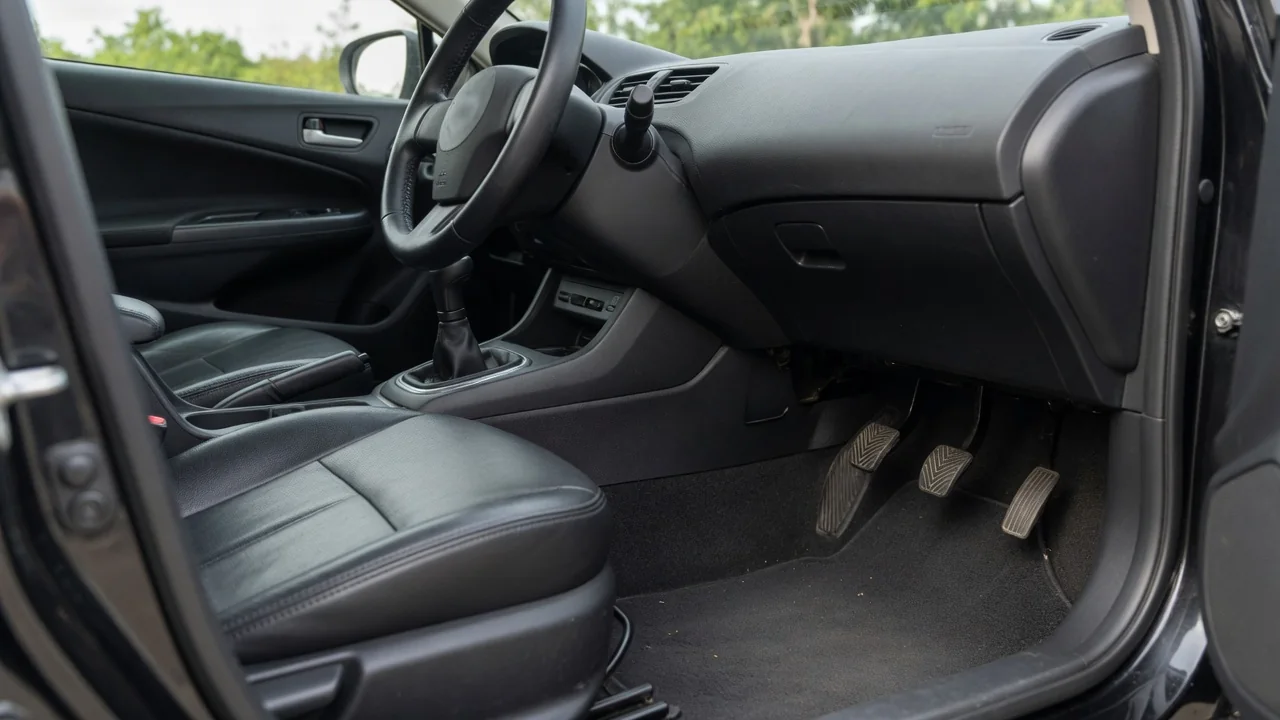
Offset pedals sit noticeably to one side of the line running from the center of the driver's seat through the steering wheel. They are usually shifted toward the middle of the car. Many drivers notice it on a first test drive, when their legs angle inward while their torso faces straight ahead. The layout is rarely accidental. It usually results from packaging trade-offs between the front wheels, the drivetrain, the cabin structure, and the limited space left for the driver's feet.
Wheel well intrusion
The driver's footwell shares its outer boundary with the front wheel well. The inner wheelhouse panel bulges into the space ahead of the door hinge, and it often intrudes most at the lower outboard corner of the footwell, where a driver's feet naturally want to go. The wheel needs clearance for more than its resting position. The arch must also clear the tire as the suspension compresses and extends and as the wheels turn toward full steering lock. The larger that movement envelope, the more of the footwell it claims. When the outboard edge of the footwell is pushed inward, the pedal assembly tends to move inward with it, because the pedals need enough clear space on both sides for a foot to operate them without catching on the trim.
The location of the front axle relative to the cabin matters as well. Designs that move the cabin forward to gain interior space, or that push the wheels toward the corners for a short front overhang and a long wheelbase, can bring the front wheels closer to the driver's feet. Wider tires and bulkier suspension or brake components add to the same effect. On the inboard side, the footwell is bounded by the center tunnel or floor structure, which may house a transmission, driveshaft, exhaust, wiring, or structural members, depending on the layout. The pedals end up squeezed between the arch on one side and the tunnel on the other. That is the core of offset car pedals packaging: the pedal box goes wherever the remaining usable width happens to be, which is not always directly in front of the seat.
Driver position
In most cars, the seat and steering wheel are aligned with each other, and the pedals are what drift off that line. How much this matters depends heavily on seating posture. In a low seating position, the driver's legs extend far forward, so the feet reach deep into the footwell, close to where wheel well intrusion is greatest. In a more upright position, typical of taller vehicles, the knees bend more sharply and the feet rest closer to the seat, farther from the arch. That is one reason pedal offset tends to come up more often in discussions of low-slung cars, although the actual result always depends on the individual vehicle's design.
Engineers cannot simply slide the seat sideways to line it up with the pedals. The seat's lateral position is constrained by the door, the side structure, the center console, the passenger space, and the steering column. Moving the seat inboard could crowd the console or the passenger, while moving the steering wheel toward the pedals would misalign the driver's hands and shoulders with the direction of travel. Some designs split the difference by angling the seat or steering column slightly, so the offset is shared between the upper body and the legs rather than concentrated at the feet. The outcome is a compromise among visibility, control reach, and space, and the driver's legs often absorb whatever misalignment remains.
Comfort
On a short trip, a modest pedal offset may go unnoticed. Over longer drives, it can become more apparent. When the feet sit to one side of the seat centerline, the knees and hips rotate slightly, and the pelvis may settle into an asymmetrical position. Some drivers notice this as fatigue or tension in the hips, knees, or lower back, while others never feel it at all. Body proportions, flexibility, and habitual sitting posture all influence how the same layout feels, so one driver's complaint can be another driver's non-issue.
The left foot is affected too. A footrest, often called a dead pedal, gives the left leg a place to brace and relax, but wheel well intrusion can narrow or angle that area. In cars with a manual transmission, the clutch pedal shares the same crowded space, and the left leg may operate it at an angle. The right foot faces its own trade-off. Many drivers plant a heel on the floor and pivot between the accelerator and the brake. If the pedals are shifted inward, the heel's natural resting spot moves, and the ankle may work at a less relaxed angle during repeated transitions. None of this makes a car unsafe by itself, but it shapes how comfortable the car feels after an hour behind the wheel.
Practical implications and limits
If pedal placement matters to you, evaluate it during a test drive rather than in a quick sit in a showroom. Set the seat the way you normally would before judging the pedals, then drive long enough to feel any strain develop. Check that you can press the brake firmly and fully, move between pedals without catching a shoe on adjacent trim, rest your left foot comfortably, and, in a manual car, operate the clutch through its full travel. Wear the shoes you usually drive in, since sole width and stiffness change how the pedal area feels.
Seat height, fore-aft position, backrest angle, and a telescoping steering column can change how the offset feels, because they alter where your feet land in the footwell. They cannot move the pedals themselves. Be cautious with aftermarket pedal pads or extensions: anything that changes pedal size, spacing, height, or position can affect how the pedals operate, and floor mats should be the correct type for the vehicle and properly secured so they cannot interfere with pedal travel. Drivers with specific physical needs can look into adaptive driving equipment installed by qualified specialists rather than improvised modifications.
Keep the limits of a general explanation in mind. The degree of offset varies widely between vehicles, and a slight offset is common and is not, on its own, a sign of a defect. The mechanisms described here explain why some cars have offset pedals, but they cannot predict how a particular vehicle will feel to a particular driver. For details on available seat and steering adjustments, the owner's manual for the specific vehicle is the most reliable starting point, and your own time behind the wheel remains the final test.