Why Do Rocker Panels Matter in Restoration?
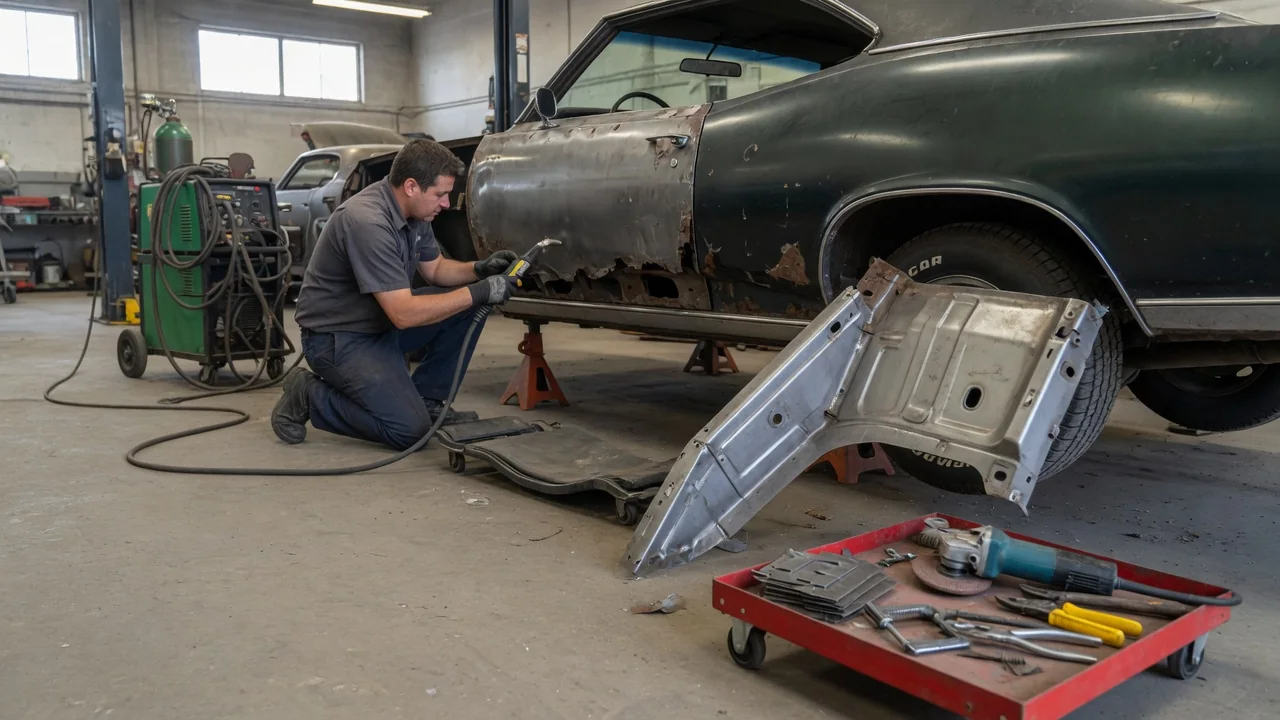
Rocker panels run low along each side of the body, between the front and rear wheel openings and below the doors. They rarely draw attention the way fenders or brightwork do, yet they often decide whether a classic car restoration is simple or extensive. Understanding why rocker panels matter in restoration means looking at what they hold together, how they deteriorate, and what a sound repair involves.
Structural role
On many classic cars built with unitized, or unibody, construction, the rocker is not a single sheet of trim. It is a boxed section made from an outer panel, an inner panel and often internal reinforcements, joined along welded flanges commonly called pinch welds. That closed box behaves like a beam. It ties the front structure to the rear structure, supports the edges of the floor pans and resists the body bending or twisting between the axles. Door openings remove a large amount of metal from the sides of the body, so the rockers below those openings, together with the pillars and roof structure, do much of the work of keeping the openings square and the doors aligned.
On body-on-frame designs, a separate frame carries most of the chassis loads, so the rockers generally contribute less to overall stiffness. They still matter. They support the outer edges of the floor, give the doors a stable lower reference and, on some vehicles, serve as lifting or jacking locations. How much a particular car depends on its rockers comes down to its construction, so the factory service manual or body dimension information for that model is the right reference for specifics rather than general assumptions.
The same boxed shape that makes rockers strong also makes them vulnerable. Water, road salt and dirt enter through door seals, seams and drain holes, then collect inside a cavity where they cannot easily dry. Drain holes clog with debris, internal corrosion protection may have been thin or missing from the start, and rust typically begins on the inside surface. By the time classic car rocker panel rust shows as bubbling paint on the outside, the hidden metal is often in worse condition than the visible damage suggests.
Inspection
Start with the exterior. Look along the lower edge and the pinch weld for blistered paint, flaking metal, pinholes and cracks. Paint that does not match the rest of the car, unusually fresh undercoating or a thick, wavy surface can point to earlier repairs. A small magnet helps identify areas built up with body filler, because it will grip weakly or not at all where filler is thick. Lightly tapping the panel can also reveal differences between solid metal and filler or thin, corroded steel.
Then work from underneath and inside. Check the inner rocker and its joint with the floor pans, which usually means lifting the carpet and removing sill plates or kick panels. Pay close attention to where the rocker meets the front pillar area, the center pillar and the rear wheel opening or quarter panel, since these junctions trap moisture. Probing suspicious spots with an awl or screwdriver, using gentle pressure, shows whether metal is solid or crumbling. A borescope inserted through existing openings can show the condition inside the cavity without cutting anything.
Structural weakness often appears indirectly. Doors that sag, bind or become hard to close, door gaps that change when the car is lifted, and cracked paint at the corners of door openings can all indicate a rocker that no longer holds its shape. Also watch for shortcuts left by earlier owners, such as slip-on rocker covers riveted over rot, fiberglass patches or cavities filled with expanding foam. These may look acceptable from a distance while hiding serious decay underneath.
Repair
Preparation matters as much as welding. Before any structural metal is removed, the body should be supported evenly so it is not sagging under its own weight, and temporary braces are commonly welded or bolted across the door openings to hold their shape. Recording reference measurements, including diagonal checks across the openings and comparisons with factory dimensions where available, gives a way to confirm nothing has moved. Many restorers replace one side at a time so the opposite side continues to provide support.
The extent of the repair follows the extent of the corrosion. Damaged metal is cut back until clean, solid steel remains. If the inner rocker and reinforcements are sound, replacing only the outer skin may be enough; when rust has spread, the inner panel, reinforcements and adjoining floor edges may need work as well. Replacement panels should be test fitted with doors and fenders in place before final welding, because small fit errors become visible in door gaps and body lines. Factory spot welds are typically reproduced with a spot welder or with MIG plug welds, while patch joints are often butt welded in short, spaced stitches to limit heat distortion in thin sheet metal.
Corrosion protection decides how long the repair lasts. Weld-through primer on mating flanges, a durable primer on bare metal, seam sealer where the factory used it, and a cavity wax or similar coating inside the closed section all help keep moisture from starting the cycle again. Drain holes must remain open. Filling the cavity with foam or covering damaged metal with cosmetic panels tends to trap water and accelerate the problem rather than solve it.
Practical implications and limits
For anyone evaluating or planning a project, rocker condition is an early indicator of overall scope. Rocker work often requires removing doors, trim, interior components and sometimes fenders, and it must be finished before final bodywork and paint, so it shapes both the schedule and the budget. Weak rockers also create a practical hazard during the project itself: lifting a car on corroded jacking areas can crush the metal or let the car shift. Supporting the body at solid structural points until repairs are complete avoids adding new damage to old.
General guidance has limits. Construction, panel design and factory joining methods vary between vehicles, and the fit of reproduction panels varies between suppliers, so model-specific references and careful test fitting remain essential. Extensive rot on a unibody car can extend into floors, pillars and wheelhouses, turning a rocker job into broader structural repair. Welding near fuel lines, brake lines, wiring and interior materials carries fire risk and demands care. Requirements for inspecting structural repairs differ by location, and restorations aimed at originality may call for factory-style seams and methods. When the condition of the structure is uncertain, an assessment by an experienced body specialist is a sensible step before cutting.