Why Do Race Cars Use Fire Suppression Systems?
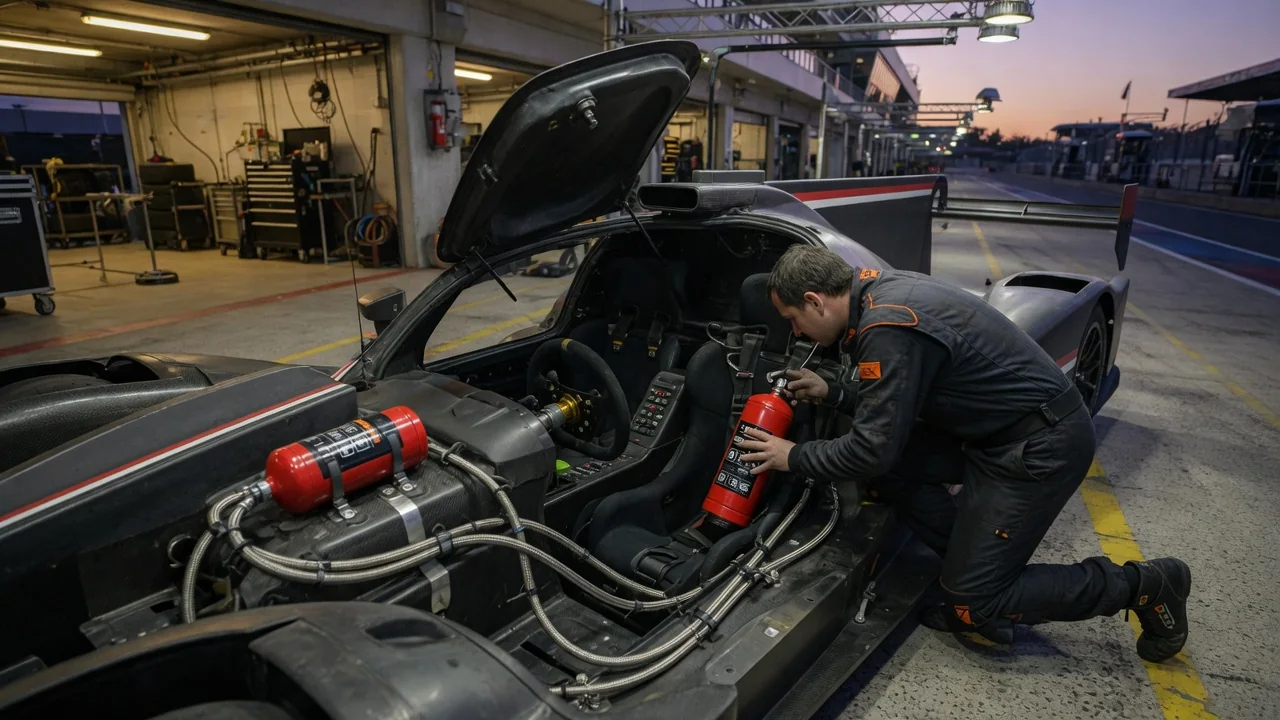
Race cars carry fuel, oil, and other flammable fluids close to hot engine and exhaust components, and they run at speeds where a crash can split a line or damage a tank in an instant. A driver held in place by a multi-point harness, helmet, and head restraint cannot always climb out quickly. That is the core reason race cars use fire suppression systems: to knock down or slow a fire long enough for the driver to escape and for safety crews to arrive.
Activation
A motorsport fire suppression system is typically a pressurized container of extinguishing agent connected by tubing to fixed nozzles placed around the car. Unlike a handheld extinguisher, it is permanently installed and aimed in advance, so the person who triggers it does not have to point or sweep anything. Once activated, the system releases its agent through the plumbing in a single discharge rather than in short, controlled bursts. The goal is to flood the most dangerous areas quickly, during the first moments when a fire is easiest to suppress and the driver is most vulnerable.
Most racing systems are triggered manually. Mechanical versions use a cable that links a pull handle to a valve on the container. Electrical versions use a push button that fires an actuator, and many designs give that circuit its own power source so it can still work if the car's main electrical system is damaged or shut off. Rulebooks in many categories call for one trigger the belted driver can reach and a second trigger outside the car, so marshals can activate the system if the driver is injured or unconscious. The external trigger is usually marked so safety crews can find it quickly.
Some systems also include automatic activation through heat-sensitive elements, but manual triggering remains common in racing because a person can react to smoke or flames before temperatures reach a sensor's threshold. Which activation methods are permitted, and where the triggers must be mounted, depends on the sanctioning body's rules and on how the specific system was designed and approved. That is why installation details differ from one series or car to another, even when the basic principle is the same.
Coverage
Coverage refers to where the nozzles send the agent. The cockpit is a priority because it is where the driver is trapped while unbuckling and getting out. Cockpit nozzles are generally positioned so the agent spreads around the driver's legs and lower body and along the escape path, rather than spraying directly into the driver's face. Protecting this space buys time during the part of an emergency that the driver controls least: releasing the harness, removing the steering wheel if needed, and climbing over the side of the car or roll structure.
The engine compartment is the other main target. Fuel lines, injectors, oil lines, turbochargers, and exhaust parts all sit close together there, so a leak can ignite on a hot surface. Engine bay nozzles are aimed at the areas where leaks and heat are most likely to meet. Some installations also add coverage near the fuel cell or other fuel system components. How much agent goes to the cockpit versus the engine bay is set by the system design and, in many cases, by the applicable rules rather than left to the installer's preference.
The type of agent also affects coverage. Foam-based agents can blanket fuel and help keep it from reigniting, while gaseous or so-called clean agents spread through enclosed spaces and leave little residue. Each type has tradeoffs in effectiveness, cleanup, and suitability for open or closed cockpits, and environmental regulations have changed which agents are available over time. For that reason, the agent, the amount carried, and the nozzle layout are matched to each other and should not be mixed or swapped casually.
Maintenance
A fire suppression system only helps if it works the moment it is needed, so routine checks matter. Many containers have a pressure gauge that should read within the marked operating range. Systems usually include a safety pin or lock that prevents accidental discharge while the car is being worked on; it must be removed before the car goes on track and put back when the car is parked or in the garage. Forgetting to remove it can leave the driver with a trigger that does nothing in an emergency. Electrical systems may also have a test indicator or battery that should be checked before each event.
Beyond pre-event checks, containers need periodic servicing and recertification at intervals defined by the system manufacturer and the sanctioning body. Service can include weighing the container to confirm it still holds its full charge, inspecting valves and seals, and refilling or replacing parts. Technical inspectors at many events look for a valid service date label, and an out-of-date container can keep a car from running even if it appears to be fully pressurized.
The rest of the installation needs attention as well. The container is heavy and must stay attached under crash loads, so its mounting brackets and fasteners should be checked regularly. Tubing should be free of kinks, chafing, and damage, especially after other work in the cockpit or engine bay. Nozzles can be knocked out of alignment or blocked during repairs, so their aim should be confirmed. After any discharge, intentional or not, the entire system needs to be serviced and recharged before the car runs again.
Practical implications and limits
An onboard system is one layer of a broader safety approach, not a complete answer. Fuel cells designed to resist rupture, fire-resistant driving suits and gloves, electrical cutoff switches, quick-release steering wheels, and trackside marshals with handheld extinguishers all work together. The suppression system carries a limited amount of agent and usually discharges once, so it is meant to buy time rather than guarantee that a fire is fully out. Hot surfaces and continued fuel leaks can allow a fire to reignite after the agent has dispersed.
For anyone preparing a club racing or track car, the key question is what the specific organizer and class require. Requirements vary widely: some events require a plumbed system, while others may accept only a mounted handheld extinguisher, and the details can change between rulebook editions. Checking the current rules for the event, and following the system manufacturer's installation instructions exactly, avoids failed inspections and installations that look correct but would not perform as intended. Added weight, cost, and ongoing service are part of the commitment.
Drivers also benefit from knowing their system, not just owning it. Practicing reaching the trigger while fully belted in and wearing gloves helps make the action automatic under stress. Knowing whether the agent leaves residue, and what cleanup the manufacturer recommends after a discharge, prepares owners for the aftermath. Understanding these limits keeps expectations realistic: a fire suppression system improves the odds of escaping a fire, but it works best as part of a well-maintained car and a prepared driver.