Race car fire suppression systems
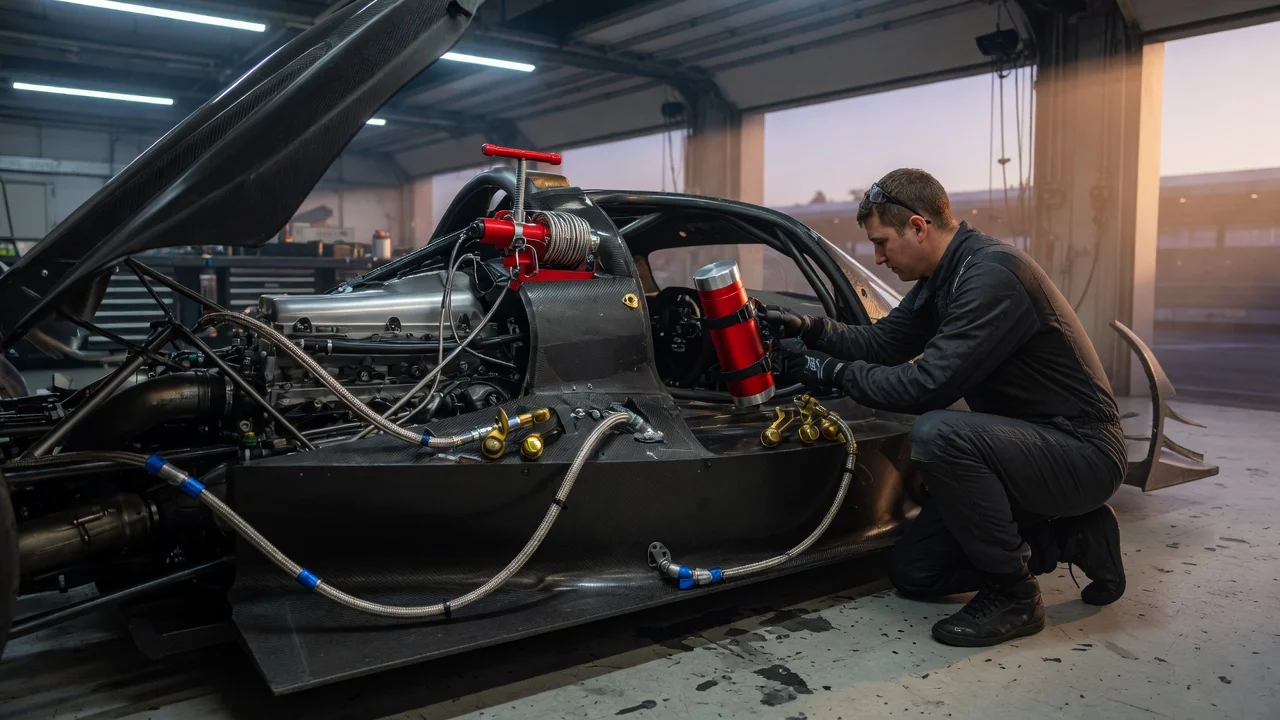
Answer the main question
A race car fire suppression system is a fixed, onboard safety installation that discharges a fire-fighting agent into a protected area or areas of the car. In most sanctioned competition, it is not an optional convenience item but part of the required safety equipment for vehicles operating with closed cockpits, high-pressure fuel systems, large fuel loads, or strong crash-energy exposure. Unlike a handheld extinguisher, the system can be triggered by the driver while seated and, depending on configuration, may also activate automatically when sensors or a heat-sensitive release detect a fire.
The direct answer to what these systems do depends on the vehicle class. A purpose-built single-seater may require a system with defined capacity, bottle location, discharge nozzle placement, and a clearly marked activation point. A production-based race car converted for endurance or sprint competition may use a different layout with separate engine-compartment and cockpit coverage. In every case, the system is meant to buy time, suppress a fire long enough for the driver to stop and exit or for trackside crews to respond, not to make a heavily damaged car safe to continue driving.
The effective answer for a specific car therefore comes down to three measurable factors: the sanctioned series rules, the discharge capacity and plumbing of the installed system, and the condition of the bottle, lines, nozzles, and activation parts on the actual service date. Two cars that appear similar can have meaningfully different protection because one carries an outdated or damaged system.
How a race car fire suppression system works
A typical system stores a liquid or gaseous agent under pressure in a cylinder. When the driver pulls a mechanical cable, pushes an electrically wired switch, or an automatic actuator opens, the agent leaves the bottle, travels through fixed lines, and is distributed through nozzles aimed at high-risk zones. The most common protected areas are the engine compartment, the fuel-cell or fuel-system area, and the cockpit or driver compartment.
The agent works by interrupting one or more sides of the fire triangle: heat, fuel, and oxygen. Some agents cool the surfaces and hot components that would otherwise reignite fuel vapor. Others dilute or displace oxygen or interfere with the chemical reaction. The useful effect is short-lived because the agent is discharged in seconds and does not remain as a permanent barrier. That is why the design goal is rapid, well-distributed delivery rather than a slow trickle of suppressant.
Activation paths matter in practical terms. A manual mechanical system is reliable when the cable, sheathing, and pull handle are clean and properly routed, but it depends on the driver being conscious and able to reach the handle. An electrically fired system can also be triggered remotely, but it requires power and sound wiring. Some installations combine the two so that the manual path remains even if electrical power is lost.
Automatic suppression adds a detection element. This may be a pressurized sensing line that ruptures when exposed to flame or heat, opening the cylinder, or an electronic sensor that commands the actuator. An automatic system can begin discharging before the driver reacts, but it can also be triggered by a fire that starts in a location where the nozzles are poorly aimed. Detection and nozzle coverage must be evaluated together.
What changes the answer
Engine configuration changes where heat and fuel vapor collect. A front-engine car often routes the bottle or distribution line from the passenger area forward, while a mid- or rear-engine car concentrates coverage around the engine bay, transaxle, and nearby fuel plumbing. Turbocharged cars can expose the exhaust turbine, wastegate, and associated oil or fuel lines to higher surface temperatures, so the nozzle layout and the risk points may differ from a naturally aspirated version of the same model.
Fuel type and tank location also affect the practical system choice. Cars with a fuel cell, high-capacity tank, or refueling hardware in the cabin or near the driver require cockpit coverage that meets the series rule for that body style. An older production-based car with the factory tank and no sealed firewall arrangement may not be accepted for certain classes without additional bulkhead work, regardless of how large the suppression bottle is.
Service history changes the real state of the equipment. A dated bottle that has not been weighed, inspected, or recharged within the interval required by the sanctioning body is not the same safety device as a freshly serviced one. Pressure can bleed down, seals can leak, powder agents can settle or pack, and discharge nozzles can be blocked by debris. A legible label or an old invoice does not by itself prove that the system will discharge correctly on race day.
Symptom conditions introduce another distinction. A system that fires during a minor wiring fire may look like a problem, but it is doing its intended job. A system that fails to fire after an impact may have a ruptured line, a disconnected actuator, or a cylinder that was already empty. Accident damage must be inspected as the cause of non-operation, not assumed to be an irrelevant coincidence.
What the owner or crew can do
Before each event, confirm that the installed system matches the current class requirements and that the bottle weight or pressure and the service date meet the approved interval. Check the pull handle or activation switch for free movement and clear labeling. Follow the discharge lines from the cylinder to each nozzle and look for kinks, cuts, heat damage, loose fittings, or signs of contact with suspension or exhaust components.
Inspect the nozzle placement against the areas that actually contain fuel, oil, and ignition sources. A nozzle pointed at an empty corner of the engine bay may satisfy a superficial visual check without protecting the fuel rail or collector. Compare the layout with the system instructions and the vehicle-specific routing used for the model year, engine variant, and conversion package.
Record service work and any observed symptoms in a durable log. If the system has been discharged in testing, damaged in an incident, or exposed to a leak, treat the car as unprotected until the bottle has been serviced, the lines have been inspected for blockage or rupture, and the correct agent has been refilled. Do not rely on track-day grace periods or an expired sanction sticker when the physical condition is unknown.
After any crash or strong impact, inspect the cylinder mounting, the pull-cable routing, the electrical connector, and all plumbing before the next session. A mechanical system that binds because the cable was pinched in body deformation may not activate at the handle. In an electrically fired circuit, check for continuity and loose terminals only according to the manufacturer's specified service method, because some live checks may introduce a firing risk.
Limitations and next step
The biggest limitation is that general advice cannot validate a particular car. Sanctioning rules differ between series, event types, body classes, and calendar years. Manufacturer specifications for the bottle, actuator, line routing, nozzle count, agent type, and service interval are the controlling reference for the installed hardware. A system that is correct for one championship may be illegal or under-specified for another, even if the car itself is the same.
Diagnostic codes and ordinary onboard vehicle diagnostics do not provide a reliable health check for most mechanical fire suppression installations. A race car may have no relevant fault signal for a low bottle charge, a blocked nozzle, or a damaged discharge line. Visual and physical inspection, along with the system's own pressure or weight indication, is usually the only dependable field check.
When the bottle is out of date, the system has discharged, the routing has been altered after an engine or body change, or the car is being prepared for a new class, the next step is a qualified inspection by a technician or service facility approved for the specific system and competition category. Have the car's rule book, the system documentation, and the current service history available so the inspection covers the installed configuration rather than a generic visual pass.