Why Do Cars Use Different Spring Rates Front and Rear?
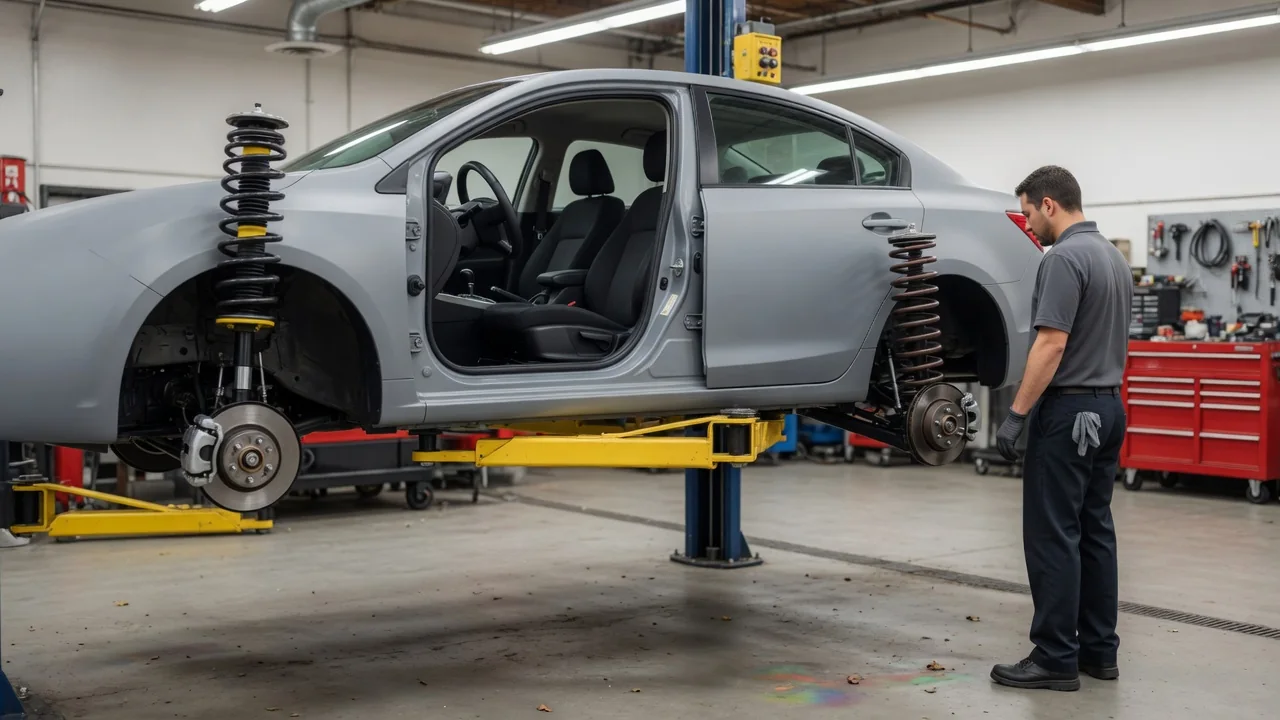
If you look up the spring specifications for almost any car, the front and rear numbers are usually different. This is deliberate. A front rear spring rate split is one of the main tools engineers use to support uneven weight, tune how the body moves over bumps, and set the car's cornering balance. So why do cars use different spring rates front and rear? Each of those three factors pushes the two ends apart in its own way.
Axle Load and Wheel Rate
The most basic reason is that the two axles rarely carry the same load. In a typical front-engine car, the engine, transmission and often the drive components sit over or ahead of the front wheels, so the front axle supports a larger share of the vehicle's mass. Rear-engine and mid-engine layouts shift that balance the other way. Each spring has to hold its corner of the car at the intended ride height, so the heavier end generally needs more spring force to avoid sitting low or using up too much of its travel just holding the car still. Load also changes with use. Rear-seat passengers, cargo and trailer tongue weight mostly add mass toward the back, which is why the rear of many vehicles has to cope with a wider range of loads than the front.
The rate listed for a spring is also not the same as the stiffness the tire actually feels. Engineers distinguish spring rate, the stiffness of the coil itself, from wheel rate, the effective stiffness measured at the wheel. The difference comes from geometry. If the spring is mounted partway along a control arm rather than directly above the wheel, the wheel moves farther than the spring compresses, and that leverage reduces the effective rate, roughly in proportion to the square of the lever ratio. Because front and rear suspensions are often different designs, such as struts at the front and a multi-link or beam axle at the rear, their motion ratios differ too. Two springs with very different rates can produce similar wheel rates, and two identical springs can produce quite different ones. That alone makes front and rear spring numbers rarely directly comparable.
Ride: Tuning How Each End Moves Over Bumps
Ride comfort depends less on the absolute spring rate than on the natural frequency of each end, meaning how quickly the body bounces on its springs after a disturbance. That frequency is set by the relationship between the wheel rate and the sprung mass supported at that axle. A heavier end needs a stiffer wheel rate just to reach the same frequency as a lighter end, so achieving the intended frequency at each axle is another reason the springs differ. Too low a frequency feels floaty and allows large body motions, while too high a frequency passes more of the road surface into the cabin.
There is also a timing issue. When a car drives over a bump, the front wheels hit it first and the rear wheels follow a moment later, with the delay depending on wheelbase and speed. If both ends had identical frequencies, the front would already be partway through its motion when the rear started, and the body would tend to rock nose-to-tail. A long-standing approach in passenger car design is to give the rear a somewhat higher natural frequency than the front, so the rear motion catches up with the front and the body rises and settles more evenly instead of pitching. How much offset a manufacturer chooses depends on the vehicle's purpose and is not a fixed rule, but the principle explains why the rates are seldom chosen to be equal.
Handling: Setting the Balance Between Understeer and Oversteer
In a corner, weight transfers toward the outside wheels. The total amount of transfer is mostly determined by the vehicle's mass, center of gravity height, track width and cornering force. The springs, together with anti-roll bars and suspension geometry, decide how that transfer is split between the front and rear axles. The end with greater roll stiffness takes a larger share of it. Because a tire's grip does not rise in direct proportion to the load placed on it, the axle that carries more of the transfer ends up with less total grip relative to the other end.
This gives engineers a direct lever on handling balance. Making the front stiffer in roll relative to the rear tends to push the car toward understeer, where the front tires reach their limit first and the car runs wide. Making the rear relatively stiffer tends to move the balance toward oversteer, where the rear tires give up first. Most road cars are tuned to understeer mildly at the limit because that behavior is generally considered easier for ordinary drivers to manage. The final balance comes from springs, anti-roll bars, dampers, tires, alignment and weight distribution working together, so the spring split is chosen alongside those elements rather than in isolation.
Practical Implications and Limits
For owners, the key point is that front and rear springs are designed as a matched set for a particular vehicle, trim and equipment level. Options that add weight, such as a larger engine, all-wheel-drive hardware or a sunroof, can lead a manufacturer to specify different springs for otherwise similar versions of the same model. When replacing springs, the most reliable reference is the part numbers or specifications in the vehicle's service information, and springs are normally replaced in pairs on the same axle so both sides stay matched in height and rate.
Lowering springs and performance kits change more than ride height. Raising the rate at one end more than the other alters the ride frequency relationship and the roll stiffness split, which can affect both comfort and behavior near the limit of grip. Well-developed kits are usually designed as front and rear pairs for that reason, while mixing springs from different sources or changing only one axle can create an unintended balance. Shorter springs can also reduce usable suspension travel, so the bump stops may come into play sooner on rough roads.
Spring rates also cannot solve every problem on their own. A rear rate chosen to keep a fully loaded car from sagging may feel firmer than ideal with only the driver aboard, and some vehicles address this with progressive-rate springs, helper springs or load-leveling systems instead of a single stiff linear spring. Dampers control how quickly the body moves, but they do not change how far it ultimately compresses under a steady load. Because motion ratios, suspension types and design targets vary from vehicle to vehicle, a spring rate from one car says little about another. The reasons for a front-to-rear difference are general, but the correct values are always specific to the vehicle.