Why Did Cars Move to Digital Instrument Displays?
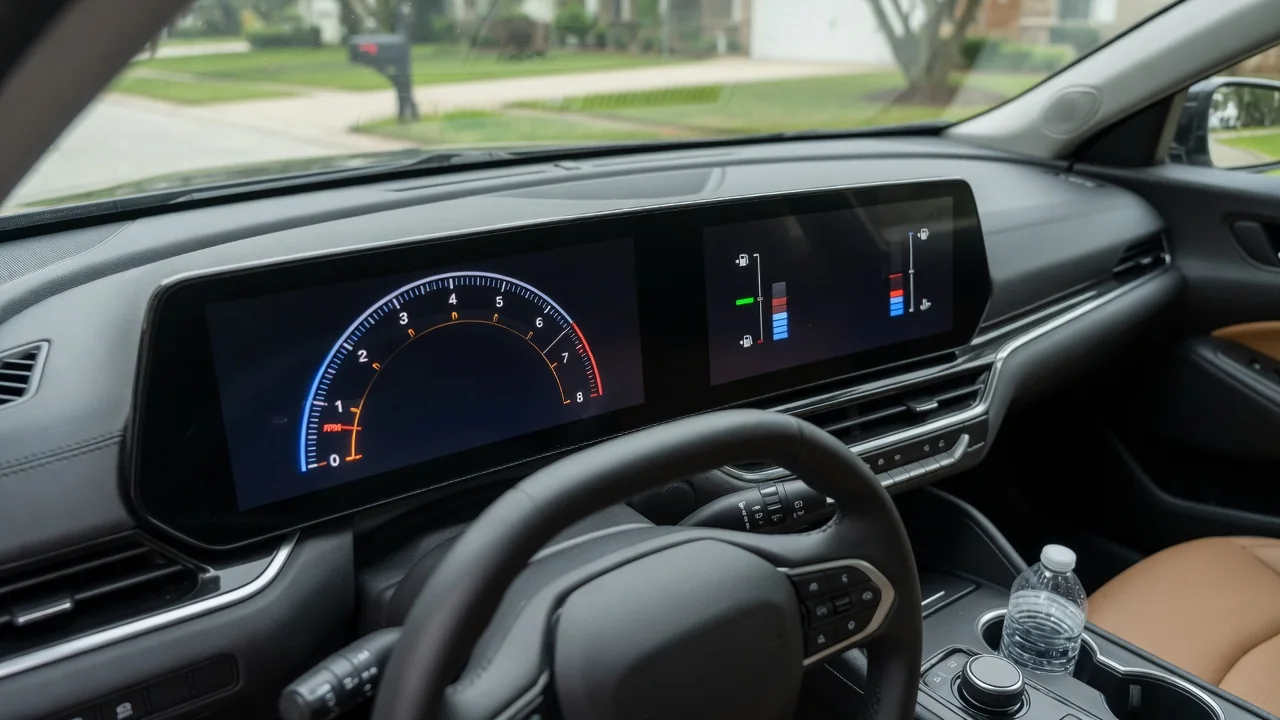
Drivers who ask why did cars move to digital instrument displays usually notice the change first as a screen where needles used to sweep. The shift came from a practical need: modern vehicles generate far more information than fixed gauges can show. A reconfigurable screen offers flexibility, though it also brings tradeoffs in readability, durability, and repair that are worth understanding.
Display possibilities
A mechanical cluster dedicates permanent space to each gauge, so a speedometer, tachometer, fuel gauge, and temperature gauge consume the whole panel whether or not the driver needs them. A screen removes that constraint. The same area can show a full navigation map, driver assistance graphics depicting surrounding traffic, a trip computer, or media details, then return to conventional round dials. For automakers, one display unit can also serve several models and trim levels with different software, which simplifies design and manufacturing compared with tooling unique gauge faces.
Electrified powertrains made the argument stronger. A hybrid or electric vehicle needs to communicate battery charge, regenerative braking, energy flow, and remaining range, none of which fits neatly on a traditional tachometer. A digital panel can swap an engine speed dial for a power meter depending on drive mode. What owners actually see varies widely, though. Some vehicles offer several selectable layouts and themes, while others use a screen that imitates fixed dials with only a small configurable center area, so the degree of flexibility depends on the manufacturer and trim.
Readability
Readability is where the tradeoffs become visible. A well-designed digital cluster can present speed as a large numeral, which many drivers read faster than estimating a needle position between tick marks. Warnings can appear as plain-language messages in the center of the panel rather than as a small symbol the driver has to decode. Brightness adjusts automatically for night driving, and some layouts dim or hide secondary information so that speed and critical alerts remain dominant when the driver only has a moment to glance down.
A physical needle has strengths that screens must work to match. Its angle communicates a rate of change at a glance, which is why many digital layouts still draw simulated dials. Screens can also suffer from glare in direct sunlight, reflections from light-colored clothing, and reduced contrast when viewed through polarized sunglasses, depending on the panel type and the hood shading it. Dense layouts with small fonts, animations, and multiple data fields can slow recognition rather than help it, so the quality of the graphic design matters as much as the hardware.
Failure considerations
Failure behaves differently on a screen than on an analog cluster. When a mechanical gauge fails, the driver typically loses one reading while the others keep working. A digital display concentrates everything in one component, so a failed backlight, a faulty panel, a software fault, or a lost power or data connection can remove speed, fuel level, and warning indicators at the same time. Symptoms owners may notice include flickering, a blank screen at startup, frozen graphics, dead pixels or lines, and a display that recovers after the vehicle is restarted.
Diagnosis also takes more care. The cluster receives most of its data over the vehicle network from other control modules, so a wrong or missing reading may originate in a sensor, wiring, or another module rather than in the screen itself. Stored fault codes are evidence to interpret alongside testing, not proof that the display has failed, and manufacturer-specific codes need confirmation against information for that exact vehicle. Replacement may involve programming and mileage data handling, which is why repair paths differ considerably between brands and model generations.
Everyday Use and Observations
In daily driving, the benefits tend to show up in small moments. Turn-by-turn directions placed directly ahead of the driver reduce the need to look across to a center screen. Adaptive cruise control and lane keeping status are easier to follow when shown as a simple road graphic. Many clusters change appearance with drive modes, emphasizing efficiency information in an economy setting and engine speed in a sport setting. Steering wheel controls usually handle the switching, and learning those menus while parked makes the system far less distracting on the road.
Owners can learn a lot by simply watching the display through different conditions. Note whether it is legible at midday with the sun behind the vehicle, whether night brightness is comfortable, and whether it starts promptly in very cold or hot weather, since some panels respond more slowly at temperature extremes. Pay attention to the startup sequence as well, because warning lamps normally illuminate briefly as a self-check. The specific behavior, menu structure, and available views differ by vehicle, so the owner's manual remains the reliable reference for what is normal.
Limits and Next Steps
Digital clusters do not make a vehicle more accurate by themselves. The screen only presents data supplied by sensors and control modules, so a crisp graphic can still display a misleading value if the underlying signal is wrong. Flexibility is also limited by what the manufacturer permits: some layouts cannot be changed, certain features may depend on trim level or software version, and updates can alter the look of a display the owner had grown used to. Long-term serviceability is another open question, since replacement parts and software support vary by brand.
For shoppers, the sensible next step is to evaluate the display during a test drive in daylight, with sunglasses on if they normally wear them, and to try each available layout. Current owners who notice flickering, blank areas, or intermittent resets should record when the symptom occurs and have the vehicle inspected by a qualified technician with access to manufacturer information, rather than assuming the screen is at fault. A cluster that goes dark while driving removes speed and warning information, so that situation deserves prompt professional attention.