Why Did Car Headlights Change From Sealed Beams?
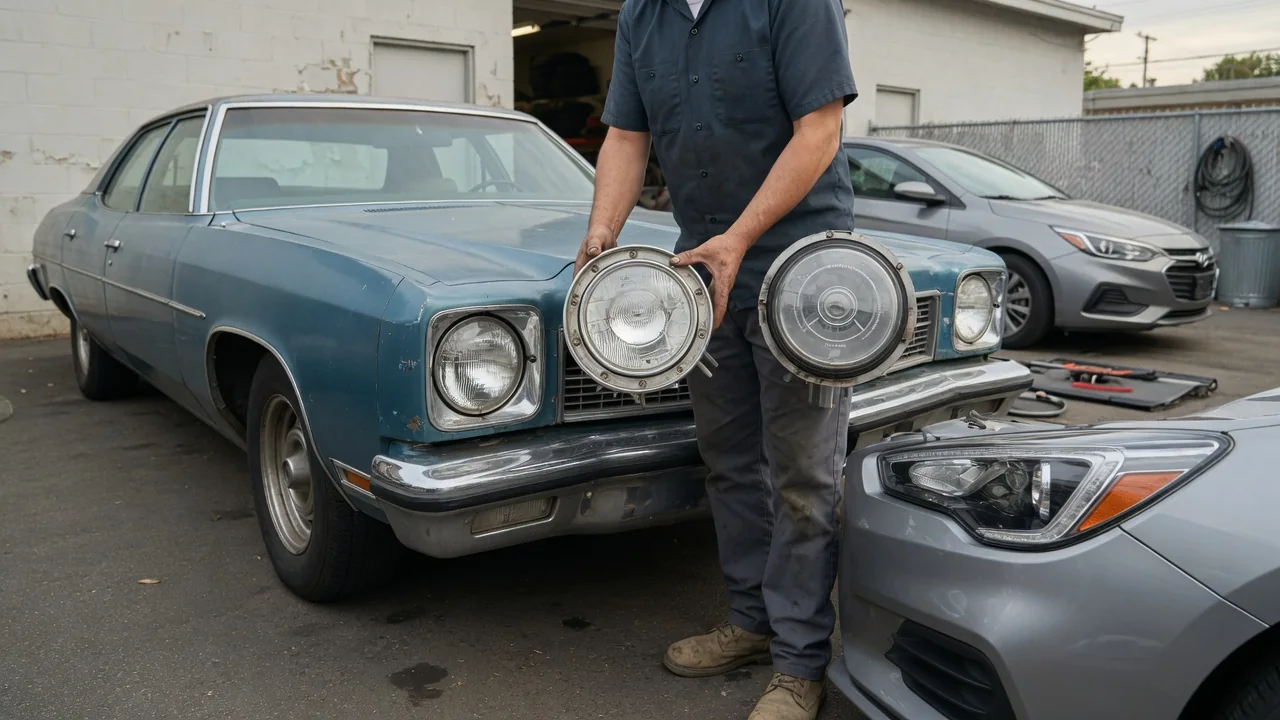
For decades, nearly every car sold in the United States wore the same round or rectangular glass lamps. Anyone asking why did car headlights change from sealed beams will find the answer in a mix of regulation, aerodynamics, styling ambition, and service practicality. The shift to composite housings with replaceable bulbs reshaped how front ends look and how owners maintain their lighting.
Unit construction
A sealed beam is a single all-glass unit in which the filament, reflector, and lens are fused together permanently. The reflector is a metallized coating on the inside of the glass shell, and the front lens carries molded flutes that shape the beam pattern. Because the whole assembly is hermetically closed, moisture and dirt cannot reach the reflective surface, so the optics stay bright for the life of the filament. When the filament burns out, the entire lamp is finished.
Composite headlamps separate those jobs. A housing bolted to the vehicle holds the reflector or projector optics, a clear or fluted lens covers the front, and a small bulb twists or clips in from behind. On older vehicles you can identify sealed beams by their standardized round or rectangular shapes held with a retaining ring, while later designs follow the body contour. Construction details vary widely between manufacturers, including how the housing is vented, sealed, and attached to the body structure.
Styling freedom
Standardized sealed beams came in only a handful of sizes and shapes, so designers had to draw every front end around the same flat-faced lamps. Grilles, fenders, and hood lines all had to accommodate upright glass circles or rectangles, which is why many cars of that era share a family resemblance from the front. Some makers hid the lamps behind retractable covers or pop-up doors simply to achieve a lower, cleaner nose when the lights were off.
Once US rules were revised to allow replaceable-bulb lamps with model-specific lenses, headlights could be shaped to match the bodywork. Flush, sloping lenses helped smooth airflow over the nose, supporting the push for lower drag and better fuel economy, and they gave each model a distinctive face. Plastic lenses made complex curves practical and reduced weight compared with thick glass. The result is visible on almost any later vehicle, where the lamp wraps into the fender and blends with the hood line.
Replacement approach
Sealed beams offered a simple service logic: any parts counter stocked the same few sizes, and one lamp fit countless vehicles regardless of brand. Replacement meant removing a trim bezel and retaining ring, unplugging the connector, and installing a new unit, which also renewed the lens and reflector every time. The drawback was discarding a complete optical assembly for one failed filament, and a stone chip that cracked the glass could let air in and end the lamp quickly.
With composite lamps, the routine part is only the bulb, which is usually reached from behind the housing under the hood. Access differs considerably by vehicle; some allow a quick change by hand, while others place the bulb behind an air box, battery, or wheel well liner. The housing itself is specific to the model and side, so collision damage or a badly deteriorated lens means sourcing that exact assembly. The owner's manual identifies the correct bulb type and the recommended access route.
Everyday Use and Observations
Drivers notice the difference mainly in beam quality and aging. Glass sealed beams never yellow, and each replacement restores full output, but conventional versions are limited by filament technology and fixed lens optics. Halogen sealed beams improved brightness, yet the format still constrained how light could be distributed. Composite designs let engineers tailor reflectors and projectors to each vehicle and later adopt high-intensity discharge and LED sources, which changed the color, reach, and cutoff sharpness you see on the road.
Polycarbonate lenses bring their own everyday trait: sunlight and road grit can leave them hazy or yellowed over time, scattering light and dimming the beam even when the bulb is healthy. Condensation inside a housing is another observation unique to vented composite lamps, and a light mist that clears with use is treated differently from standing water. On a classic vehicle, by contrast, a darkened or milky interior behind the glass usually signals a lost seal and a lamp nearing the end.
Limits and Next Steps
Neither design is automatically superior. Sealed beams remain a sensible, inexpensive fit for the vehicles built around them, and conversion housings that accept replaceable bulbs exist for common sizes, though beam quality and legal compliance depend on the specific product and local regulations. Fitting a different light source into a housing engineered for another bulb type can produce glare and a poor pattern, so matching the lamp to the optics matters more than chasing raw brightness.
If your lighting seems weak, start by observing rather than assuming. Check whether both sides are affected, whether the lens is clouded, and whether the aim looks level against a wall on flat ground. Dim output can also come from wiring, grounds, or connectors rather than the lamp itself, which is worth having a qualified technician assess. For anything beyond a like-for-like bulb or lamp change, confirm the correct parts and aiming requirements for your particular vehicle before spending money.