What Makes a Headlight Beam Pattern? Source, Optics, Cutoff and Aim
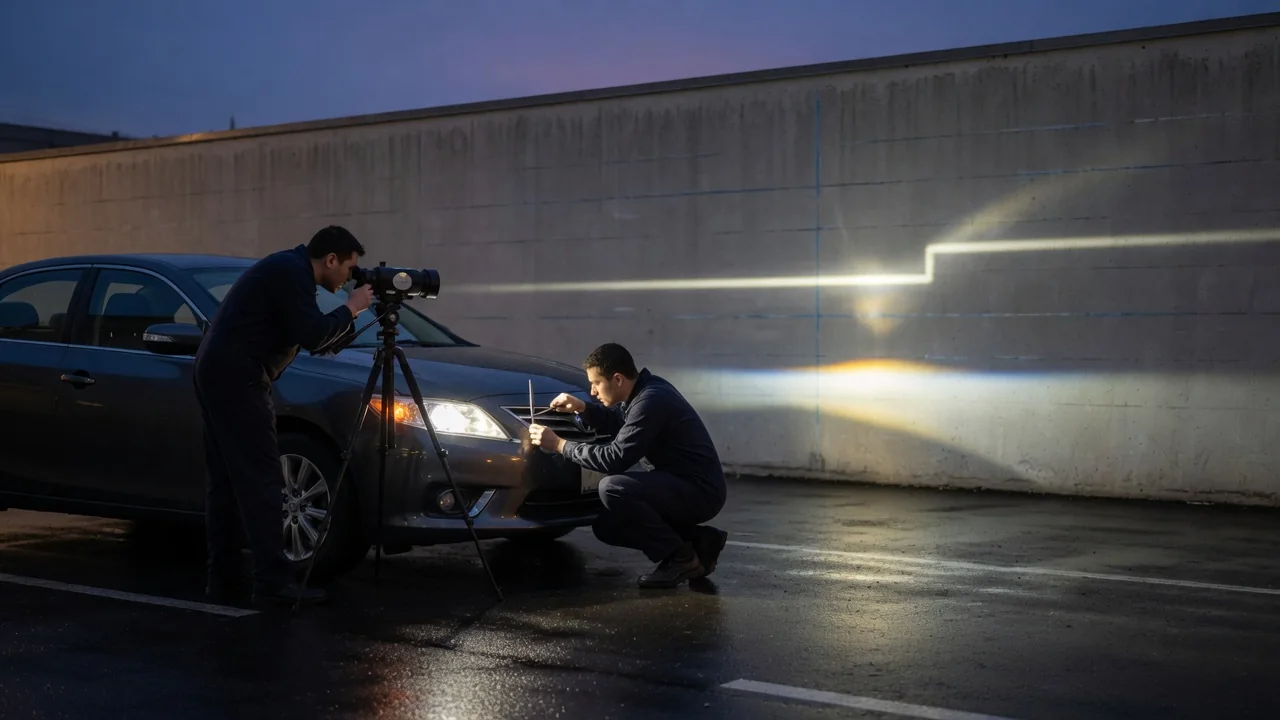
A headlight beam pattern is the deliberate distribution of light a lamp throws onto the road: where it is bright, where it is dim, and where it stops. The bulb alone does not create it. Headlight beam pattern formation depends on three things working together: the light source and the optics around it, the cutoff that limits light directed toward other road users, and the aim of the whole assembly on the vehicle. Each one explains part of why headlights behave the way they do.
Source and Optics: Where the Light Starts and How It Is Shaped
Every headlight begins with a light source. In a halogen lamp it is a glowing tungsten filament, in an HID lamp it is an electric arc inside a small capsule, and in an LED headlight it is one or more semiconductor chips mounted on a circuit board with a heat sink. What matters for the beam is not only how much light the source emits but also its size, shape and exact position. Headlight optics are designed around a precise location for the emitting element. If that element sits even slightly away from where the designer expected, the light lands somewhere other than intended, which is why bulb seating and source geometry are so important.
Reflector headlights collect light from the source and redirect it forward. Early designs used a simple parabolic reflector paired with a ribbed or fluted outer lens that spread and bent the light into a usable pattern. Many modern reflector lamps instead use a complex, multi-faceted reflector, where each segment of the surface is shaped to send light to a particular region of the road. Because the reflector does the shaping work, the outer lens can be clear.
Projector headlights work differently. A curved reflector gathers light from the source and concentrates it near a focal point, and a condenser lens in front projects that light onto the road. Between the reflector and the lens there is usually a shield whose edge defines the upper boundary of the low beam. LED headlights may use reflectors, projector lenses, light guides or combinations of these, and some use arrays of separately controlled segments. Regardless of the hardware, the principle is the same: the optics take light from a small source and redistribute it into a defined shape.
Cutoff: The Line That Controls Glare
The cutoff is the boundary in a low beam between the brightly lit area below and the much dimmer area above. Its purpose is to illuminate the road and its edges while keeping intense light out of the eyes of oncoming drivers and away from the mirrors of vehicles ahead. A high beam is designed for reach rather than glare control, so it does not have a deliberate sharp cutoff and is meant for use when no other traffic would be affected.
How the cutoff is produced depends on the optical design. In a projector, the lens forms an image of the shield edge, which is why projector low beams often show a crisp line. In a reflector lamp, the facets are arranged so that the reflected images of the source stay mostly below a certain line, and halogen low-beam bulbs commonly include a small cap or shield that blocks light that would otherwise leave the lamp at uncontrolled angles. The sharpness of the cutoff varies between designs and between regulatory traditions. Lamps built to European-style rules typically have a distinct cutoff with a raised portion toward the roadside, while North American rules have historically permitted a more gradual transition, although many current designs in both markets show clear cutoffs.
Below the cutoff, the light is not spread evenly. A low beam usually concentrates its greatest intensity in a hot spot just below the cutoff and toward the roadside, which helps light the lane ahead, signs and the shoulder. The rest of the light spreads wide and close to the vehicle to show the road edges and the area directly in front. Designers balance these zones because overly bright foreground light can make the farther, dimmer part of the road look darker by comparison.
Aim: Putting the Pattern Where It Belongs
A well-designed beam pattern only works if it is pointed correctly. Aim is the vertical and horizontal orientation of the headlamp relative to the vehicle and the road. Vertical aim determines where the cutoff falls: aimed too high, the bright zone rises into the eyes of other drivers; aimed too low, the light hits the pavement too close and shortens how far the driver can see. Horizontal aim shifts the hot spot left or right, which can either waste light on the shoulder or push it toward oncoming traffic.
Most headlamp housings have adjusters, often screws or geared mechanisms, that tilt the lamp up, down or sideways. Proper aiming procedures generally call for the vehicle to sit on a level surface at a specified distance from a screen or wall, or to be checked with dedicated aiming equipment, with tire pressure and load set as the procedure describes. Some lamps are designed for visual aiming against their cutoff line and may carry markings indicating this. The exact procedure, reference points and tolerances are vehicle-specific and are found in the service information for that model.
Aim also changes while driving. Passengers, cargo or a trailer can lower the rear of the vehicle and tilt the nose up, raising the beam. Some vehicles have manual leveling controls, and others use automatic leveling that reads ride height and corrects the lamp angle. Adaptive systems may swivel the beam into curves or switch individual light segments on and off. How these systems behave differs from one vehicle to another, so their operation should be checked in the owner's manual rather than assumed.
Practical Implications and Limits
Because optics are matched to a specific source, placing a different type of source into a housing can disrupt the pattern. An LED or HID replacement bulb installed in a lamp designed for a halogen filament may have an emitting area of a different size or in a different position, which can scatter light above the cutoff, create glare or leave dark gaps in the road coverage. Whether such conversions are permitted depends on local regulations, and brightness alone says nothing about whether the resulting pattern is usable or lawful.
The condition of the lamp matters as well. Hazed or yellowed outer lenses, scratches, moisture inside the housing and deteriorated reflective coatings all diffuse light, reducing useful intensity and sending stray light where it should not go. Restoring a cloudy lens can help, but it will not fix damaged internal optics. Collision repair, replaced headlamp assemblies, broken mounting tabs and suspension modifications can all change aim, so a recheck after such work is sensible.
Even a correctly aimed, well-maintained low beam is a compromise between seeing ahead and not dazzling others, and it cannot light the road as far as a high beam. Shining the lights on a wall can reveal obvious problems such as one side pointing much higher than the other, but it cannot measure intensity or confirm compliance. Requirements differ by region and vehicle, so the manufacturer's procedure or a qualified inspection remains the reliable reference for judging a specific car's headlights.