What Is SAE 90 Gear Oil?
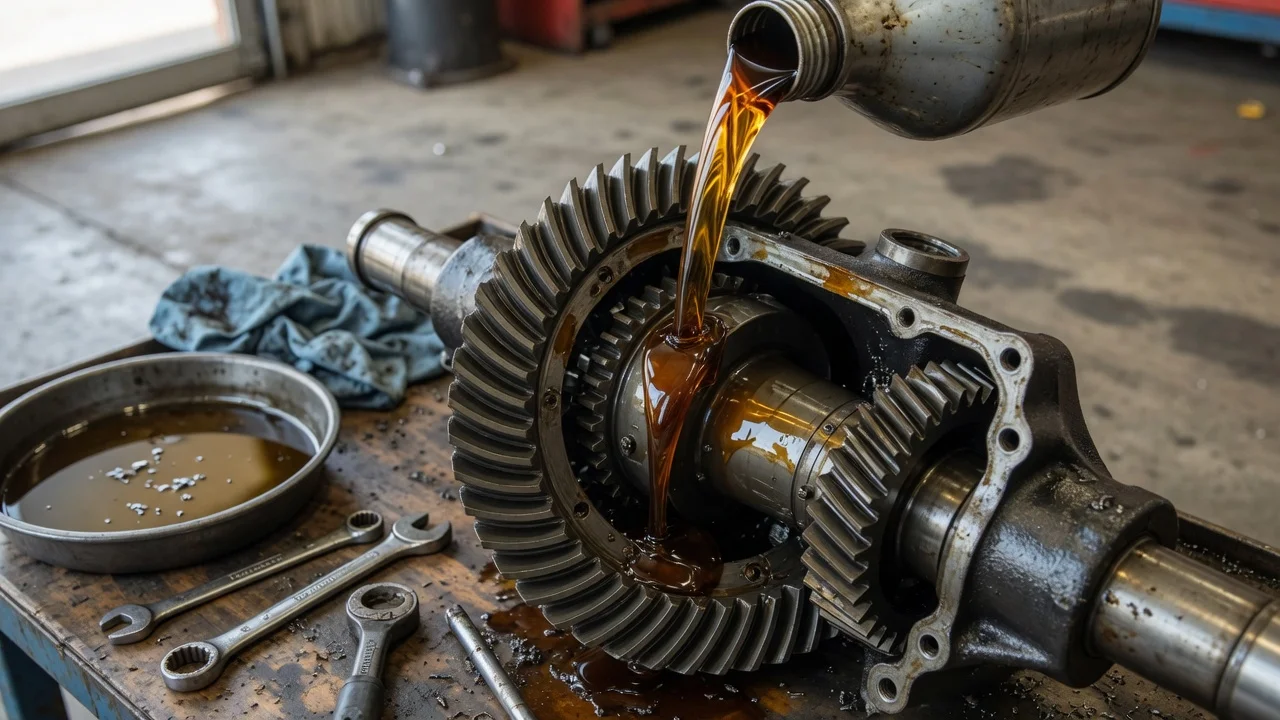
SAE 90 gear oil defined
SAE 90 gear oil is a lubricant for gearboxes, rated grade 90 on the gear oil viscosity scale published by SAE International (originally the Society of Automotive Engineers). The number describes how thick the oil is at normal operating temperature. It does not describe additive content or quality. SAE 90 is a monograde, or single-grade, oil: it carries one viscosity rating and no separate cold-weather rating.
In vehicles, gear oil is typically specified for manual transmissions, differentials (the gear sets in an axle that let the left and right wheels turn at different speeds) and some transfer cases on four-wheel-drive vehicles. Engines and most automatic transmissions use other fluids, so gear oil is not interchangeable with them.
What the "90" actually measures
Automotive gear oil grades are set by the SAE J306 standard, which assigns each grade a viscosity range measured at 100 °C, roughly the temperature a gearbox reaches in sustained use. An oil labeled SAE 90 must fall within the range defined for grade 90. A higher grade number means a thicker oil at that test temperature.
Because SAE 90 has no "W" (winter) rating, its label says nothing about how it behaves when cold. Like most oils, it thickens considerably at low temperatures.
How gear oil works and what it affects
Gear teeth slide and roll against each other under heavy pressure. Gear oil keeps a film between the metal surfaces to limit wear, carries heat away from the contact points, and helps reduce noise. Viscosity is the main factor in how well that film holds up. Oil that is too thin can let metal touch metal under load. Oil that is too thick resists flow, which can make shifting stiff in a cold manual gearbox and adds drag until the unit warms up.
Some gear designs need more than viscosity alone. Hypoid gears, the offset gear sets common in rear differentials, produce strong sliding forces between the teeth. They usually require oil containing extreme-pressure (EP) additives that protect the surfaces when the oil film is squeezed thin.
Viscosity grade versus performance rating
A gear oil container usually shows two separate ratings, and both matter when choosing a product.
Viscosity grade (for example SAE 90): how thick the oil is, defined by SAE J306. Performance category (for example API GL-4 or GL-5): the level of load protection the additive package provides, defined by the American Petroleum Institute (API).
GL-5 oils contain a higher level of EP additives and are commonly specified for hypoid differentials. Some manual transmissions, particularly older designs with brass or bronze synchronizer parts, call for GL-4. In those gearboxes, the stronger GL-5 additive chemistry may not be appropriate. Two oils can both be SAE 90 and still suit different jobs because of this second rating.
SAE 90 compared with 80W-90 and engine oil
Oil | Rating type | Hot viscosity | Cold-weather rating | Typical use; SAE 90 gear oil | Monograde, SAE J306 | Grade 90 | None | Gearboxes and axles where a straight 90 is specified; SAE 80W-90 gear oil | Multigrade, SAE J306 | Grade 90 | 80W | Gearboxes and axles that need easier flow when cold; Engine oil (for example 10W-40) | SAE J300 engine oil scale | Engine grade | Engine W grade | Engines only
SAE 90 and 80W-90 meet the same grade 90 requirement at operating temperature. The difference shows up in the cold. An 80W-90 has also passed low-temperature tests for the 80W grade, so it flows more readily on cold starts. A straight SAE 90 has no such rating, which makes it better suited to warm climates or to equipment whose manufacturer specifically lists it.
Gear oil and engine oil numbers come from different SAE standards and cannot be compared directly. A gear oil labeled 90 is not more than twice as thick as an engine oil labeled 40. The two scales overlap in actual thickness, and a comparison is only meaningful when viscosity is measured on the same basis and at the same temperature. The additive chemistry also differs, so neither oil should be used in place of the other unless the vehicle maker approves it.
Choosing the right oil for a vehicle
The correct gear oil depends on the specific make, model, year and drivetrain. The owner's manual or service documentation is the reliable source for three things: the viscosity grade, the API performance category, and any extra requirement. Limited-slip differentials, for example, may need a friction modifier. Some manual transmissions don't use gear oil at all and instead specify automatic transmission fluid or a dedicated manual transmission fluid.
Match the viscosity grade the manufacturer lists, such as SAE 90 or 80W-90. Match the API category, such as GL-4 or GL-5, rather than assuming a higher number is always better. Check for limited-slip or friction-modifier requirements on differentials. In cold climates, see whether the manufacturer lists a multigrade alternative to a straight 90.
This entry explains what the SAE 90 grade means in general. It does not cover the exact viscosity limits in SAE J306, change intervals, or fill quantities for particular vehicles. Those details should come from the current standard and the applicable service documentation.