What Is Remote Parking Assist?
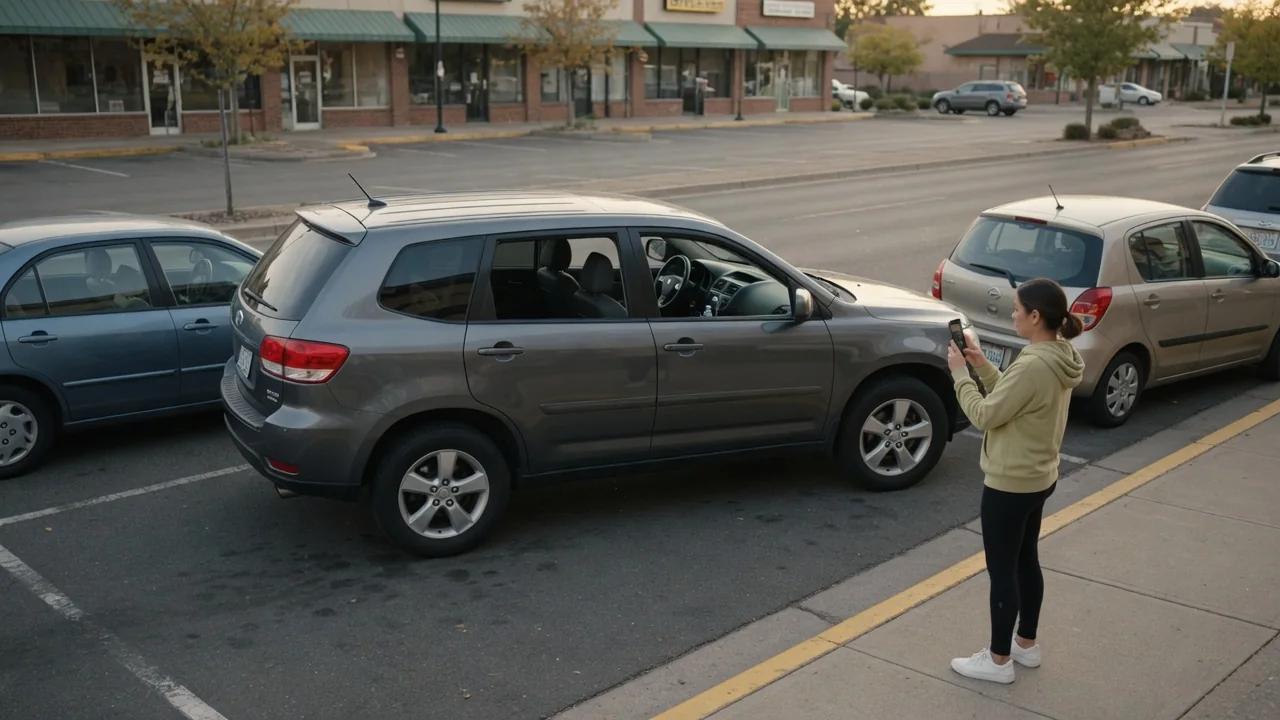
Anyone asking what is remote parking assist is usually picturing a car that slides into a tight space while its driver stands beside it. That picture is accurate. The feature lets a vehicle move itself at walking pace into or out of a parking spot, steering and braking on its own, while the person in charge supervises from outside.
Control method
Remote parking assist is commanded from outside the cabin, most often through the key fob or a smartphone app paired to the vehicle. On many systems the driver must press and hold a button or keep a finger moving on the phone screen for the entire maneuver. That continuous input works as a dead-man control: release it and the car stops immediately. The vehicle itself handles steering angle, throttle, braking and gear selection, using its own sensors to judge the gap it is entering.
How much the car does varies by manufacturer and trim level. Simpler versions only creep straight forward or backward, which suits a narrow garage or a space where the doors could not open. More capable versions steer through parallel or perpendicular maneuvers after the driver selects a detected space on the infotainment screen before stepping out. The connection between the controller and the car is short range, so the operator generally needs to stay within a few steps of the vehicle for it to keep moving.
Conditions
The system only works when a set of conditions is satisfied. The vehicle usually has to be stationary, with doors closed and the remote device recognized nearby. Ultrasonic sensors in the bumpers, often supported by surround-view cameras, need a clear view of the space and of the objects bordering it. Movement is held to a crawl, which gives the sensors time to detect obstacles and gives the brakes a very short stopping distance if something appears in the path.
Surroundings matter as much as hardware. Level, firm surfaces with clearly defined boundaries, such as adjacent parked cars, walls or painted lines, give the system the references it needs. Steep slopes, loose gravel, high curbs and deep snow can cause the feature to refuse activation or cancel partway. Dirt, ice or road salt covering the sensors and camera lenses has a similar effect. The owner's manual for each vehicle spells out the specific space sizes, gradients and distances the system is designed to handle.
Driver responsibility
Standing outside the car does not transfer responsibility to the car. Remote parking assist is a driver assistance feature, and the person holding the fob or phone is still the operator in every practical and legal sense. That means watching the whole path of travel, including the side of the vehicle that is out of direct view, and being ready to stop the maneuver the moment anything looks wrong. Releasing the control is the intended emergency action, and it should be an instinct.
The sensors have blind areas the operator must cover. Low objects such as parking blocks, thin posts, trailer hitches, overhanging loads and items sitting below bumper height may not register reliably. Children and pets can move into the path faster than a system expects. Choosing where to stand is part of the job too: beside the vehicle with a clear line of sight, never directly in front of or behind it, and never between the car and a wall or another vehicle.
Everyday Use and Observations
The most common everyday use is a space too tight for the doors. A driver stops in line with a narrow garage or a squeezed parking bay, gets out with passengers and bags, and sends the car in from the outside. Later, the process runs in reverse to bring the vehicle out before anyone climbs aboard. It is equally handy when a neighboring car has parked close enough to block the driver's door, a situation that otherwise means climbing across the cabin.
During a maneuver there are clear signs that the system is working. The hazard lights or exterior lamps typically flash, the steering wheel turns by itself, and the car moves in short, cautious stages with pauses as it rechecks distances. Some vehicles fold the mirrors, and many shut the engine off or shift into park and lock once finished. The pace can feel slow compared with a confident human driver, which is deliberate, since the low speed is what makes the feature manageable.
Limits and Next Steps
Remote parking assist is not a self-driving or valet function. It will not hunt through a parking lot for a space, deal with traffic, or travel more than a short distance from the operator. It may decline spaces a skilled driver could use, stop for a harmless obstacle such as tall grass or a snowbank, or drop out if the phone connection weakens or the fob battery runs low. When the maneuver cancels, the car stops and waits for the driver to take over normally.
Anyone considering the feature should first confirm that a particular vehicle actually has it, since similar-sounding names describe very different capabilities, and some versions require an app subscription or a specific option package. The owner's manual and the dealer can clarify exactly what is fitted. A sensible first trial takes place in an empty, open area, with practice at stopping the car on command. If the feature becomes unavailable or shows a warning, cleaning the sensors is a reasonable first check before asking a qualified technician to investigate.