What Is Laser Welding in a Car Body? Narrow Joints, Speed and Inspection
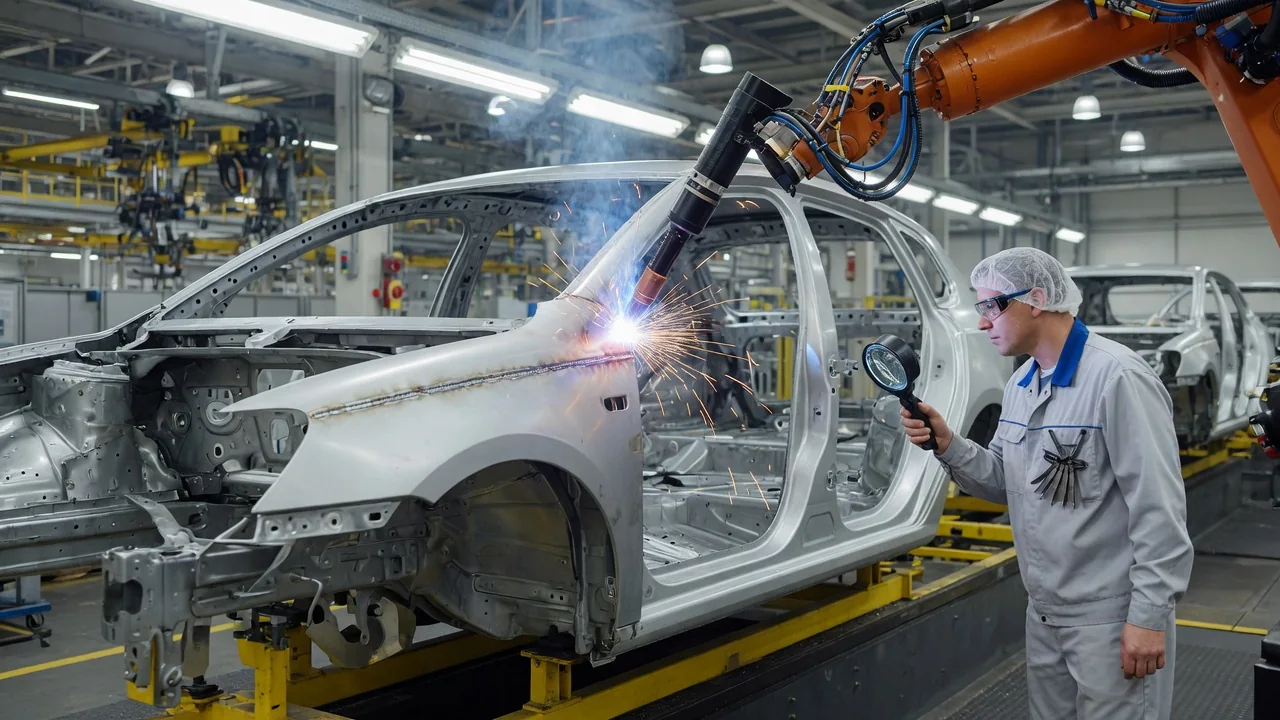
Laser welding in a car body is a joining method that uses a tightly focused beam of light to melt and fuse sheet-metal parts along a narrow seam. Automakers use it on selected body joints where a slim continuous weld, access from one side, or fast robotic travel offers an advantage over traditional resistance spot welding. Understanding automotive laser welds helps explain why some seams look unusually clean, how factories keep body lines moving, and why repairs follow specific procedures.
Narrow joint: how a focused beam fuses sheet metal
A laser concentrates a large amount of energy into a very small spot. That high power density melts the metal only where the beam strikes, instead of heating a wide area the way an open arc tends to. In the so-called keyhole mode, the energy is intense enough to vaporize a small amount of metal and form a narrow cavity that lets the beam penetrate deep into the joint; molten metal flows around it and solidifies behind the moving beam. In conduction mode, the beam heats the surface and melts it less deeply, producing a shallower and often smoother seam. Either way, the result is a weld bead that is narrow compared with its depth and a heat-affected zone that is relatively small, which helps limit distortion in thin body panels.
Shape matters as much as size. A resistance spot weld joins two sheets at separate points, and the electrodes must squeeze the flange from both sides. A laser seam can be continuous or applied as short stitches, spreading load along the flange, and it usually needs access from only one side. That can allow designers to use narrower flanges or reach areas a spot-welding gun cannot. Laser processes also appear in tailor-welded blanks, where sheets of different thickness or steel grade are butt-welded together before stamping, and in laser brazing, where a filler wire is melted to join visible exterior seams without fully melting the base metal.
The narrow beam has a cost: it tolerates very little misalignment. Parts must fit closely, and the beam must follow the seam accurately. Coatings add complexity, because the zinc on galvanized steel vaporizes at a temperature below the melting point of steel. In overlapping joints, trapped zinc vapor can blow through the molten pool and leave pores, so processes are designed to manage that vapor, for example by controlling a very small gap between sheets. Aluminum behaves differently again, reflecting more laser energy and conducting heat away quickly, which calls for its own process settings.
Production speed: why factories use lasers
In a body shop, the laser source is typically remote from the work, and fiber optics carry the beam to processing optics mounted on a robot. Because there is no electrode touching the metal, there are no tips to wear out, dress or replace, and no clamping cycle at every weld point. Remote laser welding takes this further: scanner mirrors in the optics redirect the beam from a distance, so it can jump from one seam to the next in a fraction of the time a robot arm would need to reposition a welding gun. Reducing that non-productive movement is a major reason lasers can shorten the time a body spends in a station.
Speed is never achieved by the laser alone. Fixtures have to clamp panels firmly enough to hold the tight fit-up the process requires, the cell needs enclosures that contain laser radiation, and the equipment represents a substantial investment that has to be justified by volume. For these reasons, a modern body is usually assembled with a mix of methods: resistance spot welds, structural adhesives, mechanical fasteners, arc welding and laser joining. Engineers assign each joint the process that best balances strength, access, cost and cycle time, so laser welding is used selectively rather than everywhere.
Inspection: checking welds you cannot fully see
A neat surface bead does not prove that a laser weld fused properly at the interface between sheets, because the critical part of the joint is hidden inside the material. Manufacturers therefore rely on monitoring during welding as well as checks afterward. Seam-tracking sensors can locate the joint before the beam arrives, while in-process sensors observe signals such as light emitted from the weld zone, reflected laser energy or camera images of the melt pool. Deviations from a learned normal pattern can flag a seam for further review. After welding, optical or laser-profile scanners can measure the visible bead for width, height, holes or missing sections.
Deeper verification uses other methods. Non-destructive techniques such as ultrasonic testing can help assess internal fusion in some joint types. Destructive testing remains important: sample parts or bodies are torn down, and welds are peeled apart or cut, polished and etched so the cross-section reveals penetration depth, fusion width and internal porosity. Typical defects these checks look for include porosity, cracks, lack of fusion, undercut, burn-through and excessive spatter. How often each check is performed and which acceptance limits apply are set by each manufacturer's quality system rather than by a single universal rule.
What it means for owners and repairers
For most owners, laser welds are not something to maintain or monitor. They usually sit under sealer, paint or trim, and the body's corrosion protection still depends on coatings and sealing rather than the joining method itself. It is also worth being cautious with broad claims: a laser-welded joint is not automatically stronger or better than a spot-welded one. Any stiffness or weight benefit depends on how engineers designed the entire structure, not on the presence of laser seams alone.
Collision repair is where the topic becomes practical. Independent body shops generally do not have production laser cells, so when a panel originally joined by laser has to be replaced, the vehicle manufacturer's repair information specifies the substitute method. Depending on the vehicle and the location, that might involve resistance spot welding, MIG or MAG welding, MIG brazing, or rivet bonding with adhesive. Many modern bodies use high-strength steels that are sensitive to heat, so improvising a repair method can change how the structure performs in a crash. Anyone evaluating body repairs should ask whether the shop followed the official procedure for that exact model.
There are limits to what can be known from the outside. You usually cannot tell by looking which joints on a given car were laser welded, laser brazed or joined another way, and the term laser welding covers several distinct processes. The explanations here describe general mechanisms used across the industry, not the construction of any particular make or model. For vehicle-specific details, the manufacturer's body repair manual is the authoritative reference.