What Is Ceramic Coating on Automotive Glass at the Factory?
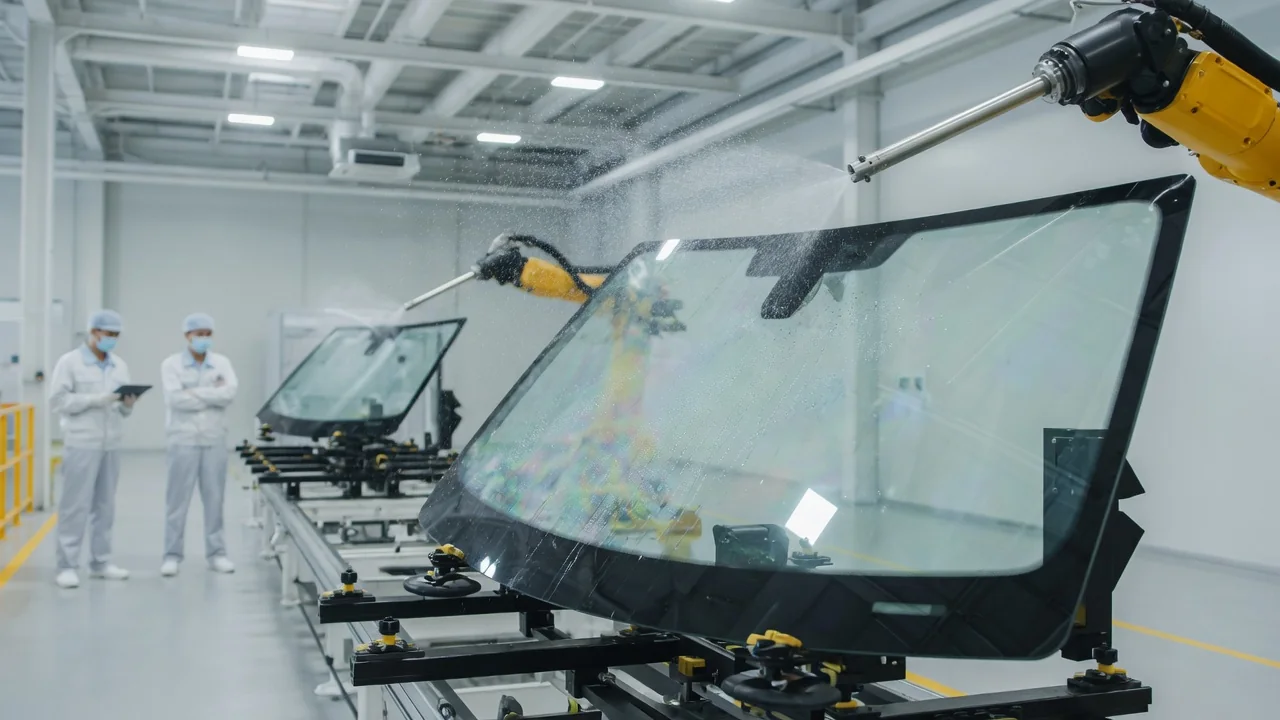
When people ask what ceramic coating on automotive glass at the factory is, they usually mean the black band and dot pattern around the edges of a windshield, rear window or fixed side glass. It is not a polish or a water-repellent product applied at a detail shop. It is a ceramic enamel, commonly called frit, printed onto the glass and fused to it during production. This article explains how that treatment is made, what it does optically, and how to care for it.
Surface treatment: how the ceramic band is made
The ceramic material starts as a paste. It combines finely ground glass with a low melting point, inorganic pigments that give the dark color, and an organic carrier that lets the paste flow through a printing screen. Glass manufacturers typically apply it by screen printing while the glass is still flat, before it is shaped. The carrier is then driven off, and during the heating cycle used to bend the glass and then temper or laminate it, the glass powder softens and fuses with the surface. The result is not a layer of paint sitting on top of the glass. It is an enamel bonded into the glass surface, which is why it does not peel or flake the way paint can.
Where the print sits depends on how the glass is built. A laminated windshield consists of two glass plies with a plastic interlayer between them, and depending on the design, the ceramic print may be on a surface sealed inside the laminate or on the surface that faces the cabin. Tempered side and rear glass is a single ply, so the print is on one face, usually the inside. On heated rear windows, the conductive defroster lines and their bus bars are often printed with a similar print-and-fire process, and their ends commonly run over or alongside the ceramic band.
The band does several jobs at once. Most fixed automotive glass is bonded to the body with urethane adhesive, and urethane degrades under prolonged ultraviolet exposure. The opaque ceramic blocks sunlight from reaching the adhesive bead through the glass. It also hides the bead, the body flange and trim edges from view, provides a consistent surface for the adhesive system when used with the appropriate primer, and conceals hardware such as the rearview mirror mount or sensor brackets. The exact width, placement and adhesive requirements vary by vehicle and glass design.
Optical effect: the black border and dot pattern
The most visible effect is the solid dark border that frames the view. Its inner edge usually does not end in a hard line. Instead, it breaks into a gradient of dots that become smaller or more widely spaced as they approach the clear area. This dot pattern softens the visual transition, so the eye sees a gradual fade rather than a sharp black edge against a bright sky or road scene. It also makes the border look more finished from outside the vehicle.
The dots also serve a manufacturing purpose. Dark ceramic absorbs heat differently from clear glass, so a wide solid band next to clear glass heats unevenly in the furnace. That temperature difference can cause localized distortion, sometimes seen as a wavy or lens-like bending of the view near the border. Breaking the edge into dots helps spread the transition across a wider zone. Some distortion right at the frit band is still normal on many vehicles, and it is generally confined to the edge, outside the main viewing area.
Many windshields also have an extra printed area behind the rearview mirror, often called a third visor band, which reduces glare in the gap between the sun visors. Areas around cameras and sensors may be left clear or given a specific shape so the print does not block the sensor's field of view. Whether a particular vehicle has these features depends on its design, so their presence or shape says something only about that specific glass part.
Care for factory ceramic-coated glass
Because the enamel is fused to the glass, it does not need waxing, sealing or special products. A regular automotive glass cleaner and clean microfiber towels are appropriate for both the clear glass and the printed border. The printed surface has a slightly different texture from clear glass, and the dot area can hold residue or cleaner film along its edges. Wiping in more than one direction and checking the border in good light helps catch streaks that are easy to miss against the dark background.
The main risks are mechanical rather than chemical. A razor blade used carelessly to remove stickers, inspection decals or old film can scratch or chip the print, especially near its edges. Abrasive pads and heavy compounds can dull or wear it. On rear windows, scraping across the band can also damage defroster lines and their connections, which are much easier to harm than the enamel itself. When removing adhesive residue, use a method suited to automotive glass and work with the direction of any conductive lines rather than across them.
Aftermarket window film is the other common care issue. Film does not adhere evenly over the slightly raised dot pattern, which can leave a light-colored halo or silvery edge where the film crosses the dots. Installers handle this with different techniques, and the result depends on the glass, the film and the installation. If the border matters to you cosmetically, ask the installer how they treat the dot area before the film goes on.
Practical implications and limits
Terminology causes much of the confusion. Searches for factory coated automotive glass often lead to detailing products, but the factory ceramic print is not a protective coating over the whole windshield. It does not repel water, reduce heat across the clear viewing area or protect against chips. Aftermarket ceramic glass coatings and ceramic window tints are separate products applied after production, and any claims about their performance come from their makers, not from the factory frit.
Glass replacement is where the band matters most to owners. A replacement part carries its own print, and its pattern, border width or dot layout may differ from the original even when the glass fits correctly. Because the adhesive bead is meant to sit behind the opaque area, a proper installation keeps the urethane covered by the band. A deep scratch through the print on an installed window can expose a small spot of the adhesive area to light; minor marks are usually cosmetic, but extensive damage is worth showing to a glass technician.
There are also clear limits to what an owner can do. The ceramic band cannot be removed or repainted at home, because it is part of the glass surface. Edge distortion created during forming cannot be polished out. If distortion seems to extend into the main field of view, that is a question about the glass part itself and should be evaluated by a glass professional. For vehicle-specific details, such as sensor areas or approved cleaning methods, the owner's manual or the glass manufacturer's guidance is the most reliable reference.