What Is Automotive Ethernet? High-Data Functions, Wiring and Service
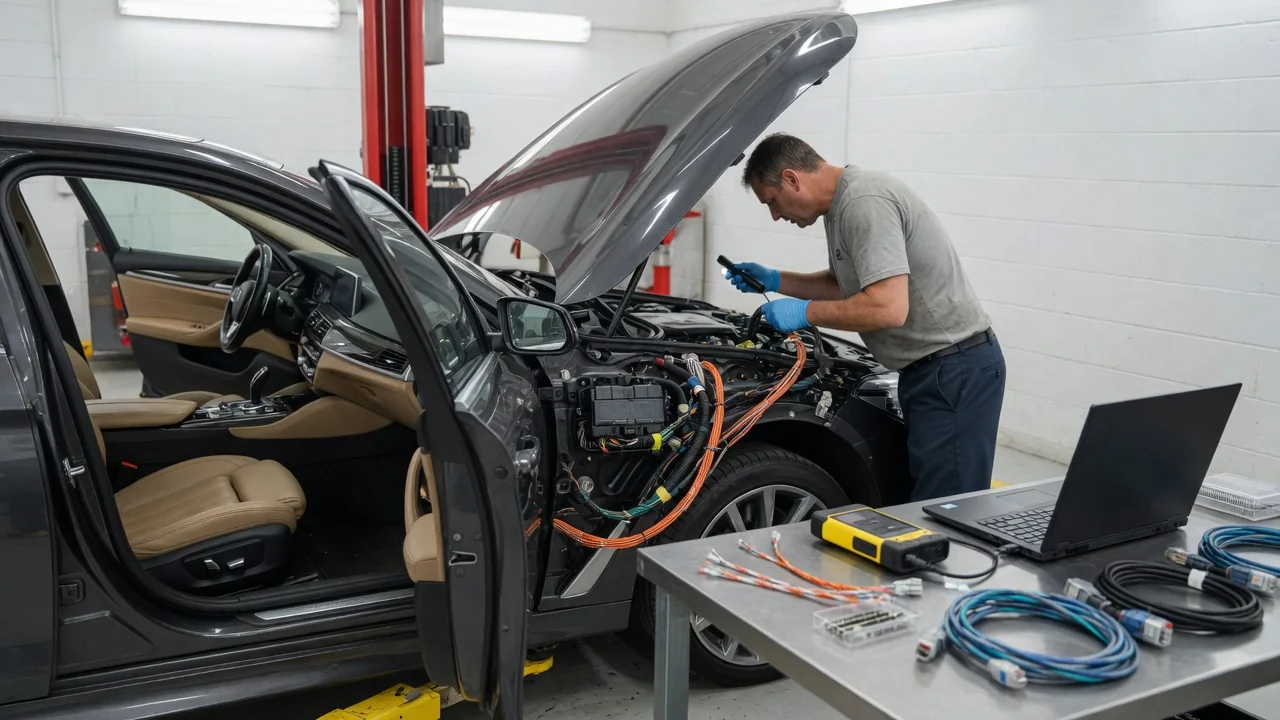
Automotive Ethernet is a family of Ethernet networking technologies adapted for use inside vehicles. It moves large volumes of data between electronic control units, cameras, displays and central computing modules, and it usually works alongside older in-vehicle buses such as CAN and LIN rather than replacing them outright. Knowing how a vehicle Ethernet network works helps explain how modern cars support driver assistance, rich infotainment and software updates, and why these systems need specific care during diagnosis and repair.
High-Data Functions That Rely on Automotive Ethernet
For decades, most communication between vehicle modules has run over CAN, a robust bus designed for short control messages such as engine speed, switch positions and fault flags. CAN works very well for that job, and faster variants such as CAN FD extend its capacity, but none of these buses were intended to carry continuous streams of camera images, high-resolution graphics or large software files. As vehicles gained more sensors, larger screens and more powerful processors, manufacturers needed a network with far more bandwidth. Ethernet, already proven in computing and industrial settings, was adapted to fill that gap.
The functions that typically benefit most are those that generate or consume a lot of data. Camera-based driver assistance and surround-view systems send image data to processing modules. Some vehicles combine inputs from several sensors in a central computer, which requires fast and predictable links. Infotainment head units, digital instrument clusters and rear-seat displays exchange graphics and media. Telematics units and over-the-air update systems move large software packages to modules throughout the vehicle. Ethernet can also speed up module programming during service, because flashing a large file takes far less time over a high-bandwidth link.
In many designs, Ethernet acts as a backbone connecting gateways, domain controllers or zone controllers, while CAN and LIN still handle local, low-speed tasks such as window motors or climate control actuators. Supporting protocols allow software services to communicate over the network, and timing extensions known as Time-Sensitive Networking help deliver critical messages with predictable delay. Exactly which functions use Ethernet, and how the network is arranged, varies by manufacturer, model and vehicle generation, so the presence of a feature does not by itself confirm how its data is carried.
How Automotive Ethernet Wiring Works
The most visible difference from office Ethernet is the cable. A typical office network cable contains four twisted pairs and ends in a familiar RJ45 plug. Common automotive Ethernet variants, such as those standardized by the IEEE as 100BASE-T1 and 1000BASE-T1, send data in both directions over a single twisted pair. Using one pair reduces wiring weight, cost and connector size, which matters in a vehicle harness that may already contain a large amount of copper. The underlying approach grew out of technology originally marketed as BroadR-Reach before it was standardized for wider industry use.
Most automotive Ethernet links are point-to-point: each cable connects one device to another, often to a switch that routes traffic between modules. This differs from CAN, where many modules share the same pair of wires. A lower-speed variant, 10BASE-T1S, allows several nodes to share one pair in a bus-like arrangement, which can suit simpler devices. Higher-speed links may use shielded cable, while lower-speed links can often use unshielded twisted pair, depending on the design and the electrical environment in which the wiring is routed.
Because the signals run at high frequencies, the physical quality of the wiring has a direct effect on reliability. The twist of the pair, its routing away from noise sources, and the design of the connectors all help control electromagnetic interference and signal reflections. Specialized automotive connectors are used instead of consumer plugs, and the short untwisted section where wires enter a connector is kept to a minimum. Damage, corrosion or a poorly made joint that might go unnoticed on a simple switch circuit can cause intermittent data errors on an Ethernet link.
Servicing Vehicles With Ethernet Networks
On vehicles that support it, diagnostics can run over Ethernet using Diagnostics over Internet Protocol, often abbreviated DoIP. In those cases, certain pins in the diagnostic connector provide an Ethernet path in addition to the familiar CAN lines. A compatible scan tool or vehicle communication interface is needed to use it. The practical benefit is faster data transfer, especially when reprogramming modules with large software files. Whether a given vehicle uses DoIP, and for which modules, depends on the manufacturer and should be confirmed in the service information for that vehicle.
Troubleshooting an Ethernet link differs from checking a basic circuit. Simple voltage or resistance checks can reveal an open or shorted wire, but they cannot confirm that a high-frequency data signal is clean. Symptoms of a network problem may include a blank camera image, a display that loses content, a module reported as not communicating, or stored network fault codes. Technicians generally rely on the manufacturer's diagnostic routines, module self-tests and network status data, and in some cases specialized test equipment designed for automotive Ethernet physical layers.
Repairs call for particular care. Some manufacturers permit wiring repairs on Ethernet circuits only with specified repair kits, connectors and procedures that preserve the twist and limit untwisted length, while others may require replacing a harness section. Following that guidance matters because an improvised splice can introduce reflections or noise. Replacing a module on the network may also require software configuration, coding or calibration afterward, particularly for cameras and other driver assistance components. Security gateways on some vehicles can additionally restrict which tools are allowed to access certain functions.
Practical Implications and Limits for Car Owners
For most drivers, automotive Ethernet is invisible. It is rarely listed in a brochure, and there is no port intended for an owner to connect a laptop to the in-vehicle network. Its effects show up indirectly: quicker screen responses, multiple camera views, and software updates that complete in a reasonable time. Having an Ethernet backbone does not mean every system in the car is fast or that the vehicle can browse the internet; connectivity to outside networks is handled by separate telematics or cellular hardware with its own limits.
There are also practical limits worth keeping in mind. Ethernet supplements rather than replaces CAN and LIN, so many faults still occur on those older buses. Aftermarket accessories that tap into vehicle wiring can disturb sensitive data lines, and water intrusion or harness damage near cameras and modules can cause intermittent problems that are hard to trace. When a network-related fault appears, it helps to choose a repair shop with access to current manufacturer service information and suitable diagnostic tools, and to expect that module replacement may involve programming or calibration steps.