What Is an Automotive Wiring Harness?
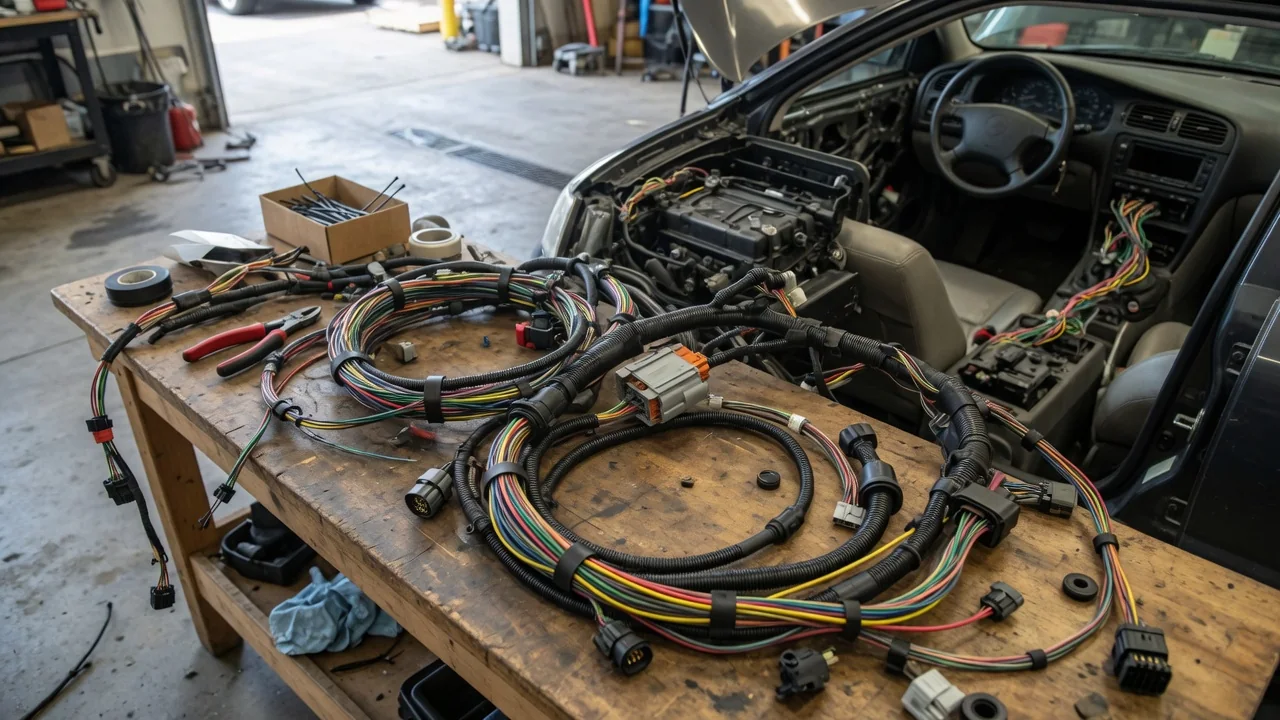
What is an automotive wiring harness? It is an organized assembly of wires, terminals and connectors bundled together so that power, ground and data signals can travel between a vehicle's battery, control modules, sensors, switches and lights. Instead of hundreds of loose conductors, the harness gives each circuit a planned path, a defined connection point and a covering suited to its location.
Routing
A harness follows a path the manufacturer chooses during vehicle design, and that path is rarely the shortest line between two components. The main trunk typically runs along structural members such as the firewall, inner fenders, rocker sills or roof rails, with smaller branches breaking out toward individual components like headlamps, fuel injectors, door switches or tail lamps. Clips, brackets and molded retainers hold the bundle at fixed points so it cannot drift toward exhaust parts, belts, steering shafts or suspension components that move during driving.
Looking under the hood, readers can usually see where the engine harness leaves the main bundle and reaches each sensor through a short breakout, often with a little slack to absorb engine movement on its mounts. Where wiring passes through sheet metal, such as between the engine bay and cabin or between a door and the body, a rubber grommet or flexible boot guides it. The exact route, the number of separate harness sections and the location of junction connectors differ by make, model, engine and option level.
Protection
Each wire has its own insulation, but the harness adds further layers because the bundle faces heat, vibration, moisture, road salt and abrasion. Common coverings include fabric or vinyl tape, split corrugated conduit, braided sleeving and, near hot components, heat-reflective wrap. Connectors exposed to weather generally use rubber seals around each terminal and a locking tab that keeps the two halves mated. Inside the cabin, where conditions are milder, harnesses are often wrapped in soft fleece tape that also prevents rattles against trim panels.
Electrical protection is part of the design as well. Circuits are fed through fuses, fusible links or relays, usually grouped in a fuse box, so that a short circuit opens a protective device before the wire overheats. Wire gauge is matched to the current each circuit carries, which is why the starter cable is thick while a sensor signal wire is thin. Some data and sensor circuits use twisted pairs or shielding to limit electrical interference. Owners can see many of these features, though fuse layouts and covering materials vary by vehicle.
Repair considerations
Harness faults tend to show up as intermittent problems, because a chafed wire, corroded terminal or loose connector pin may make contact only some of the time. A stored fault code naming a circuit points to a place to start testing; it does not prove that the sensor, the module or the wiring itself has failed. Technicians typically confirm with the correct wiring diagram for the vehicle, a visual inspection and electrical measurements such as voltage drop or continuity checks before deciding what needs attention.
Depending on the damage, a repair may involve cleaning or replacing a terminal, splicing in a section of wire, fitting a repair pigtail connector or replacing an entire harness section. Manufacturers often publish approved methods, and some circuits, notably those for airbags and high-voltage hybrid or electric systems, carry specific restrictions and should be left to qualified technicians. A poorly made splice can add resistance or admit moisture, creating a new fault later. Parts availability and the labor involved depend heavily on where the harness runs and how much must be removed to reach it.
Everyday Use and Observations
In daily driving the harness works unnoticed: turning the key or pressing the start button, switching on the headlights, lowering a window and reading the gauges all depend on current and signals moving through it. Drivers usually become aware of the wiring only when something behaves oddly, such as a light that flickers over bumps, a power window that works only with the door at certain angles, or a warning lamp that comes and goes in wet weather. Patterns like these hint at a connection or wire affected by movement or moisture.
A careful look, with the engine off and cool, can reveal useful clues without touching anything. Cracked conduit, tape that has unraveled, a bundle hanging loose from a broken clip, green or white deposits at a connector, or nesting material and chewed insulation left by rodents are all worth noting. Aftermarket accessories such as trailer wiring, remote starters or audio equipment are frequent points of interest because they tap into factory circuits. How accessible these areas are depends on the vehicle's layout and how much covering and trim surrounds the wiring.
Limits and Next Steps
A general explanation can describe what a harness does, but it cannot identify which wire feeds which component on a particular car. Wire colors, connector shapes, pin assignments, ground locations and fuse positions are specific to the manufacturer and frequently change between model years, trim levels and factory options. Two vehicles that look identical may carry different harnesses if one has heated seats or a towing package. For that reason, any diagnosis should rely on the wiring diagram and service information published for the exact vehicle.
When an electrical symptom appears, the sensible next steps are to note when it happens, check the owner's manual for the relevant fuse location, and record any warning messages before seeking help. If a fuse blows repeatedly, fitting a higher-rated one is unsafe because it removes the protection the wire depends on. Burning smells, melted insulation, or problems involving airbag, braking or high-voltage systems warrant professional inspection rather than experimentation. Sharing the observed patterns with a technician shortens the testing needed to find the affected circuit.