What Is an Intercooler Heat Exchanger? How It Cools Boosted Air
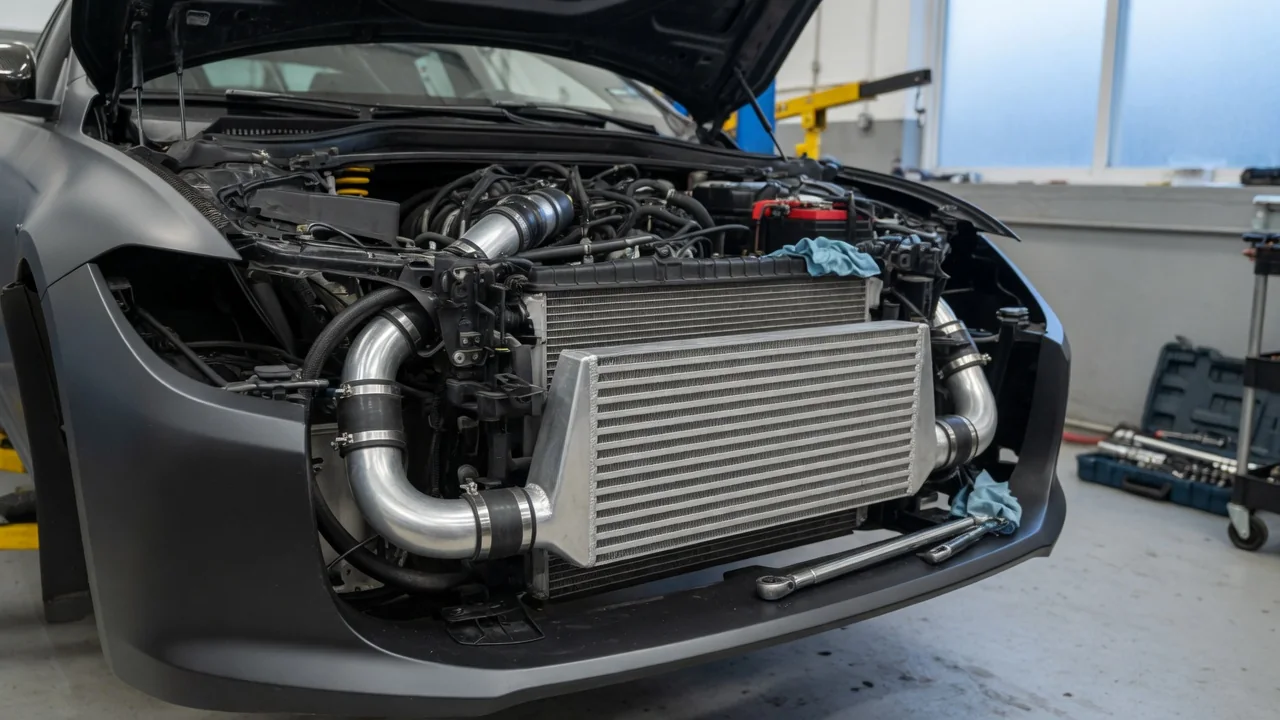
An intercooler is a heat exchanger placed between a turbocharger or supercharger and the engine's intake. Its job is to remove heat from air that the compressor has just pressurized, so the engine receives cooler, denser charge air. If you are asking what an intercooler heat exchanger is, the short answer is that it works like a radiator for intake air instead of engine coolant. Knowing why boosted air gets hot, how the heat leaves the core and what happens when the system leaks explains most of its behavior.
Compressed Air Heat: Why Boosted Air Needs Cooling
A turbocharger or supercharger squeezes intake air into a smaller volume so more of it can be pushed into the cylinders. Compressing a gas does work on it, and that work appears as a rise in temperature. No compressor is perfectly efficient, so it adds some heat beyond what ideal compression alone would produce. On a turbocharged engine, the compressor also shares a housing and shaft with the exhaust-driven turbine, so it can pick up additional heat from the hot side. The result is that air leaving the compressor is noticeably warmer than the air that entered, and it generally gets hotter as boost pressure rises.
Hot air is less dense than cool air at the same pressure, so each intake stroke carries less oxygen than it could. That partly cancels the benefit of boosting in the first place. Higher intake temperature also raises temperatures in the combustion chamber, which makes gasoline engines more prone to knock, also called detonation. Engine management systems typically respond to knock or high intake air temperature by retarding ignition timing or limiting boost, which protects the engine but costs power and can affect efficiency. Cooling the charge after compression restores much of the density gain and gives the engine more margin before those protective strategies step in. This is why effective turbo intercooler heat exchange matters so much on boosted engines.
Air or Liquid Path: Two Ways to Move the Heat
The most common layout is air-to-air. Pressurized air from the compressor travels through ducting, often called charge pipes or boost hoses, into a core made of many small internal passages. Outside air flows across fins attached to those passages and carries heat away, much as a radiator does for engine coolant. The cooled charge air then continues through more ducting to the throttle body and intake manifold. Because it depends on outside airflow, an air-to-air intercooler is usually mounted where it receives ram air, most often at the front of the vehicle behind the bumper. It has no pump or separate fluid, which keeps it relatively simple, but the long pipe run adds volume the compressor has to fill.
An air-to-liquid design, sometimes called a water-to-air intercooler or charge air cooler, uses coolant as a middle step. Charge air passes through a compact core, frequently built into or near the intake manifold, while coolant flows through the other side of that core and absorbs the heat. A pump, commonly electric, circulates the coolant to a low-temperature radiator at the front of the vehicle, where outside air finally carries the heat away. Many systems use a circuit separate from the main engine cooling system so charge air can be cooled below normal engine coolant temperature, though arrangements vary by manufacturer.
Each path has trade-offs. Liquid absorbs and moves heat effectively, so an air-to-liquid core can be smaller and placed close to the engine, shortening the boosted air path. In exchange it adds a pump, hoses, a second radiator and another fluid to maintain. An air-to-air unit is simpler but depends more directly on vehicle speed and front-end airflow. In either design, the core balances cooling ability against the pressure drop it creates: more internal fin area removes more heat but also resists flow, so the compressor must work harder to deliver the same pressure at the engine.
Leaks: What Can Fail and How It Shows Up
Because the intercooler sits on the pressurized side of the intake, any leak there lets boosted air escape before it reaches the engine. Common leak points include loose clamps, split rubber couplers, damaged pipe ends and failed seals where the core's end tanks join the tubes. Road debris can also puncture a front-mounted core. On engines that measure airflow with a mass airflow sensor ahead of the turbo, air that has already been counted is then lost, which can upset fuel trims. In general, a boost leak makes the turbo work harder to reach its target pressure or prevents it from reaching that target at all.
Air-to-liquid systems add the possibility of coolant leaks. External leaks may show up as a falling level in the intercooler coolant reservoir, wet hoses or residue around fittings and the pump. An internal leak inside the core is more serious because coolant can enter the intake tract, which may cause misfires, white exhaust smoke or, in severe cases, liquid reaching the cylinders. Oil can also appear in charge pipes on either design; a light film often comes from normal crankcase ventilation, while heavy pooling suggests a fault elsewhere that deserves investigation.
Typical signs of a leak on the intercooler side include reduced power, slower boost response, a hissing or whooshing sound under load and sometimes a warning light for underboost or lean running. Technicians usually confirm a suspected leak by pressurizing the intake system with regulated air while the engine is off, then listening or applying soapy water to joints. The correct test pressure and procedure depend on the specific engine, so the vehicle's service manual is the right reference rather than a generic figure.
Practical Implications and Limits
In everyday driving an intercooler mostly works without attention, but its effectiveness is not constant. Charge cooling tends to be strongest when the vehicle is moving through cool air and weakest during repeated hard acceleration, slow traffic in hot weather or after the engine bay has heat-soaked. Engine management may quietly reduce output in those conditions, so a boosted car can feel less eager on a hot day without anything being broken. Keeping the grille and core face free of debris helps an air-to-air unit, while keeping the correct coolant type and level helps an air-to-liquid system.
There are also firm limits. An intercooler can only bring charge air toward the temperature of whatever cools it, whether outside air or circuit coolant, never below it. Larger aftermarket cores may lower intake temperatures further, but they can add pipe volume and pressure drop, and the real result depends on the engine, calibration and packaging. Because layouts, coolant specifications and leak-test procedures vary widely, model-specific diagnosis and repair should follow the manufacturer's documentation rather than general assumptions.