Choosing an Air-to-Air Intercooler
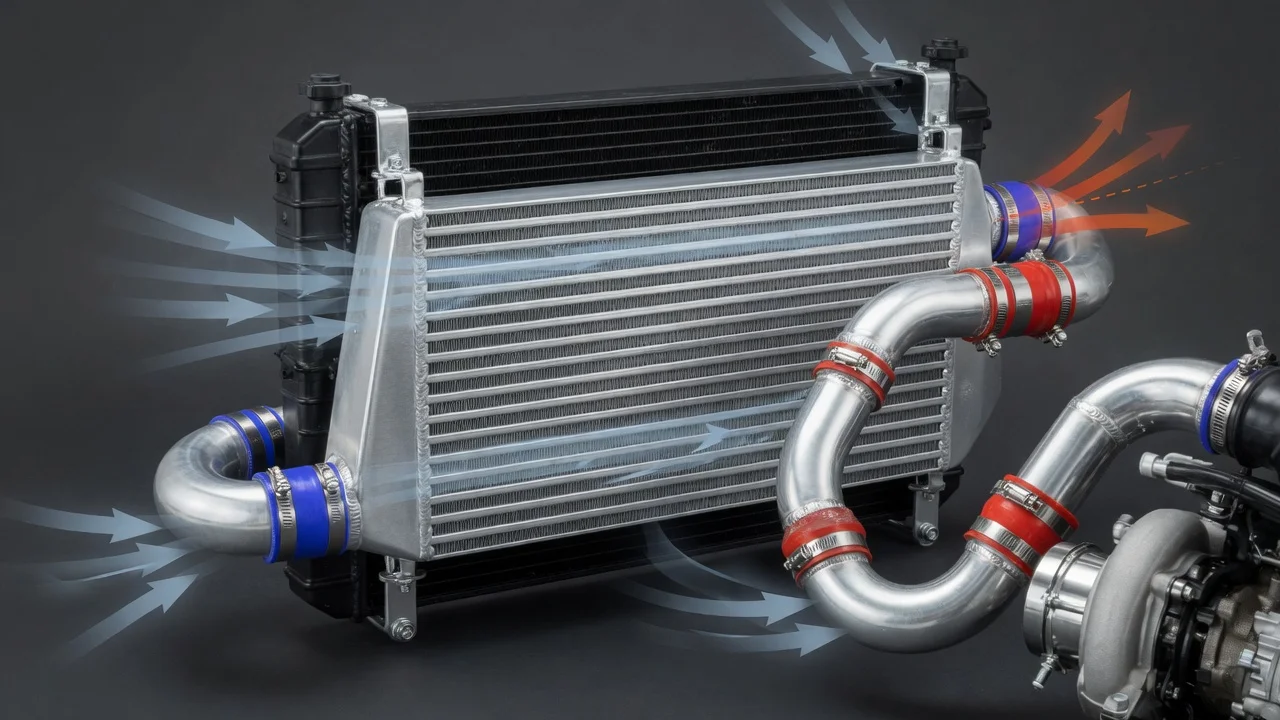
An air-to-air intercooler cools the charge air leaving a turbocharger or supercharger before it reaches the intake, using outside airflow passing through a finned core. Picking the right one is less about buying the biggest core and more about matching your engine configuration, model year, the airflow available at the front of the vehicle and how you actually drive. This guide covers how to define the job, confirm fitment, weigh features honestly and plan for the costs of owning one.
Define the job the product must do
Start with the reason you are shopping. A replacement for a damaged or leaking factory unit should restore original performance, so an OEM-equivalent part is often the sensible choice. An upgrade is a different job: it aims to limit the rise in intake air temperature during repeated or sustained boost, such as towing in hot weather, long grades, track sessions or running more boost after a tune. If your driving never produces prolonged boost, a larger core may offer little you will notice.
Separate symptom reports from verified failures before you spend money. Power loss, hesitation, a whistle under boost or smoke are often blamed on the intercooler, but the same symptom conditions can come from a split coupler, a loose clamp, a failing bypass or diverter valve, a faulty sensor or a worn turbocharger. Confirm the cause with an inspection: pressure or smoke test the charge-air system, look for cracked end tanks and damaged fins, read any stored diagnostic codes and compare actual boost and intake air temperature against expected values in live data. A light oil film inside the piping is common on turbocharged engines; heavy pooling usually points to the turbo or crankcase ventilation, which a new intercooler will not fix.
Finally, list your practical constraints: budget, whether you will install it yourself, whether trimming the bumper or support is acceptable, whether the vehicle is still under warranty and what your state requires for road use and emissions compliance.
Check compatibility
Fitment depends on the exact model year and engine variant, not just the nameplate. The same model can carry different turbocharged engines, different mounting points and different sensor locations across generations or after a mid-cycle update. Confirm the part against your vehicle identification number through a parts lookup, or against the manufacturer specifications for your specific build, rather than relying on a broad year range in a listing.
Then check the physical interfaces. Compare inlet and outlet diameters and their orientation, end tank direction, bracket design and clearance to the radiator, air conditioning condenser, crash bar and bumper supports. Find out whether the kit includes charge piping, couplers and clamps or reuses the factory pieces. If your engine has an intake air temperature or boost sensor mounted in the charge pipe, or a valve flange on the piping, the new parts need matching provisions.
Consider calibration as part of compatibility. A larger core and longer piping change the system volume, and moving a sensor can change the readings the engine computer relies on. Some vehicles adapt without issue, while others run best with a revised calibration. Read the kit notes for whether a tune is required or only recommended, and check whether the part is legal for road use where you live.
Features that affect the choice
Core construction is the first real trade-off. Bar-and-plate cores tend to be heavier and more resistant to damage, and their extra mass can absorb heat during short bursts of boost. Tube-and-fin cores are usually lighter and, depending on design, can flow with less restriction. Neither type is universally better; the right choice depends on your use and the space available.
Size and placement matter as much as construction. A front-mount layout sees the coolest incoming air but needs longer piping and can reduce airflow to the radiator and condenser behind it. A top-mount layout keeps the charge path short but is more exposed to engine bay heat, especially in slow traffic. A bigger core adds volume that can slightly soften boost response, and any design that cools well but creates a large pressure drop gives back part of its benefit. Cooling efficiency and flow restriction should be judged together.
Learn to tell useful evidence from marketing labels. Phrases like race-proven or vague percentage gains say little without stated test conditions. More useful are published core dimensions, inlet and outlet sizes, end tank construction and any test data that states the vehicle, engine, ambient temperature and boost level. Data logs from owners with the same engine variant can be helpful, but treat them as individual reports rather than controlled results.
Limitations and ownership costs
Installation is often more involved than the part suggests. Many vehicles require removing the bumper cover and undertrays, and some kits call for trimming. Sensors must be transferred and connectors secured, and the charge-air system should be pressure tested afterward to confirm there are no leaks. If a shop does the work, labor and any calibration can add meaningfully to the total cost.
Ongoing care is simple but easy to neglect. Check couplers and clamps after the first few drives and at regular service intervals, since a coupler that slips off under boost is a common cause of sudden power loss. Clean debris and insects from the fins, gently straighten bent fins, and note any oil buildup in the piping. Record the installation and later inspections in your service history; it helps with future diagnosis, warranty questions and resale.
Be clear about what an air intercooler cannot do. On an otherwise stock engine, the main gain is usually more consistent performance under sustained load rather than a large jump in peak power. It will not cure a failing turbocharger, a faulty sensor, a vacuum leak or fuel and ignition limits, and it cannot make an unsupported tune safe.
Build a practical shortlist
For each candidate, write down the same set of facts: confirmed fit for your model year and engine variant, whether it is a replacement or an upgrade, core type and dimensions, inlet and outlet sizes, whether piping and hardware are included, sensor and valve provisions, any tuning requirement, expected effect on radiator and condenser airflow, warranty and return terms, road-use legality in your state and the total installed cost including labor.
Then narrow the list. Drop any option that cannot confirm fitment for your exact vehicle or that publishes no meaningful specifications. Among the rest, favor the smallest unit that clearly meets your purpose, because extra size brings installation work, airflow trade-offs and cost without guaranteed benefit. If the original problem was a verified failure of the factory part, a quality direct replacement may be the most sensible answer of all.