What Is an HVAC Recirculation Flap? Function, Control and Failure
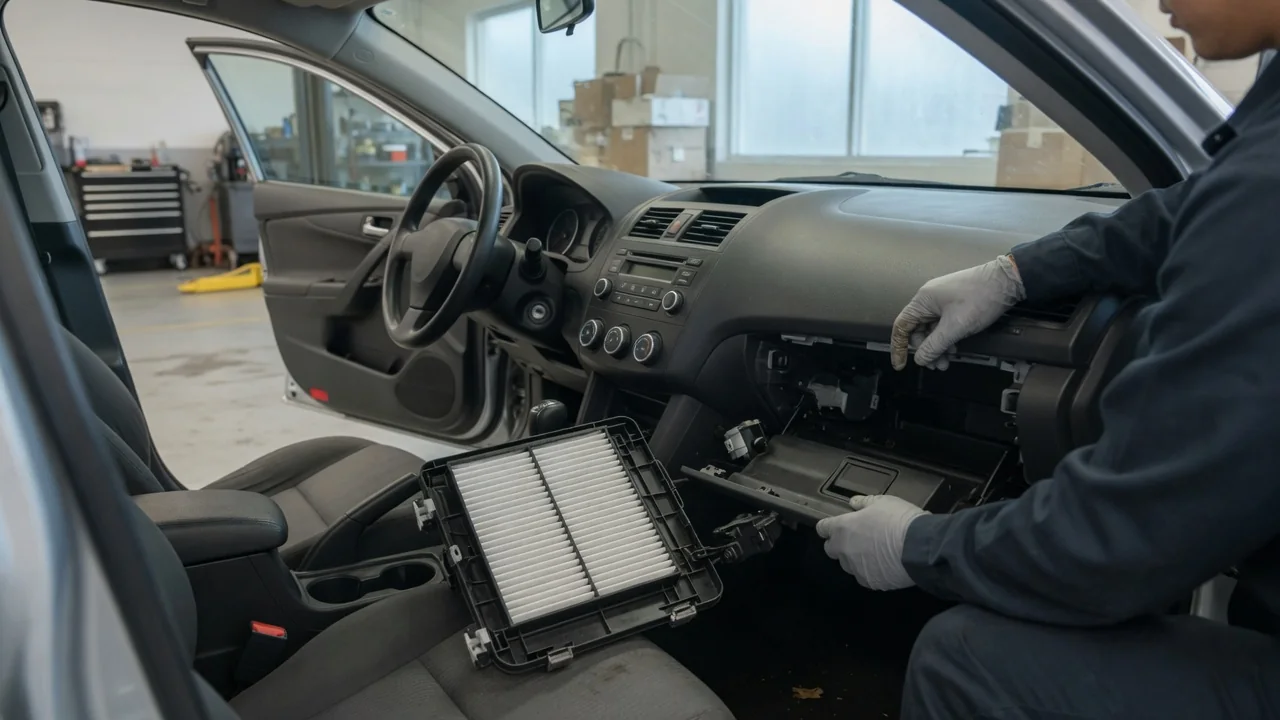
An HVAC recirculation flap is a movable door inside a car's heating, ventilation and air conditioning housing that decides where the blower draws its air from: outside the vehicle or the cabin itself. It is small and usually hidden behind the dashboard, yet its position affects cooling speed, window fogging, odors and how fresh the cabin air feels. This guide explains what the flap does, how it is controlled and how it typically fails.
Outside versus inside air
In most vehicles the recirculation flap, sometimes called the recirculation door or fresh-air door, sits at the intake end of the HVAC module, close to the blower motor. It separates two openings. One leads to the fresh-air intake, which on many cars draws from the cowl area at the base of the windshield. The other opens into the cabin, often behind the glovebox or near the passenger footwell. The flap pivots or slides to block one path while opening the other. From there, air typically passes through the cabin air filter where one is fitted, the blower, the evaporator and heater core, and the blend and mode doors before reaching the vents. The exact layout differs between vehicles.
In fresh-air mode, the blower pulls air from outside. Because air keeps entering, the cabin runs at a slight positive pressure and stale air leaves through body exhaust vents, usually hidden toward the rear of the vehicle. This steady exchange dilutes the moisture and carbon dioxide that occupants exhale, which is why fresh air generally keeps windows clearer and the cabin feeling less stuffy. The trade-off is that whatever is outside comes in too: exhaust from the vehicle ahead, dust, pollen beyond what the filter can catch, and on a hot day, hot air that the air conditioning must cool continuously.
In recirculation mode, the flap closes the outside intake and the blower draws cabin air back through the system. On a hot day, cabin air that has already been cooled is usually cooler than outside air, so the air conditioning can bring the interior down to temperature faster and with less effort. Recirculation also limits how much outside odor and smoke enters, which is useful in tunnels or heavy traffic. Its weakness is moisture: humidity from breathing and wet clothing builds up, and in cool or damp weather the glass can fog quickly. Some systems can hold the flap in an intermediate position to blend outside and cabin air, but that capability depends on the design.
Control
Drivers normally request recirculation with a button showing a car outline with a curved arrow inside it, or with a lever or slider on older manual systems. What happens behind that control depends on the vehicle's era and design. Older and simpler systems often move the flap with a cable or with a vacuum actuator fed by engine vacuum through a selector valve. Many current vehicles use a small electric actuator: a motor driving a plastic gear train, sometimes with a position sensor so the climate control module knows where the flap actually is. In networked vehicles, the button, control module and actuator may communicate over a data bus rather than a direct wire.
Automatic climate control adds another layer. Depending on the manufacturer, the system may select recirculation automatically at maximum cooling, switch to fresh air when windshield defrost is chosen so incoming drier air can clear the glass, or return to fresh air after the ignition is cycled. Some vehicles use an air quality sensor near the intake to close the flap temporarily when it detects elevated levels of certain pollutants. Because these rules vary widely, the owner's manual is the place to check how a particular car behaves, including whether a manual recirculation request can be overridden.
Electric actuators with position feedback may also need to learn their end positions. On some vehicles this happens automatically when the system powers up, while others require a specific procedure after battery disconnection or actuator replacement. Where such a procedure is required and skipped, the flap may not reach its intended positions.
Failure
A failing recirculation flap tends to reveal itself through airflow and sound rather than warning lights. If the flap sticks in recirculation, windows may fog persistently and the air can feel stale even with the fresh-air setting selected. If it sticks in the fresh-air position, outside smells come through regardless of the button, and cooling on hot days may feel slower than expected. A repetitive clicking or knocking from behind the dashboard commonly points to an electric actuator with damaged gear teeth or a flap that is meeting an obstruction. In some cases the indicator light on the button changes while nothing changes in the airflow, which suggests the request is not reaching or moving the door.
Typical causes include a worn or failed actuator motor, stripped gears, a broken linkage or flap pivot, a stretched or detached cable on cable-operated systems, and leaking hoses or a failed diaphragm on vacuum-operated systems. Leaves and debris drawn through the cowl can jam the flap, particularly where the intake screen is damaged or no cabin filter is installed. Wiring faults, connector problems, a fault in the climate control module, or a lost calibration can produce similar symptoms. On vehicles whose HVAC module stores diagnostic trouble codes, a scan tool with access to that module can help separate an electrical fault from a mechanical one.
Symptoms overlap with other problems, so a stuck flap should not be assumed. Fogging can also come from a clogged cabin filter, water leaks that wet the carpet, or a leaking heater core, which often leaves a sweet smell and an oily film on the glass. A useful first check is to toggle the recirculation control with the blower running and listen and feel for a change in intake sound and airflow near the passenger footwell.
Practical implications and limits
For everyday driving, a car recirculation flap works best as a short-term tool: to speed up initial cool-down on a hot day, or to keep out fumes in a tunnel or behind a smoky vehicle. Returning to fresh air afterward helps keep humidity and carbon dioxide from building, which matters more on long trips, with several occupants, and in cold or wet weather when fogged glass becomes a safety issue. On cars with automatic climate control, leaving intake selection to the system is generally reasonable.
It also helps to understand what the flap cannot do. Closing the outside intake reduces how much outside air enters, but a cabin is not airtight, so recirculation does not seal out pollution completely. It does not clean air by itself either; any filtering comes from the cabin air filter, whose condition and type vary. Repair effort varies just as much: some actuators can be reached under the dashboard, while others sit deep in the HVAC housing and require significant disassembly, so the vehicle's service information should guide any attempt. Forcing a stuck flap by hand or repeatedly cycling a clicking actuator can damage the gears or the door further.