What Is a Windshield Frit Pattern?
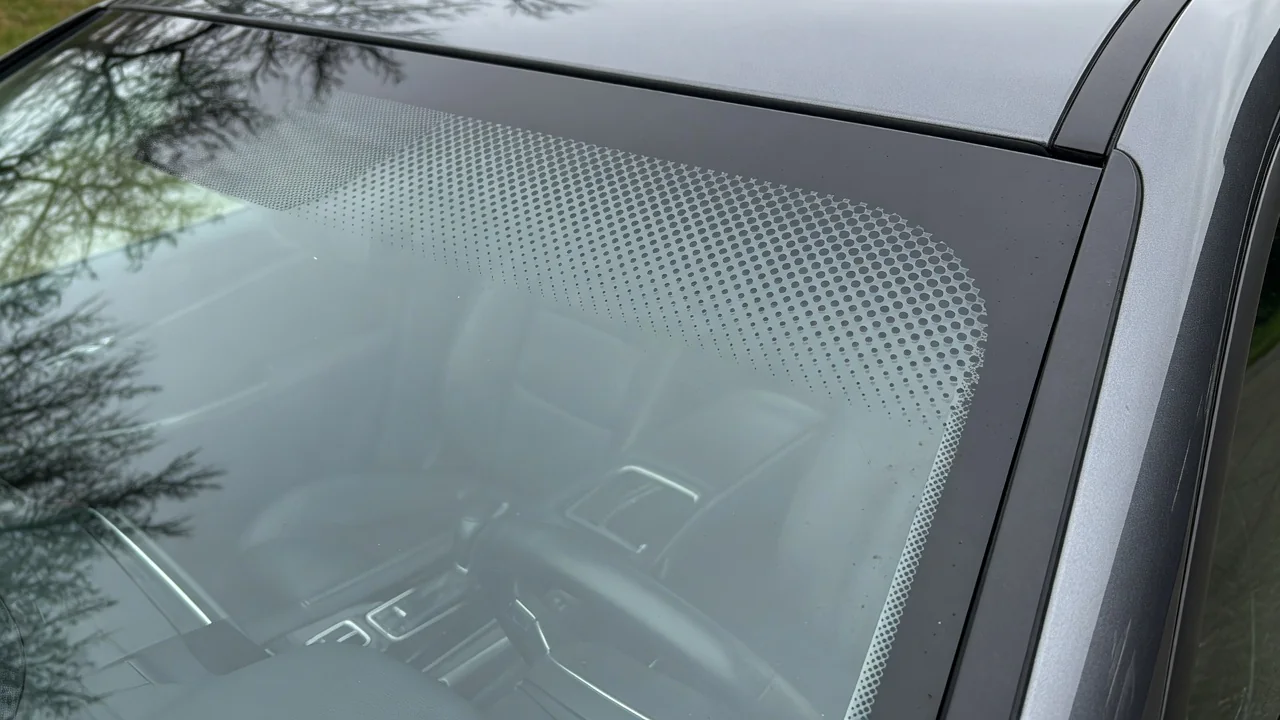
If you look closely at the edge of almost any modern windshield, you will see a solid black border that breaks up into rows of shrinking dots toward the center. That border is the frit, and the arrangement of solid band and dots is the windshield frit pattern. It is not paint or tint film added later. It is a ceramic layer fused into the glass during manufacturing, and it does several jobs at once: protecting the adhesive, supporting the bond, and finishing the look of the glass.
Ceramic print: what the frit actually is
Every automotive glass frit pattern starts as a ceramic enamel paste. The base is a finely ground glass powder, which is where the name frit comes from, mixed with heat-stable pigments, usually dark metal oxides, and an organic carrier that makes the paste printable. In automotive glass production the paste is typically applied by screen printing onto flat glass before it is shaped. A mesh screen defines exactly where enamel goes, which is how the solid band, the dot fields, and any extra printed zones are reproduced consistently across a production run.
The printed glass then goes through the heating stage used for bending or tempering. At those temperatures the carrier burns off and the glass particles in the enamel soften and fuse to the surface of the glass beneath. The result is a hard, permanent layer that becomes part of the glass surface rather than a coating sitting on top of it. It will not peel like a sticker, and normal cleaning will not remove it, although it can be scratched or chipped in the same way the glass itself can.
A windshield is laminated, meaning two sheets of glass are bonded to a plastic interlayer. The main frit band is commonly printed on the inner face of the outer sheet, so it ends up between that sheet and the interlayer. Some windshields also carry print on the surface facing the cabin. Where the print sits depends on the specific glass design, so the arrangement on one windshield is not a rule for all of them.
Bonding: why the band matters to the windshield seal
Most modern windshields are held in place by a bead of urethane adhesive that bonds the glass to the pinch weld around the body opening. In many vehicles that bond contributes to body stiffness and helps keep the windshield in place during a collision, where it can matter for airbag performance and roof support. The frit band sits directly over the area where the adhesive bead runs, and that placement is deliberate.
The first job is protection from sunlight. Urethane adhesives can degrade under prolonged ultraviolet exposure, and clear glass would let sunlight reach the bead every day the car is parked outside. The opaque ceramic band blocks that light, helping the adhesive retain its strength over years of service. When the band is inside the laminate, the adhesive bonds to the inner glass surface while the print behind it provides the shade. When enamel is on the surface that receives the adhesive, installation systems are designed to bond to that fired surface, typically with a primer or activator specified by the adhesive maker. In either case the frit supports the bond rather than creating it.
Printed zones are also where many attachments go. Mirror mounts, sensor brackets, and molding clips are often bonded within or next to the frit, where the opaque background shields their adhesive pads from sunlight and keeps them out of view.
Appearance: the solid band and the dot gradient
From outside the car, the frit band hides the urethane bead, the pinch weld, primer marks, and the edges of interior trim. Without it, the edge of the windshield would show an uneven strip of adhesive and bare metal. The solid black also gives the glass a clean, finished border that blends with the dark trim surrounding many windshields.
The dot pattern, sometimes called a halftone or dot matrix, is the transition between the black band and clear glass. Dots typically get smaller or more widely spaced toward the center, so the edge reads as a gradual fade rather than a hard line. There is also a manufacturing reason commonly cited for the gradient. Black enamel absorbs heat differently than clear glass, so a sharp boundary between the two can cause uneven heating during bending and visible optical distortion along the edge. Breaking the transition into dots spreads that temperature difference over a wider area and reduces the effect.
Many windshields add extra printed areas, such as a dotted patch behind the rearview mirror that cuts sun glare in the gap between the sun visors, or a framed opening around a forward camera or rain sensor. Whether a given windshield has these zones depends on the vehicle and the glass design.
Practical implications and limits
For owners, the frit matters most at replacement time. Replacement windshields from different manufacturers can have bands of slightly different width, dot shape, or edge finish, even when they fit the same opening. That variation is usually cosmetic, but a band narrower than the original may leave some adhesive or body flange visible, and a differently shaped opening around a camera or sensor should be checked against the vehicle's requirements before installation. Comparing a replacement with the original glass before it goes in is a reasonable step.
The dotted area sometimes looks slightly wavy when viewed at an angle, and small irregularities in the dots are a normal byproduct of firing enamel on curved glass. That effect is confined to the edge region and is not, by itself, a sign of a failing windshield. Other symptoms, such as a crack starting inside the band, haze or moisture inside the laminate, wind noise, or water leaks, point to damage or installation problems rather than to the frit.
It also helps to know what the frit cannot do. It shields and supports the bond, but the quality of an installation still depends on the correct adhesive, primer, surface preparation, and cure time specified by the glass and adhesive makers. The frit cannot be added, repaired, or reprinted after the glass is made, so a scratched or chipped band stays that way unless the windshield is replaced. Rules for tint film and inspection that refer to the upper edge of the windshield vary by location, so check local regulations rather than assuming the band changes what is allowed.