What Is a Welcome-Light Feature on a Car?
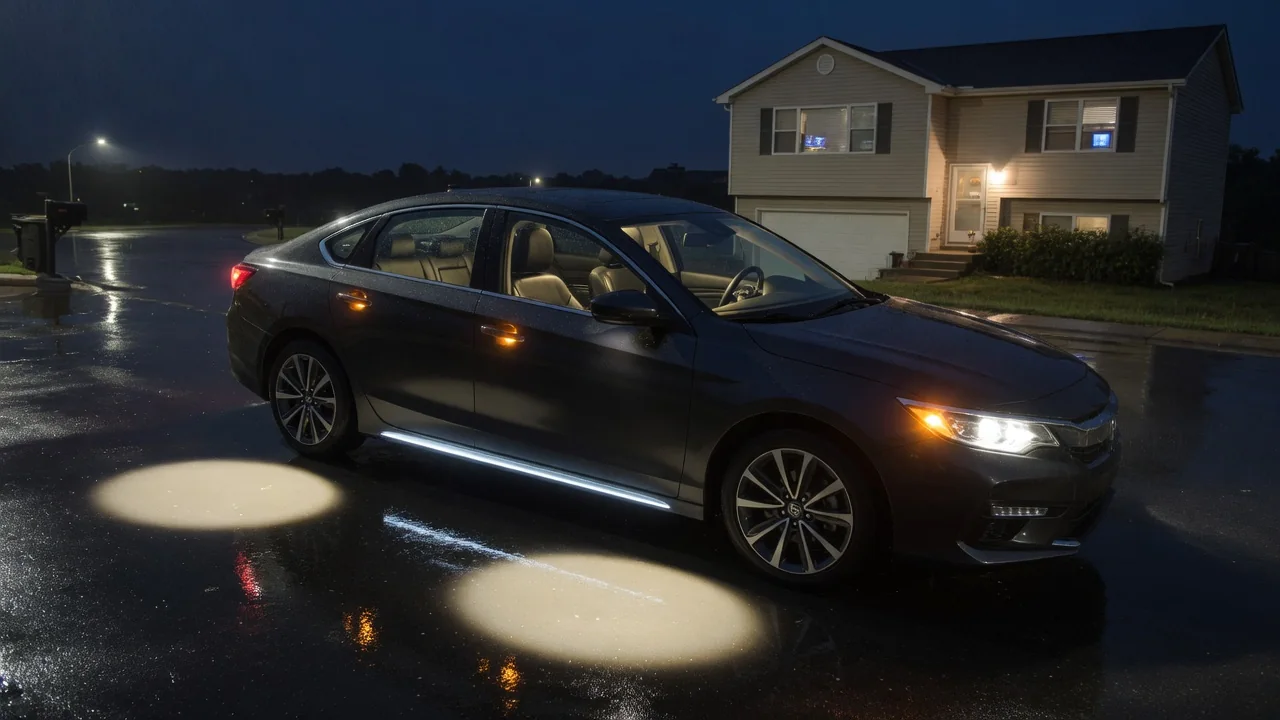
Drivers who ask what is a welcome light feature on a car are usually describing the moment a parked vehicle lights up as they walk toward it. The feature switches on selected exterior and interior lamps before the door opens, making the car easier to find, the ground easier to see, and entry feel more secure after dark.
Light locations
Welcome lighting usually begins outside the cabin. Many vehicles place small puddle lamps under the side mirrors or along the lower door edges, aiming light at the ground beside the doors so puddles, ice, and curbs are visible before you step in. Some designs illuminate the door handle recesses, which helps you find the handle and keyhole area in a dark driveway. Others briefly run the daytime running lamps, parking lamps, or taillamps, sometimes in an animated sequence.
Inside, the feature often brings up the dome lamp, footwell lighting, or ambient strips along the doors and dashboard, so the seat and floor are visible the moment the door swings open. A few brands project a logo onto the pavement from the mirror or door. Which lamps participate depends heavily on trim level and model year, so two cars with the same badge may behave differently. The owner's manual lists the lamps that belong to the welcome sequence on your vehicle.
Trigger
The lighting needs a signal that the driver is nearby. On vehicles with a proximity key, low-power antennas in the body listen for the fob, and the body control module switches on the lamps once the key comes within a short range. On vehicles without that hardware, pressing the unlock button on the remote typically starts the same sequence. Some cars also respond to a paired phone acting as a digital key, or to a hand touching the door handle sensor.
Ambient conditions often shape the response. Many systems consult the light sensor used for automatic headlamps and skip the exterior lamps in daylight, leaving only a mirror unfold or a subtle cabin glow. A timer then fades the lamps if no door opens, and starting the engine or locking the car usually ends the sequence. You can observe this by approaching at dusk and noting which lamps come on, how long they stay lit, and whether repeated approaches produce the same result.
Battery use
Welcome lamps draw power from the 12-volt battery while the engine is off, which naturally raises concern about drain. In practice the load is modest, because most modern systems use LEDs and run for only a short, timed period. The larger consideration is the standby electronics: the receivers that listen for the key stay awake at a low level while the car is parked. That background draw exists on any keyless vehicle, whether or not the lamps ever switch on.
Manufacturers commonly build in safeguards. Many vehicles stop responding to approach after the car has sat unused for an extended period, or when the control module detects low battery voltage, and return to normal after a drive. Storing the key close to the parked car, such as on a hook just inside the garage wall, can trigger repeated wake-ups and add unnecessary cycles. If welcome lighting stops working on a car that sits for long stretches, a weak battery is worth testing before suspecting lamps or sensors.
Everyday Use and Observations
In daily driving the feature mostly proves its value in parking lots and unlit driveways. The glow helps you pick out your car among similar vehicles, shows whether anything is lying beside the door, and lets passengers see the step height on taller trucks and SUVs. Interior lamps coming up early also make it easier to check the rear seat and load bags or a child seat without fumbling for a switch.
Owners often notice small behaviors that look like faults but are normal. The lamps may light only on the side you approach, may not repeat if you walk away and return within a short time, or may stay dark at midday. Many vehicles pair the welcome sequence with an exit version, sometimes called follow-me-home lighting, which keeps the headlamps or puddle lamps on briefly after you lock up. Settings menus in the infotainment screen or instrument cluster frequently allow these functions to be shortened or turned off.
Limits and Next Steps
Welcome lighting is a convenience, not a security system or a substitute for looking around before you enter. Its range is deliberately short, puddle lamps cover only a small patch of ground, and dirt, snow, or a damaged mirror housing can block the beam. A weak fob battery reduces detection distance on proximity systems, so a feature that seems intermittent may simply be responding to a fading key signal. Aftermarket accessories wired into lamp circuits can also disrupt the sequence.
If the feature changes behavior, start with simple checks: confirm the setting is still enabled, since a battery disconnect or software update may reset preferences, try the spare key, and compare operation in darkness versus daylight. A single lamp that stays dark points toward that lamp or its wiring, while a completely absent sequence suggests settings, key, or battery condition. When those checks do not explain it, a technician can read body control data for your specific vehicle, because the logic varies by manufacturer.