What Is a Vehicle's SIM or eSIM? Network Identity, Services and Replacement
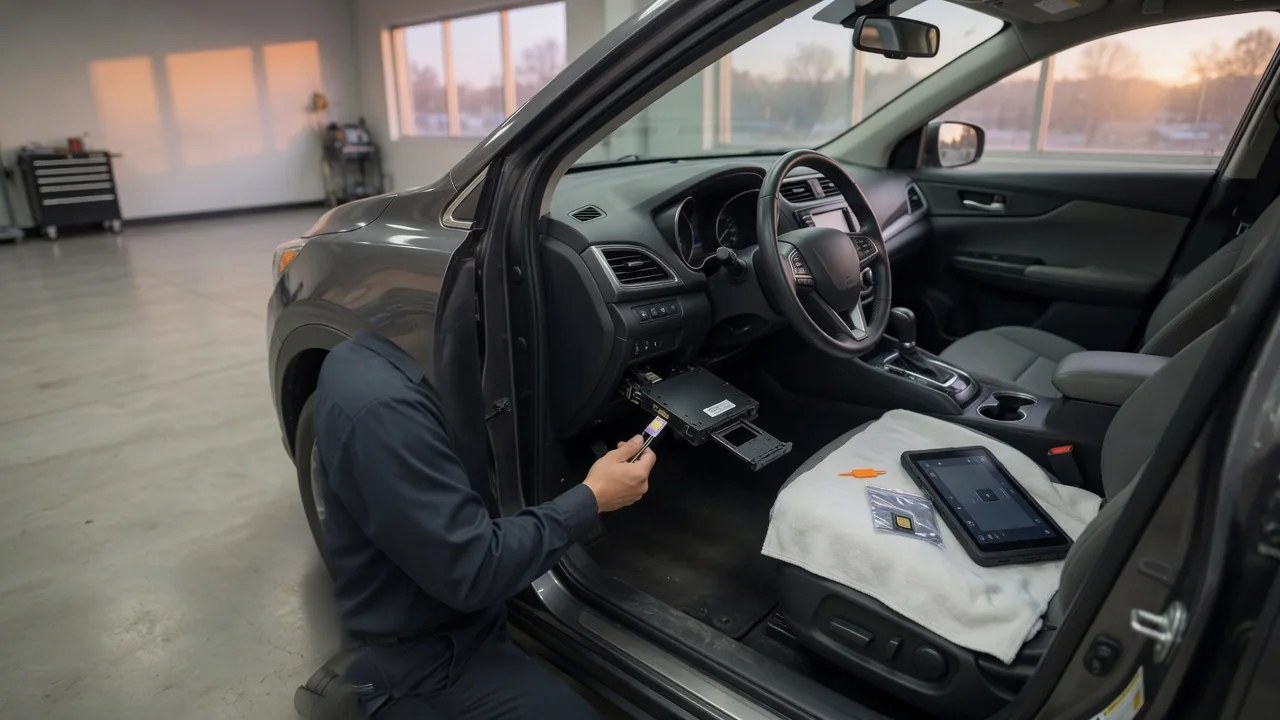
Many modern vehicles have their own cellular connection, separate from the driver's phone. That connection depends on a SIM or eSIM inside the car's telematics hardware. It tells a mobile network which vehicle is connecting and what that vehicle is allowed to do. Knowing the role of a car's cellular eSIM helps owners understand connected features, subscription prompts, and what happens when a network changes or a part is replaced.
Network identity: what the SIM tells the carrier
SIM stands for subscriber identity module. In a connected vehicle it usually sits inside the telematics control unit, a module with its own cellular modem, antenna connection, and processor. The SIM stores the credentials a mobile network uses to authenticate the device. These include an ICCID that identifies the SIM itself, an IMSI that identifies the subscription, and secret keys used during network authentication. The modem has a separate hardware identifier, the IMEI. Together, these let the carrier recognize the car as a legitimate subscriber, route its data, and bill the right account. In most cases that account belongs to the automaker or its connectivity provider, not the owner. That is why owners rarely see a phone number or carrier bill tied to the car.
People often treat SIM, embedded SIM, and eSIM as the same thing, but they describe different things. A traditional SIM is a removable card, like the one in older phones. Many automotive modules instead use a chip soldered directly to the circuit board. Manufacturers choose this format because it handles vibration, moisture, and temperature extremes better than a card in a slot. An eSIM, or eUICC, goes a step further. It can store one or more operator profiles and receive new ones remotely through a standardized provisioning process. In short, 'embedded' describes how the chip is mounted, while 'eSIM' describes whether its network profile can be changed over the air. Which type a given vehicle uses depends on the manufacturer, model year, and market.
Services that rely on the vehicle's cellular connection
The SIM or eSIM lets the car use connected services when no phone is paired. Depending on the vehicle and region, these can include automatic crash notification and emergency calling, roadside assistance requests, remote lock and unlock, remote start or climate control on equipped vehicles, vehicle location through a companion app, and stolen vehicle assistance. The same link can carry live traffic and connected navigation data, vehicle health reports, and over-the-air software updates. Some vehicles also share the connection with passengers through a built-in Wi-Fi hotspot.
Not every service is handled the same way behind the scenes. The manufacturer typically arranges the data used for safety functions, diagnostics, and software updates as part of its connected services program. Consumer data such as a Wi-Fi hotspot often needs a separate plan, bought through the manufacturer or a partner carrier. Some features come free for a set period with a new vehicle and then move to a paid subscription. Regulation can also shape what is installed. In the European Union, new type-approved passenger cars must support the eCall emergency system. As a result, vehicles built for that market include cellular hardware whether or not the owner signs up for other services.
Replacement: when the SIM or its profile changes
A car's SIM may need to change for reasons that have nothing to do with a fault. Vehicles often stay on the road much longer than a typical carrier contract or network technology. When carriers retire older networks, as happened with 2G and 3G shutdowns in several countries, telematics units built only for those networks can lose their connection. A new SIM alone does not fix this, because the modem itself must support a current network generation. Where the manufacturer offers a fix, it is usually a hardware upgrade of the telematics module. An eSIM solves a different problem. If the automaker changes carrier partners, it can download a new operator profile to the vehicle remotely, with no service visit.
Physical replacement is generally a job for a dealer or authorized service center, not the owner. Soldered chips are replaced together with the telematics module, and even removable SIMs in automotive modules are rarely in a place owners can reach. After the work, the new identifiers must be registered with the manufacturer's backend and linked to the vehicle identification number before connected services resume. A personal phone SIM generally cannot stand in for the factory one, because the manufacturer's systems expect the specific identity they provisioned. Changing owners is a separate matter. The SIM stays in the car; only the account changes. The previous owner should remove the vehicle from their app and service account, and the new owner should enroll it in their own name.
Practical implications and limits
A built-in connection is only as reliable as the cellular coverage around the car. In parking garages, remote rural areas, or regions where the vehicle's carrier has no service, remote commands may be delayed or fail. App location data may be out of date, and live navigation may fall back to stored data. The car's basic driving functions do not depend on this link, but connected features do. Owners who rely on remote unlock or location tracking should keep that limitation in mind.
Subscription status and connectivity are not the same thing. When a trial or paid plan ends, the module usually stays installed and may still communicate for functions the manufacturer defines, such as certain safety or software-update tasks. The service terms for that vehicle and market set the exact behavior. Because the module can transmit location and vehicle data, privacy is a fair concern. Many manufacturers offer privacy settings or a process to limit data sharing or deactivate connected services, sometimes at the cost of features. Physically disconnecting the module is a different step and may affect other vehicle functions, so discuss it with a qualified technician first.
Anyone buying a used connected vehicle can cover most of what matters with a few questions. Are connected services still supported for that vehicle identification number? Does the telematics hardware use a network generation that is still active locally? Has the previous owner's account been removed? Which features require a subscription? The owner's manual and the manufacturer's connected services support are the most reliable places to confirm these details for a specific car.