What Is a Vehicle Design Freeze? Geometry, Tooling and Later Changes
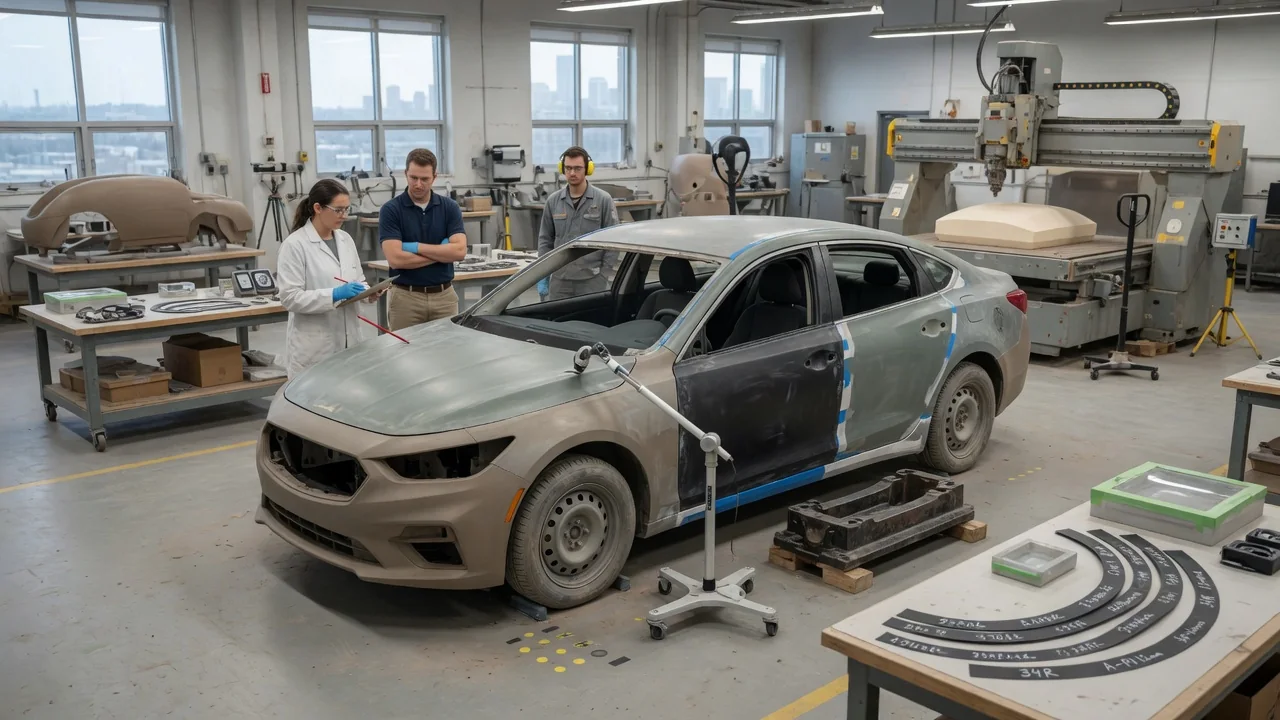
A vehicle design freeze is the point in a development program when the approved design is locked so engineering teams, suppliers, and manufacturing can commit to building it. If you have wondered about the car design freeze meaning, it is less a single dramatic moment than a controlled agreement: the shape and key dimensions stop moving, expensive production tooling can be ordered, and any later change must pass a formal review instead of being made freely.
Approved geometry
At its core, a design freeze locks the geometry of the vehicle. That includes the visible exterior and interior surfaces that designers and surface modelers refine, often called show or appearance surfaces, along with the underlying engineering data that defines how parts fit together. Key reference points, sometimes called hard points, are also fixed. These cover items such as wheel positions, occupant seating reference points, windshield angle, roof height, and mounting locations for major systems. Once these points are agreed, the overall package of the vehicle stops changing, and every team works from the same set of dimensions rather than from a moving target.
In practice, freezing is usually staged rather than done all at once. A styling freeze may come first, confirming the approved exterior and interior appearance. Engineering data for body structure, closures, trim, and mechanical components then matures and is released in steps as each area is validated. The released digital models become the master reference: drawings, supplier quotations, simulation models, and assembly planning are all derived from them. Exact naming, timing, and the number of stages differ between manufacturers and programs, so the term describes a common principle rather than a single industry-wide standard.
The reason geometry must be locked is simple coordination. A body panel affects the lamps, seals, and trim around it; a change to a mounting point affects brackets, wiring routes, and fasteners. Without an agreed baseline, each team's changes would ripple through everyone else's work, and the program could never converge on a buildable car.
Tooling
Tooling is the main reason a design freeze carries so much weight. Mass production relies on dedicated tools: stamping dies for sheet metal panels, injection molds for plastic parts, casting and forging tools for metal components, plus welding fixtures, assembly jigs, and checking fixtures used to verify that finished parts match the design. These tools are typically expensive and take considerable time to design, machine, and tune. They are built directly from the released geometry, so they cannot responsibly be started until that geometry is stable.
Before production tooling exists, development vehicles are often assembled from parts made with prototype methods, such as temporary or so-called soft tooling, machined parts, or additive manufacturing. These approaches tolerate change more easily and allow engineers to test fit, function, and durability while the design is still evolving. Hard production tools are a different commitment. Once a die surface has been machined or a mold cavity has been cut, altering it means rework, added inserts, or in some cases a replacement tool, along with renewed tryout and approval.
The freeze also anchors supplier relationships. Many components are made by outside companies that quote prices, plan capacity, and build their own tools based on the released data. A stable design lets those suppliers commit, and it lets the manufacturer plan parts approval and production ramp-up on a predictable schedule.
Later changes
A design freeze does not mean nothing can ever change. It means change becomes controlled. After the freeze, a modification typically starts as a formal change request, followed by an assessment of its effect on cost, tooling, timing, validation, regulatory compliance, and connected parts. If approved, the change is released as a new revision of the affected data and part definitions so that everyone, including suppliers, builds to the same updated version. Common reasons for late changes include findings from physical testing, crash or durability results, manufacturing feasibility problems, quality concerns, supplier issues, and updated legal requirements.
The later a change arrives, the more it tends to disturb. A modification made before tools are cut may only require updated data, while the same modification after tooling is complete can involve tool rework and repeated validation. For that reason, programs often sort proposed changes by urgency. Safety and compliance problems are addressed as required, while less critical improvements may be bundled into a later running change during production or held for a planned update of the model.
Once production has started, approved changes usually take effect from a specific point in the build sequence. This is why the same model can contain different versions of a part depending on when an individual vehicle was built, even though its appearance and name stay the same.
Practical implications and limits
For owners, the freeze process explains several everyday observations. Because geometry and tooling are committed well before sales begin, a newly launched car reflects decisions made some time earlier, which is one reason styling or features can seem slightly behind current trends at launch. It also explains why a known issue on a model may only be corrected on vehicles built after a certain date: the fix had to pass through the change process and reach the production line.
Running changes have direct consequences for maintenance and repair. Parts catalogs and service documentation often split information by production date, build sequence, or vehicle identification number, and an updated part may replace an earlier one under a new number. When ordering components or following repair procedures, matching the exact build of your vehicle matters more than matching only the model name and year, and the manufacturer's official service information is the reliable reference for which version applies.
There are also limits to what the concept can tell you. Design freeze terminology, stages, and timing are not standardized across the industry, and manufacturers rarely publish when a given program froze its design, so outside observers cannot reliably date it. Camouflaged prototypes seen in public testing may carry temporary parts that do not represent the final design. Finally, a freeze is a planning and control milestone, not a guarantee of quality; it fixes what will be built, while validation, manufacturing discipline, and later corrections determine how well the finished vehicle performs.