Why Are Early Car Prototypes Hand-Built?
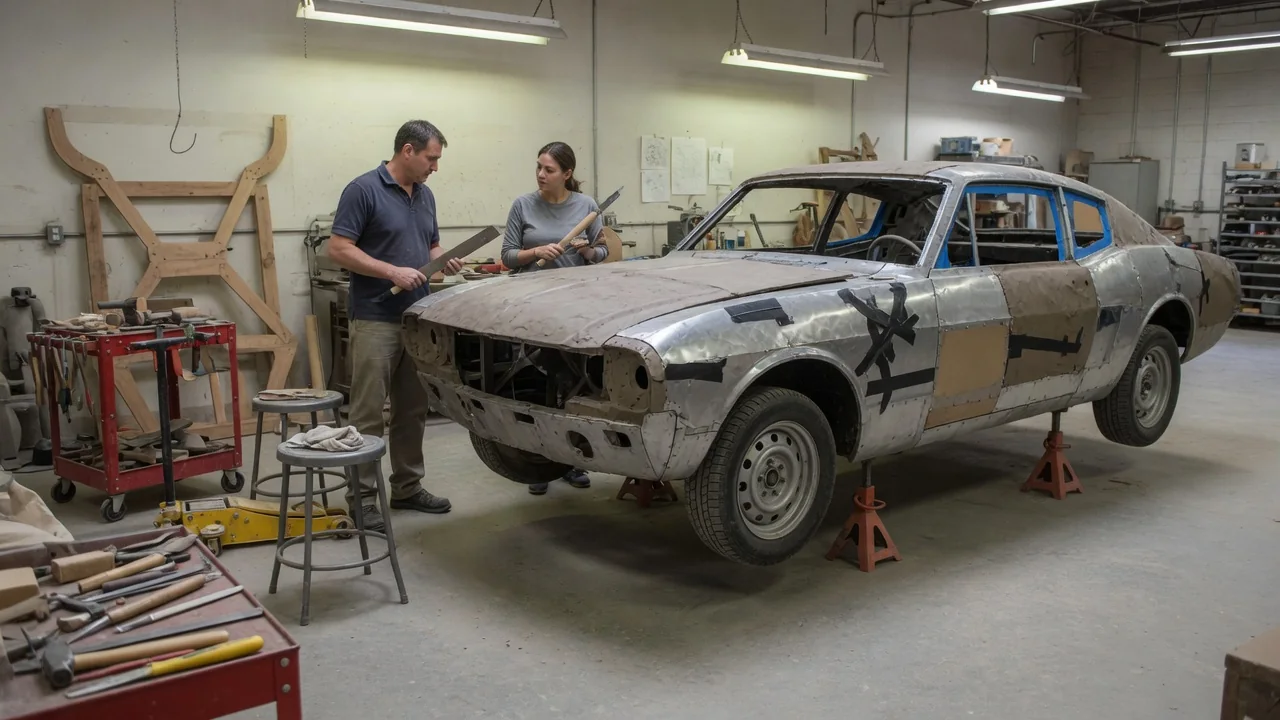
Early car prototypes are hand-built because, at that stage, the factory that will eventually make the car does not yet exist in usable form. Production tooling, stamping dies, and assembly fixtures take a long time and a large investment to create, and they only make sense once a design is settled. Until then, engineers need a small number of vehicles they can assemble, measure, and alter quickly. Hand building meets that need through low-volume parts, hands-on fit testing, and easy changes.
Low-Volume Parts Come Before Production Tooling
A mass-produced car depends on parts made with dedicated tooling: large stamping dies for body panels, injection molds for interior trim, casting patterns for engine and suspension components, and fixtures that hold everything in place during welding. That tooling is designed to produce very large numbers of identical parts at a low cost per piece, but it is expensive and slow to make. Committing to it before a design has been proven would mean paying for tools that might have to be scrapped or reworked after the first round of testing.
Prototype teams therefore use methods that suit a handful of parts. Body panels may be formed from sheet metal by skilled panel makers, shaped on simpler soft tools, or laid up in composites. Brackets and housings can be machined from solid stock, and many plastic parts are 3D printed or cast in temporary molds. These approaches cost more per part, yet far less overall when only a few vehicles are needed. Because each part exists in such small numbers, it is natural for technicians to fit, trim, and fasten them by hand rather than on an automated line. Early prototypes may also borrow components from existing vehicles, such as a powertrain or suspension, mounted on a modified structure, so engineers can evaluate one new system without waiting for every other part to be ready.
Fit Testing on a Physical Vehicle
One of the main jobs of an early prototype is to show whether everything actually fits. Computer models and digital packaging studies catch many problems, but a physical vehicle reveals issues that are hard to judge on screen: a wiring harness that must bend too sharply, a hose that rubs against a bracket when the engine moves on its mounts, a fastener a technician cannot reach with a real tool, or a gap between panels that grows once parts are assembled with normal variation.
Hand assembly is well suited to finding these problems. A technician building the car piece by piece notices interference, awkward assembly steps, and parts that need adjustment to line up. Those observations go back to engineers, who decide whether to change a part, its mounting point, or the assembly order. Hand builds also let teams check clearances for service access, ergonomics such as seat position and control reach, and how components are routed through the body, all before those decisions are locked into permanent tooling.
Not every fit check requires a complete running car. Teams may build partial bodies, interior mockups, or engine-bay bucks to study one area in detail. These are also assembled largely by hand, because their purpose is to answer a narrow question quickly, and a small team can adjust them as answers emerge.
Changes Are Cheaper Before Tooling Is Locked
Design changes are expected during early development. Test results, packaging conflicts, cost reviews, and regulatory requirements can all lead to revisions. On a hand-built prototype, a change might mean cutting and rewelding a bracket, reshaping a panel, printing a revised trim piece, or rerouting a harness. That work can usually be done in a workshop with general-purpose equipment, without waiting for new production parts from an outside supplier.
The same change made after production tooling exists is far more disruptive. A revised body panel may require a modified or entirely new die, an altered part can affect welding fixtures and robot programs, and suppliers may need to rework their own tools. Keeping the vehicle hand-built while the design is still moving gives engineers freedom to iterate, compare alternatives, and learn from each build. Each revision can be documented and carried into the next round of prototypes, so the design converges before money is spent on tools meant to last for an entire production run.
Practical Implications and Limits
Hand-built automotive prototypes have clear limits. They show whether a design can work, not whether it can be made consistently at volume. Hand-formed panels, machined parts, and printed components may differ in material, finish, weight, or durability from the production parts that eventually replace them, so results such as noise levels, rattles, or long-term wear may not carry over directly. For that reason, development programs typically move on to pre-production vehicles built with real or near-final tooling. Those builds test the manufacturing process itself and expose problems that only appear when parts come from production tools and assembly lines.
For interested car owners, this explains a few things often noticed from the outside. Disguised test vehicles seen on public roads may look unfinished, use mismatched parts, or differ visibly from the model eventually sold, because they represent a stage of development rather than the final product. It also means a prototype's behavior is not a reliable guide to how a production car will drive or hold up; that depends on the finished design and the process used to build it. The sequence of prototype stages, the number of vehicles built, and the fabrication methods used vary between manufacturers and projects, so this general picture should not be read as a description of any particular car's development.