What Is a Tailgate Latch?
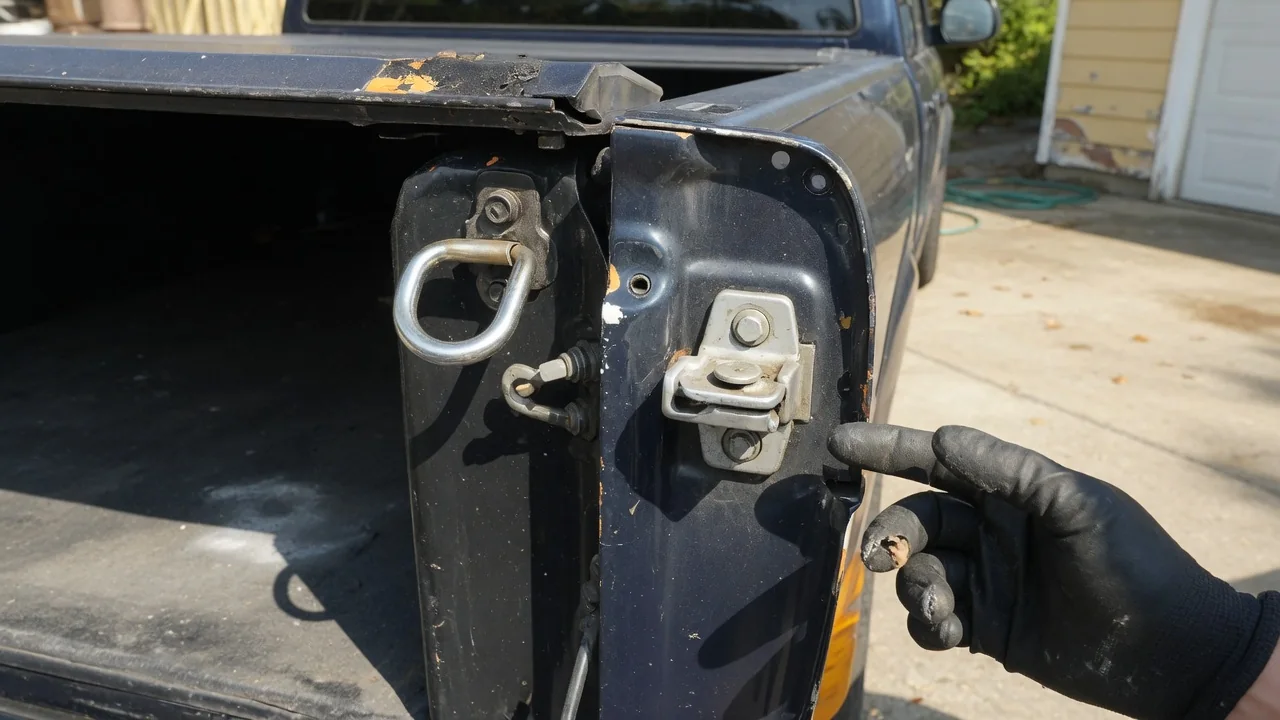
What is a tailgate latch? It is the mechanism that holds a pickup tailgate, SUV liftgate, or hatchback rear door closed against the body and lets it go when you ask. Some designs are purely mechanical, worked by a handle and rods, while others add an electric actuator for powered release. Understanding how it retains and releases helps you interpret what the rear of your vehicle is telling you.
Latch location
On a traditional pickup, the latches usually sit inside the tailgate itself, one near each upper outer edge, where they grip pins or strikers mounted on the bed sides. A central handle connects to both through rods or cables hidden behind the inner panel. You can often see the latch mouths by lowering the gate and looking at its side edges, where a forked rotor sits inside a small opening in the sheet metal.
Liftgates on SUVs, crossovers, and hatchbacks generally use a single latch centered along the lower edge of the door, meeting a striker on the cargo floor sill. Some manufacturers reverse this arrangement and put the latch in the body with the striker on the door. Powered versions add a small motor or actuator to the same housing, and power liftgates may include a cinching mechanism that pulls the door fully shut. Layouts differ by model, so the owner's manual is the reliable guide for your vehicle.
Striker
The striker is the fixed partner the latch grabs. It may be a U-shaped loop of hardened steel bolted to the body, or a round pin or post on a pickup's bed side. As the gate closes, the striker enters the latch mouth and pushes a rotating fork around it, and a spring-loaded pawl drops in behind the fork to keep it from turning back. That pawl is what the handle or electric actuator moves to release the gate.
Most latches have two retention positions: a first catch that holds the gate partly closed and a fully latched position that pulls it tight against the weatherstrip. Because the striker determines where the gate sits when closed, its mounting usually allows a small amount of adjustment. A striker that sits slightly out of position can cause a gate that needs a hard slam, sits uneven with the body, or rattles over bumps. Shiny wear marks or a worn plastic coating on the striker are visible hints about how the two parts are meeting.
Fault clues
A latch that is struggling usually announces itself through feel and sound. The gate may bounce back instead of catching, hold only on the first position, or need several attempts in cold or dusty conditions. On pickups, one side may release while the other stays hooked, which points toward the rod, cable, or latch on the stuck side rather than the handle. A loose-feeling handle with no resistance suggests a disconnected linkage, though confirming that requires looking behind the access panel.
Powered systems add electrical clues. Many latches contain a switch that reports whether the gate is closed, so a door-ajar warning, a cargo light that stays on, or a power liftgate that reverses or refuses to cinch can all trace back to the latch area. A stored fault code related to the rear closure is evidence to interpret, not proof that the latch has failed, since wiring in the flexing hinge-area harness, a fuse, a release switch, or a control module can produce similar symptoms. Code meanings also vary by manufacturer.
Everyday Use and Observations
In daily use, a healthy latch is nearly invisible. A mechanical tailgate releases with a consistent handle pull and closes with a solid click on both sides. An electric release typically responds to an exterior touch pad, a key fob button, or a dashboard switch with a brief whir or clunk from the actuator before the gate frees. Many vehicles tie powered release to the central locking system, so a gate that will not open may simply be locked rather than faulty.
Conditions shape behavior more than many owners expect. Road grit, bed debris, and dried grease can slow the rotor and pawl, while ice can hold a latch or seal shut on a winter morning. Heavy cargo pressing against the inside of the gate loads the latch and can make release stiffer until the load is shifted. Paying attention to how the gate normally sounds and feels gives you a baseline, so a change in closing effort, alignment, or release timing stands out early.
Limits and Next Steps
There are sensible limits to what observation alone can tell you. Looking over the latch mouth and striker for debris, damage, or obvious looseness, and noting exactly when the problem occurs, is useful and low risk. Beyond that, the correct lubricant, adjustment method, and any emergency release provision are specific to the vehicle, so the owner's manual or service information should guide any hands-on work. Power liftgates deserve extra caution, because a motorized door and its cinching latch can move unexpectedly and pinch fingers.
A gate that will not stay fully latched should be treated as a priority rather than an annoyance. An unsecured tailgate can drop open and spill cargo, and an open liftgate can draw exhaust fumes into the cabin while driving. If the gate cannot be reliably closed, or if warnings and powered functions behave inconsistently, a qualified technician can test the latch, actuator, switches, and wiring together before any part is replaced. It is also worth asking whether any open recalls apply to your vehicle's rear closure.