What Is a Hands-Free Tailgate?
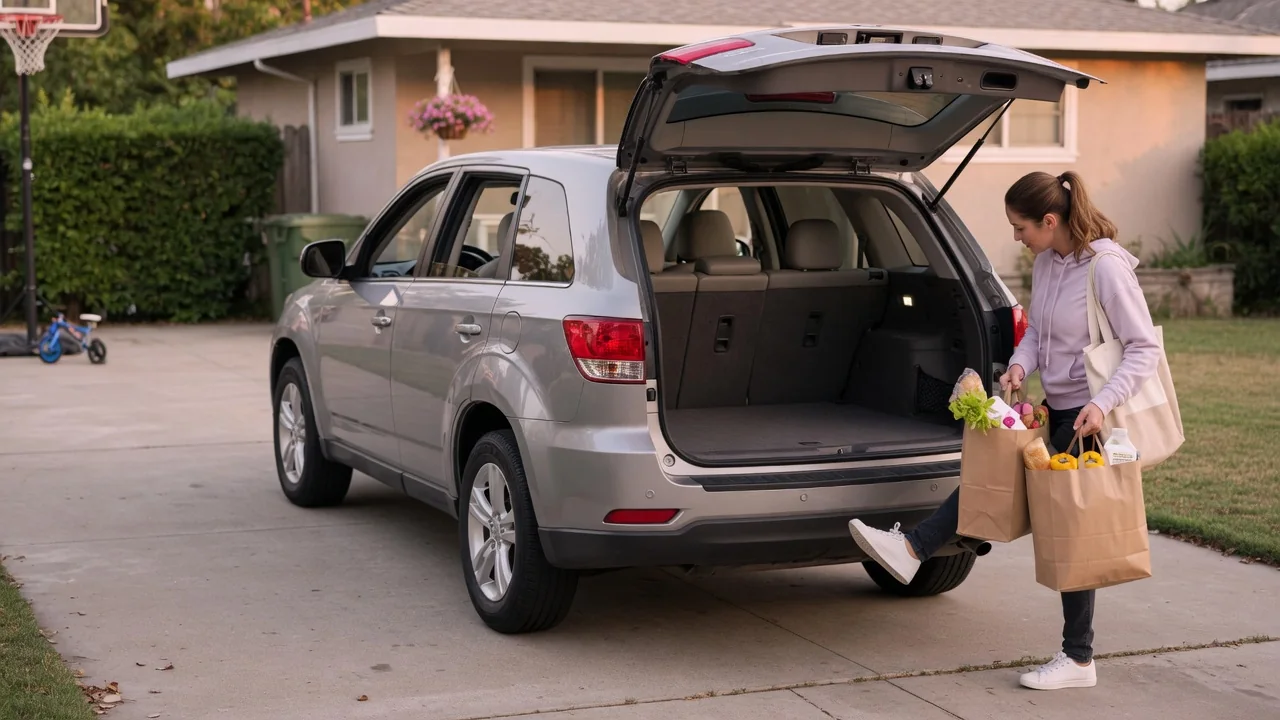
Anyone asking what is a hands free tailgate usually has full arms and a closed cargo door in mind. The feature lets a powered liftgate open, and often close, without touching a handle or a key fob button. Sensors detect a deliberate gesture or the driver's presence, and the vehicle decides whether conditions are right to move the door.
Activation
The most common activation method is a kick gesture. Sensors mounted behind the rear bumper, often capacitive strips that react to a nearby object changing their electrical field, look for a foot moving in and back out beneath the bumper. A quick straight kick and withdrawal is the pattern the control module expects. Holding the foot in place or sweeping it sideways often fails, because the system is tuned to recognize a short, intentional motion rather than anything that happens to pass underneath.
Other designs skip the gesture entirely. Some vehicles open the liftgate when the driver simply stands behind the vehicle with the key for a few seconds, usually signaling the countdown with flashing lights or beeps. A few project a marker onto the ground showing where to step or kick. Because the sensing zone, required motion and warning signals differ by manufacturer and even by model year, the owner's manual is the reliable guide to how a particular vehicle expects to be asked.
Key proximity
A gesture alone is not enough. The system is tied to the passive entry hardware, so the vehicle must also detect an authorized key fob, or on some vehicles a paired phone acting as a digital key, close to the rear. Antennas near the back of the body check that the key is within a short range before the liftgate motor is allowed to run. That is why a stranger kicking under the bumper of a locked vehicle should get no response at all.
Key location explains many puzzling results. A fob buried in a bag alongside electronics, or one with a weak battery, may not be detected reliably, so the gesture seems to be ignored. A key left inside the cabin can also block the feature on some vehicles, since the system wants to see it outside and behind the car. Detection range and the rules about where the key must be vary by make, so behavior learned on one vehicle may not carry over to another.
False triggers
Manufacturers design the logic to reject accidental openings, but false triggers still occur. Because the key must be present, they tend to happen when the owner is working near the rear with the fob in a pocket: washing the bumper, loading a bike rack, or hooking up a trailer. Water streaming across the sensor area in a car wash or from a hose can resemble the changing signal of a foot. Many vehicles allow the function to be switched off through a settings menu for exactly these situations.
The opposite problem, a missed trigger, is just as common and usually has a simple cause. Mud, road salt, snow or ice packed onto the lower bumper can mask the sensors, and a hitch-mounted accessory may sit right in the detection zone. Aftermarket bumper trim can interfere as well. When the feature becomes erratic after winter driving or an off-road trip, cleaning the underside of the bumper is a sensible first observation before assuming any component has failed.
Everyday Use and Observations
In daily use the feature earns its keep in ordinary moments: carrying groceries, holding a child, or wrangling luggage in an airport lot. A working system typically acknowledges the request before moving, with a chime, a flash of the tail lamps, or both, and then the liftgate rises under power. Standing slightly back matters, since the door swings outward and upward. Many vehicles also accept the same gesture to close the liftgate, though some only open hands-free and need a button press to shut.
Owners often notice that technique matters more than force. Kicking at the center of the bumper, or wherever the manual indicates, and stepping back promptly gives the most consistent results, while kicking near a corner or brushing the bumper with a shin may do nothing. Powered liftgates commonly include obstacle detection that stops or reverses the door if it meets resistance, and some let the driver set a lower opening height for garages with limited ceiling clearance.
Limits and Next Steps
The feature has built-in limits. It generally works only when the vehicle is parked, and it may be disabled when the battery is low to conserve power. It also depends on the whole power liftgate system being healthy, including the motor or powered struts, the latch, and the control module. If the liftgate will not respond to its regular buttons either, the fault likely lies beyond the gesture sensors, and the hands-free function is simply the most visible symptom.
When the gesture stops working, start with the simple checks: confirm the feature is enabled in the vehicle settings, try a fresh fob battery, clean the lower bumper, and remove any hitch accessories. If it still fails, a shop can scan the body electronics for stored fault codes. A code points toward a circuit or sensor to test rather than proving a part is bad, and its meaning can be manufacturer-specific, so diagnosis should be confirmed against information for that exact vehicle.