What Is a Hood-Latch Safety Catch?
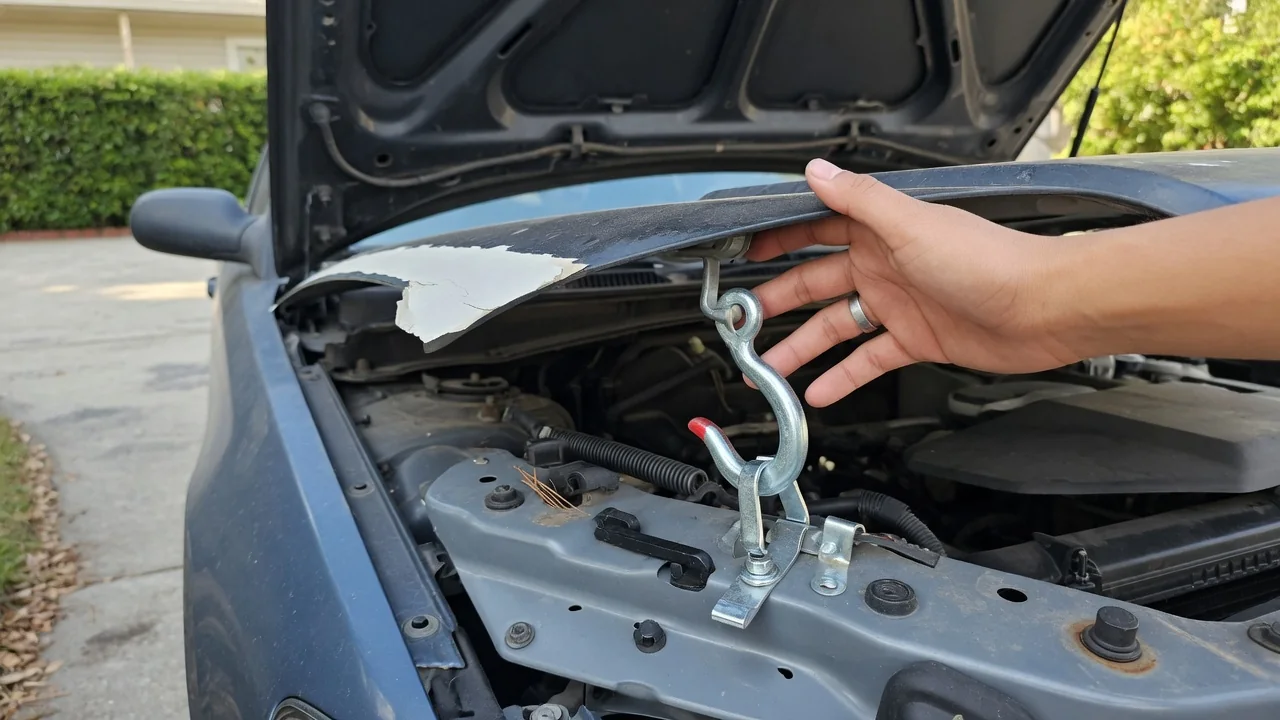
Drivers asking what is a hood latch safety catch are usually looking at the small hook or lever they must move by hand after pulling the interior release. It is the secondary retention device that keeps a partly released hood from lifting freely, and understanding how it works alongside the main latch explains why opening a hood takes two separate steps.
Primary latch
The primary latch is the mechanism that holds the hood fully closed while the vehicle is driven. On most vehicles it sits on the radiator support or front crossmember and grips a striker, a steel loop or pin fixed to the underside of the hood. When the hood is pushed down, a spring-loaded pawl rotates around the striker and locks it, pulling the panel tight against its rubber bumpers and seals so it sits flush with the fenders.
Pulling the release handle inside the cabin tugs a cable that retracts the pawl, and a pop-up spring lifts the front edge of the hood slightly. At this point the primary latch has done its job and let go, yet the hood should rise only a small distance. Layouts differ: some vehicles use one central latch, others use two latches spaced across the front, and a few use electric actuators instead of a cable. The owner's manual shows the arrangement for a particular model.
Secondary catch
The secondary catch is the safety catch itself, a separate hook that remains engaged after the primary latch releases. It typically hangs from the hood or rises from the latch assembly and snags a lip, slot or the striker so the panel cannot swing upward. Its purpose is straightforward: if the primary latch is released accidentally, fails to engage after service, or works loose, airflow at speed could otherwise throw the hood back against the windshield and block the driver's view.
Releasing it requires a deliberate action from outside the vehicle, which is why it cannot normally be defeated from the driver's seat. Many designs use a lever under the hood's front edge that is pushed sideways or lifted upward; others place a tab that protrudes through the grille. Some vehicles instead require a second pull of the interior handle to release the catch. A return spring pushes the hook back into its engaged position so it is ready the next time the hood is lowered.
Inspection
A basic visual check is possible whenever the hood is open and the engine is off. The hook should look straight, not bent or cracked, and it should spring back firmly when moved by hand and let go. Heavy rust, dried grease packed with grit, or a hook that stays where it is pushed all suggest the catch may not re-engage reliably. The striker and its mounting bolts deserve a look as well, since a loose or misaligned striker affects both stages.
A simple functional observation is to lower the hood gently until it rests on the secondary catch without latching fully, then try to lift the front edge. It should stop after a short travel and stay retained until the lever is operated. If the hood lifts freely, the catch is not doing its job and the vehicle should be examined before further driving. Front-end collision damage, replaced hoods and worn release cables are among the reasons a previously sound latch system falls out of alignment.
Everyday Use and Observations
In daily use, most people meet the safety catch only when checking oil or topping up washer fluid. After the interior handle is pulled, the hood sits raised by roughly a finger's width, and a hand slid under the front edge finds the lever by feel. On an unfamiliar vehicle it may be off-center or hidden behind the emblem, so a moment's searching is normal. A lever that feels stiff or gritty is worth noting, particularly after winter driving on salted roads.
Closing matters as much as opening. A hood lowered too softly can come to rest on the secondary catch alone, leaving a visible gap along the front edge and sometimes a slight flutter at highway speed. Many vehicles show a hood-ajar warning on the instrument panel when a switch in the latch detects this, though not every model has one. Lowering the hood and letting it drop from a modest height, or pressing as the manual directs, then tugging upward confirms that the primary latch has engaged.
Limits and Next Steps
The safety catch is a backup, not a substitute for a working primary latch. It is designed to hold a hood briefly so the driver can slow down and stop, not to carry repeated wind loads over long distances. Driving with the hood resting only on the secondary hook puts stress on a small component and its spring, and a hood that shakes, lifts or shows an uneven gap should be treated as a reason to pull over safely and re-close it.
When the catch sticks, fails to spring back or will not hold, the sensible next step is a professional inspection instead of bending parts to fit. Latch position, striker height and cable adjustment interact, and correct settings are specific to each vehicle. A hood-ajar warning or related diagnostic message is evidence to interpret, since it may point to a switch or wiring issue as easily as a mechanical one. It is also worth checking whether an open safety recall covers the latch on that vehicle.