What Is a Racing Harness? Belts, Seat Integration and Proper Use
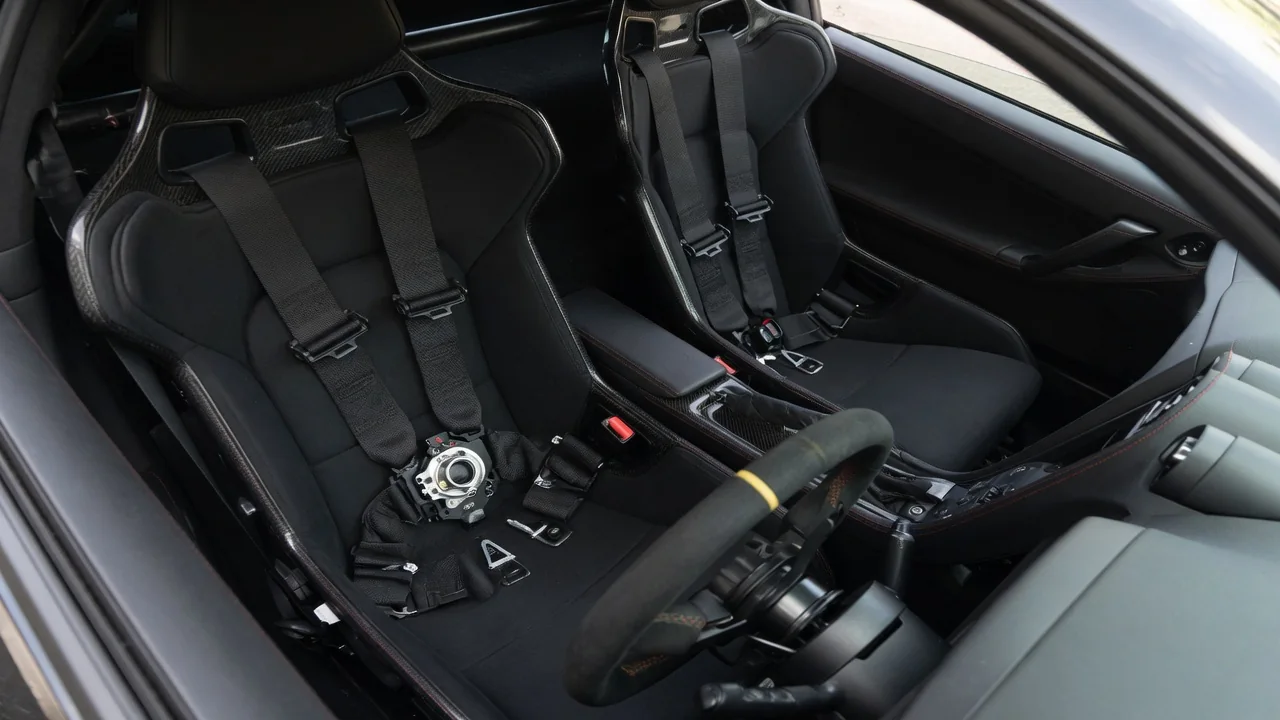
A racing harness is a multi-strap restraint system that holds a driver firmly in a fixed seat during the loads of competition driving. A standard three-point seat belt lets the occupant move freely until it locks. A harness is cinched tight before the car moves and keeps the body planted against the seat. To understand what a racing harness is, you need to look at its separate belts, how it works with the seat, and where it actually belongs.
Multiple Belts and How They Share the Load
The defining feature of motorsport harness design is that restraint is divided among several straps instead of one continuous belt. A typical layout includes two lap belts that cross the pelvis, two shoulder belts that run over the collarbones and chest, and one or more straps that pass between the legs. Harnesses are commonly described by the number of anchor points, and four-point, five-point and six-point designs are the most familiar. Each added point controls a specific way the body can move in a crash. It is not simply extra strength.
The lap belts do the most important work. They are meant to sit low across the bony pelvis, not the soft abdomen, because the pelvis can tolerate high loads while internal organs cannot. The shoulder belts control the upper torso and keep it from pitching forward. The straps between the legs are often called anti-submarine or crotch straps. They keep the lap belts from riding up and stop the occupant from sliding forward under the lap belt, a dangerous movement known as submarining. A five-point harness uses a single center strap for this job. A six-point layout uses two straps that run under the thighs and can position the pelvis more consistently.
All of these belts usually meet at a central buckle. There are two common styles. A cam-lock uses a rotating mechanism that releases every belt at once. A latch-and-link has tabs that drop into a hinged latch. Both designs aim at the same goal: a quick, single-motion release so the driver can get out of the car rapidly after an incident. Webbing width, adjusters and hardware vary by product. Certified harnesses carry labels identifying the standard they were built to meet.
Seat Integration: Harness and Seat as One System
A racing harness is only as effective as the seat it is used with. The harness pins the body against the seat, so the seat itself becomes part of the restraint path. Competition seats are generally fixed-back buckets with side bolsters that support the hips, ribs and sometimes the head and shoulders. They have dedicated slots where the shoulder belts pass through the backrest and where the anti-submarine straps exit the seat base. These openings put each strap in the right position relative to the occupant's body.
Seat integration is also a matter of geometry. The shoulder belts should leave the seat near shoulder height and run back to their anchor at a fairly shallow angle. If they drop steeply toward a low mounting point, a frontal impact can push the shoulders downward and load the spine. The lap belts need to reach the pelvis at an angle that keeps them low and snug. These angles depend on the specific car, seat height, mounting hardware and driver size. The installation instructions from the harness and seat manufacturers, plus any applicable sanctioning-body rules, govern the details.
This is why a reclining street seat is a poor partner for a harness. Its backrest is designed to move, it usually lacks proper belt routing, and it may not be built to resist the loads that a harness concentrates through it. A harness and a fixed competition seat, mounted to solid structure, are meant to be treated as a matched set.
Proper Context: Where a Racing Harness Belongs
Racing harnesses come from environments where several other safety measures are in place at the same time. In a typical competition car, a roll cage or roll bar provides anchor points and protects the occupant space. The driver also has a fixed seat, a helmet and very often a head and neck restraint. That last item matters. When the harness holds the torso firmly, the head can still swing forward in a sudden stop, and a head and neck restraint is designed to limit that motion. The harness was developed with this full system in mind.
A road car is built around a different system. Factory three-point belts work with airbags, pretensioners, load limiters and seat structures that were engineered and tested together for street use. Adding a harness to an ordinary passenger car can change how these parts interact and create new problems. Without a suitable bar or cage, the shoulder belts may end up anchored low on the floor behind the seat. In a rollover, a harness that holds the occupant upright offers no protection if the roof crushes. Rear passengers may also be affected if anchors or bars are added in their space.
So a full answer to what a racing harness is includes where it fits. It is a competition restraint intended for vehicles equipped to support it, not a simple upgrade over a standard seat belt. Some vehicles come from the factory with harness provisions. Whether a particular car suits one depends on that vehicle's design, its owner's manual and any rules that apply to its use.
Practical Implications and Limits
In daily use, a correctly fitted harness changes how driving feels. Because the belts are tightened before driving, the driver cannot easily lean forward to reach controls, storage compartments or door handles, and checking blind spots can be harder. Getting in and out takes longer, and the belts must be readjusted whenever a different person drives. Loose belts lose much of their benefit, so proper use includes the habit of tightening the lap belts first and the shoulder belts second.
Harnesses also have a limited service life. Webbing can degrade from sunlight, moisture, chemicals and abrasion, and any harness involved in a significant impact is generally expected to be replaced, not reused. Many racing organizations accept only certified harnesses and enforce the expiration periods printed on their labels, so a harness that is legal for one event may not be accepted later. Finally, a harness cannot make up for a poor installation or a missing part of the safety system. Its protection depends on correct anchors, a compatible seat, accurate fit and the other equipment it was designed to work with.