What Is a Pushrod Valvetrain? Cam Location, Lifters, Rods and Packaging
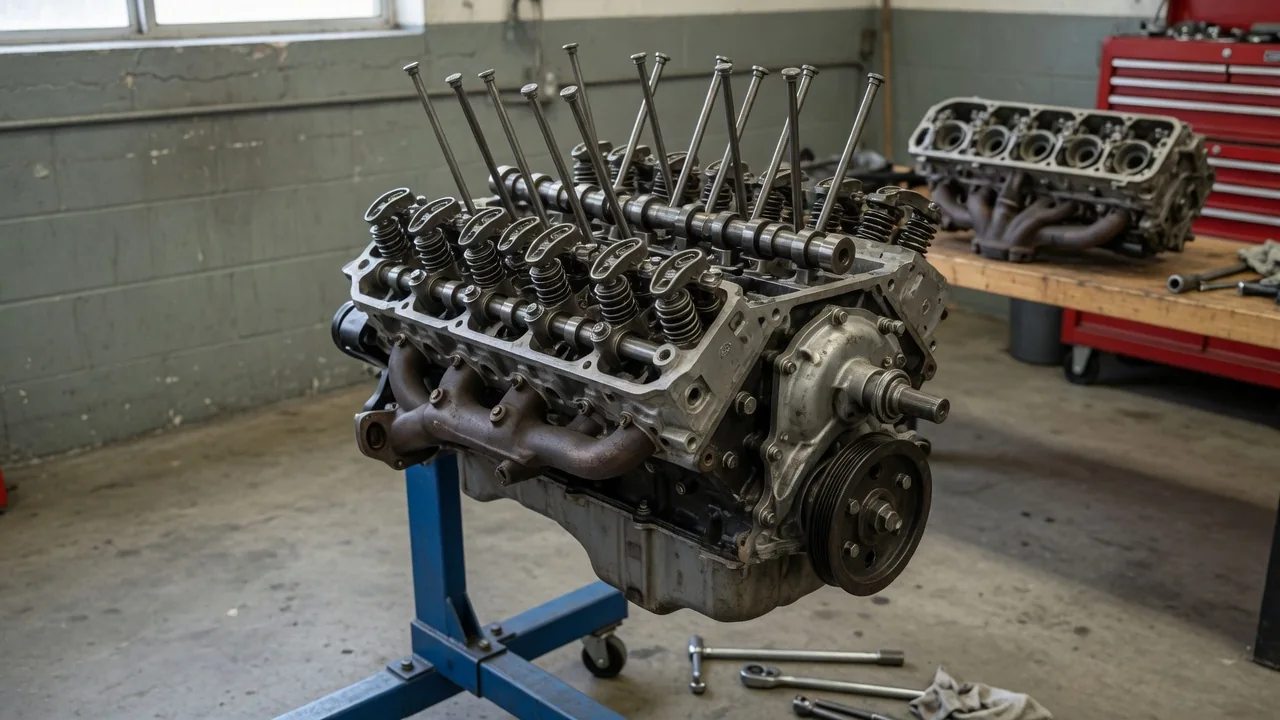
A pushrod valvetrain is a way of opening and closing an engine's valves in which the camshaft sits in the engine block rather than in the cylinder head. Because the cam is far from the valves, its motion has to be carried upward by a chain of parts: lifters, pushrods and rocker arms. Understanding this pushrod engine valve operation explains why the layout is often called overhead valve, or OHV, and why it behaves differently from overhead cam designs.
Cam Location: A Camshaft in the Block
In a pushrod engine, the camshaft is mounted in the engine block rather than in the cylinder head, which is why the layout is also described as cam-in-block. It usually sits just above the crankshaft. In a V-type engine, the cam typically runs lengthwise through the valley between the two cylinder banks, allowing a single camshaft to operate the valves for both banks. In an inline engine, it runs along one side of the block. The valves themselves are still located in the cylinder head above the combustion chamber, so the design is called overhead valve. That distinguishes it from older flathead engines, where the valves sat in the block beside the cylinders.
Because the camshaft is close to the crankshaft, the drive between them can be short. Depending on the design, it may be a short timing chain, a set of meshing gears or, less commonly, a belt. In a four-stroke engine the camshaft turns at half crankshaft speed, since each valve opens once for every two crankshaft revolutions. Each cam lobe has a profile that sets when its valve opens, how far it lifts and how long it stays open. Because one camshaft carries both the intake and exhaust lobes, the relationship between intake and exhaust events is fixed when the cam is ground.
Lifters and Rods: Carrying Motion to the Valves
The lifter, also called a tappet, is the first link in the chain. It rides directly on a cam lobe and sits in a bore machined into the block. Simpler designs use flat tappet lifters, whose base slides across the lobe; these usually rely on a slight taper on the lobe and an offset between lobe and lifter so the lifter rotates and wears evenly. Roller lifters instead use a small wheel that rolls along the lobe, reducing friction and allowing more aggressive lobe shapes. Lifters may be hydraulic, using engine oil pressure to take up clearance automatically, or solid, which requires a set clearance, called lash, to be checked and adjusted.
The pushrod is a slender metal rod that sits in a cup at the top of the lifter and extends up through the block and cylinder head. Its job is to carry the lifter's upward motion to the rocker arm. Many pushrods are hollow tubes, and in many engines they also route oil from the lifter up to the rocker arms. Pushrods need to be stiff enough to resist bending under load while remaining light, because every bit of mass in the chain must be accelerated and stopped on every valve event.
The rocker arm pivots on a stud, shaft or pedestal mounted on the cylinder head. When the pushrod pushes up on one end, the other end pushes down on the valve stem, opening the valve against its spring. The distance from the pivot to each end sets the rocker ratio, which multiplies the lobe's lift so the valve opens farther than the lifter travels. The valve spring then closes the valve and keeps the lifter, pushrod and rocker pressed together so they continue following the lobe.
Packaging: Why the Layout Is Compact
The main packaging advantage of a pushrod valvetrain is that the cylinder heads do not have to house camshafts, cam bearings or cam drive sprockets. That makes each head shorter and narrower than an equivalent overhead cam head. In a V engine the difference is significant: a pushrod V layout needs one camshaft in the valley, while a dual overhead cam V layout needs four camshafts spread across two heads. The result is an engine that is typically lower and narrower for its displacement, which can help it fit in a tight engine bay or under a low hood line.
The drive system is also simpler. With one camshaft close to the crankshaft, there is no need for a long chain or belt running up to the heads, and fewer sprockets, guides and tensioners are involved. More of the valvetrain's mass sits low in the block. Packaging does create constraints inside the head, however. The pushrods must pass through the head near the intake and exhaust ports, which limits how the ports can be shaped and sized. Operating more than two valves per cylinder through pushrods also complicates rocker geometry, so many pushrod engines use two valves per cylinder, although that is a design choice rather than a fixed rule.
Practical Implications and Limits
The number of parts between the cam lobe and the valve affects how the engine behaves at high speed. Lifters, pushrods and rockers add mass and some flex, and at high engine speeds the valve can fail to follow the cam profile, a condition known as valve float. Designers counter this with stiffer springs, lighter components and roller lifters, but each measure has its own costs. As a general tendency, pushrod layouts are more often tuned for strong low and midrange output than for very high engine speeds, though the actual limits depend entirely on the specific design.
For owners, the valvetrain's dependence on oil is the most practical concern. Hydraulic lifters need clean oil at the viscosity the manufacturer specifies to maintain correct clearance; a persistent ticking noise can point to an oil supply problem, a worn lifter or excessive clearance, and should be diagnosed rather than ignored. Flat tappet camshafts are particularly sensitive to break-in procedure and to anti-wear protection in the oil, and a replacement camshaft is generally paired with new lifters. Engines with solid lifters need periodic lash checks according to their service manual. In many V engines, reaching the lifters requires removing the intake manifold, which adds to repair time.
A single block-mounted camshaft also shapes what timing technology can do. A cam phaser can shift the camshaft relative to the crankshaft, but it moves intake and exhaust timing together rather than independently, which is less flexible than designs with separate intake and exhaust camshafts. Some pushrod engines use specialized lifters to disable the valves on selected cylinders, but such features vary by design. Whether a particular engine uses a pushrod valvetrain, which lifter type it has and what maintenance it needs should always be confirmed in that engine's own service documentation.