What Is a Powertrain Control Module? PCM Basics Explained
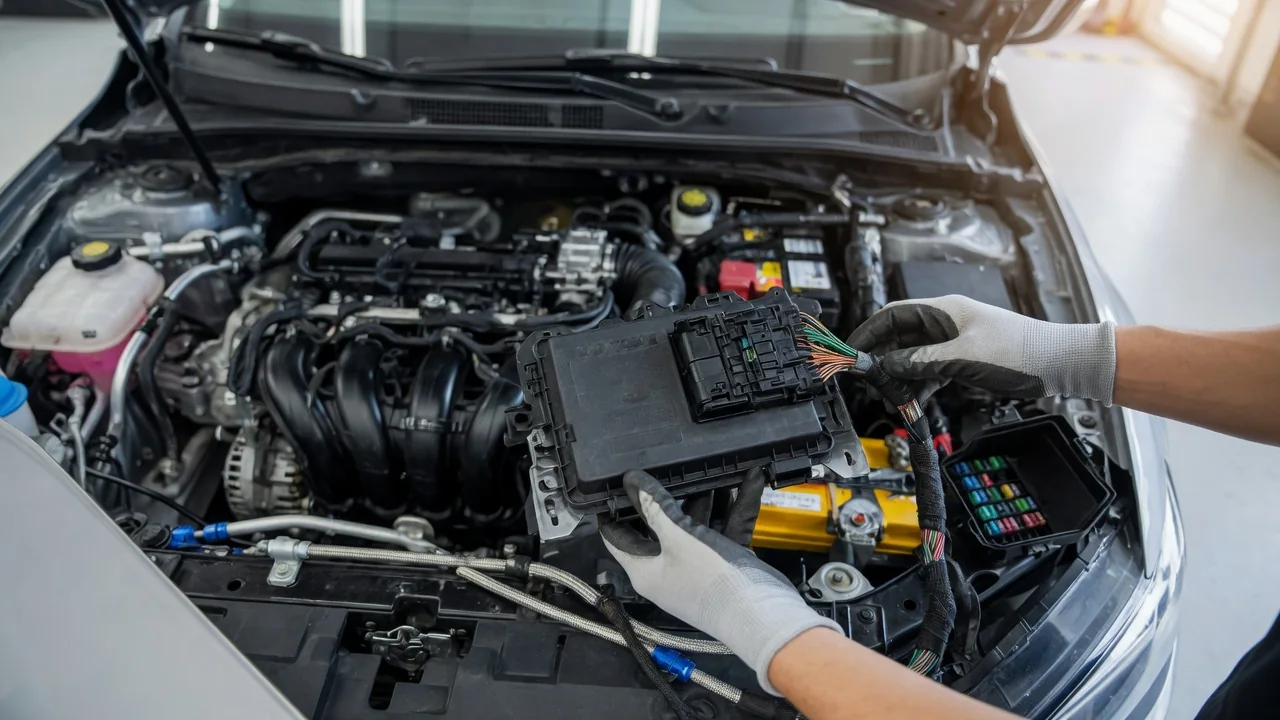
A powertrain control module, usually shortened to PCM, is the onboard computer that manages how a vehicle's engine and, in many designs, its automatic transmission operate. It reads signals from sensors, calculates what the engine and gearbox need at each moment, and commands actuators such as fuel injectors, ignition coils, and shift solenoids. Knowing the basics helps owners make sense of drivability symptoms, warning lights, and diagnostic codes without guessing.
Engine and transmission
On the engine side, the PCM controls the core variables of combustion. It decides how much fuel each injector delivers and for how long, when each spark plug fires relative to piston position, and how much air is admitted at idle or through an electronically controlled throttle. It also typically manages functions such as cooling fan operation, evaporative emission purging, exhaust gas recirculation where fitted, and variable valve timing on engines that use it. The goal is to balance power, fuel economy, smooth running, and emissions across a wide range of temperatures, loads, and altitudes.
When a vehicle has an electronically controlled automatic transmission, the PCM may also decide when to shift, how firmly to apply clutches, and when to lock the torque converter clutch. Combining engine and transmission control in one unit lets the computer coordinate the two directly, for example by briefly reducing engine torque during a gear change to make the shift smoother. That integration is what distinguishes a PCM from a narrower engine control module.
Naming and packaging vary by manufacturer. Some vehicles use a single PCM, while others split the work between an engine control module (ECM) and a separate transmission control module (TCM) that exchange data over a vehicle network such as CAN. The control logic is similar either way; the difference is where the software lives and how many physical units are involved. Manual-transmission vehicles still have engine management, but the driver selects the gears, so the transmission role of the module is limited or absent. The owner's or service manual for a specific vehicle is the reliable way to confirm which arrangement it uses.
Sensor inputs
A PCM cannot see the engine directly; it relies on sensors that convert physical conditions into electrical signals. Common inputs include the crankshaft and camshaft position sensors, which tell the module engine speed and where each cylinder is in its cycle. Airflow is measured by a mass airflow sensor, estimated from a manifold absolute pressure sensor, or both. A throttle position sensor and, on drive-by-wire systems, an accelerator pedal position sensor report what the driver is requesting. Coolant temperature and intake air temperature sensors help the module adjust fuel and timing for cold starts and changing conditions.
Exhaust oxygen or air-fuel ratio sensors give feedback on combustion. Once the engine is warm, the PCM uses their readings in what is called closed-loop operation, trimming fuel delivery up or down to stay near the target mixture. Knock sensors detect vibration patterns associated with abnormal combustion so the module can retard ignition timing. For transmission control, inputs typically include vehicle or output shaft speed, input or turbine speed, transmission fluid temperature, and gear selector position.
The module also receives information it did not measure itself. Brake switch status, air conditioning requests, and data from other modules arrive over dedicated circuits or the vehicle network. The PCM checks many inputs for plausibility by comparing them against each other and against expected ranges. A reading that is electrically out of range, or that disagrees with related signals, is treated as suspect, and that is the starting point for fault detection.
Fault codes
When the PCM detects a problem that meets its programmed criteria, it stores a diagnostic trouble code, often called a DTC. On vehicles that follow the OBD-II standard, powertrain codes begin with the letter P followed by four characters. Codes in the generic range share standardized definitions across manufacturers, while manufacturer-specific codes require that maker's documentation to interpret precisely. Depending on the fault and its effect on emissions or safety, the module may illuminate the malfunction indicator lamp, commonly known as the check engine light.
Many faults are not flagged on the first occurrence. The PCM runs self-tests called monitors, covering areas such as misfire, the catalytic converter, oxygen sensors, and the evaporative system, and some run only under specific driving conditions. A problem may first be recorded as a pending code and become a confirmed code only if it repeats. Many systems also save freeze frame data, a snapshot of conditions such as engine speed, load, and coolant temperature at the moment the fault was set, which helps a technician reproduce it.
A code identifies the circuit or condition the module flagged, not necessarily the failed part. A lean mixture code, for instance, can result from a vacuum leak, a weak fuel supply, or a faulty sensor reporting the wrong value. Codes can be read through the standardized diagnostic connector with a scan tool, and clearing them without fixing the cause usually means they return once the relevant monitor runs again.
Practical implications and limits
For an owner, the PCM explains why one failed sensor can change how the whole vehicle behaves. If a critical input is lost or implausible, the module may substitute a default value or enter a reduced-power mode, sometimes called limp mode, to protect the engine or transmission. Shift quality, idle, fuel economy, and throttle response can all change as a result, even when the mechanical components are sound. Symptoms that seem unrelated may share a single electrical cause, such as a damaged connector, a corroded ground, or low system voltage.
The module itself is generally not the first suspect in a diagnosis; wiring, sensors, and power supply problems are more frequent causes of codes. When a PCM does need replacement, it often must be programmed or configured for the specific vehicle, and on many vehicles it is linked to the immobilizer or anti-theft system, so a used unit from another car may not work without setup. Manufacturer software updates can also change how the module handles shifting, idle behavior, or diagnostics.
General explanations have limits. Exact sensor lists, code definitions, monitor conditions, and replacement procedures differ by manufacturer, model, engine, and year. A generic scan tool shows standardized data, but deeper information may require manufacturer-level software. For any repair decision, the service information for the specific vehicle and a careful test of the circuit involved matter more than the code number alone.