What Is an Engine Cooling Fan Module? Speed, Sensors and Troubleshooting
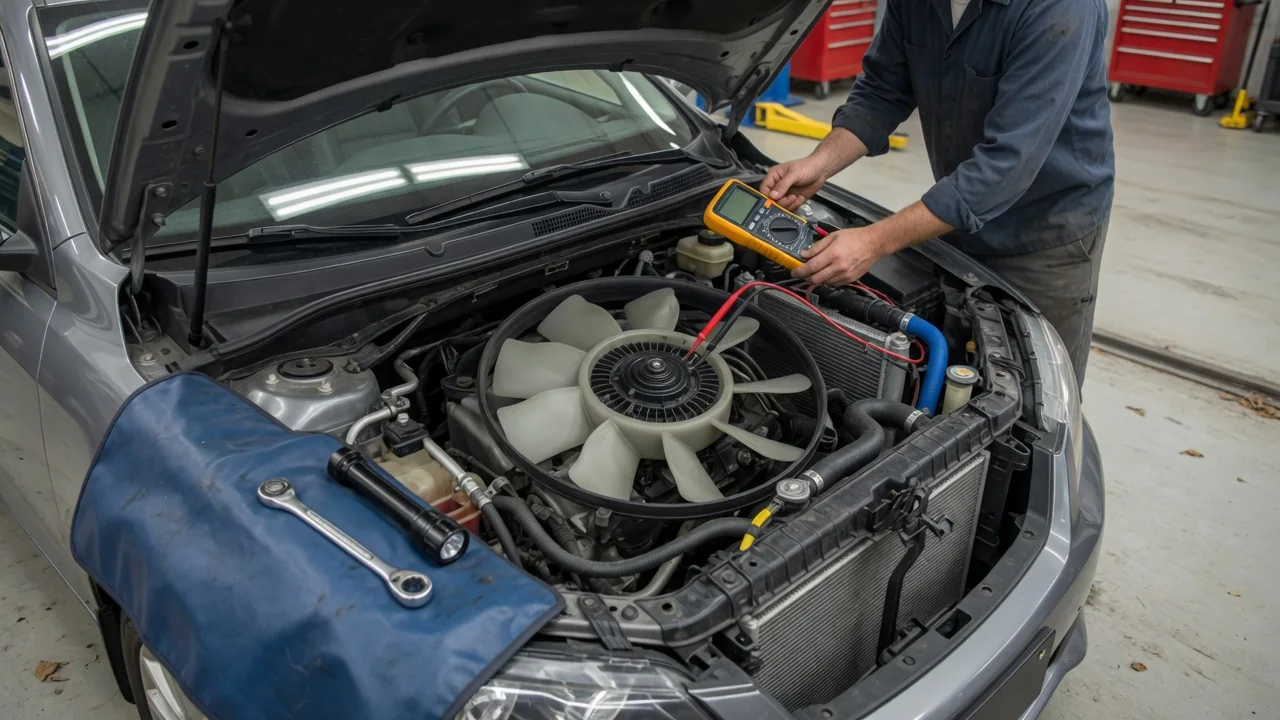
An engine cooling fan module is the electric fan assembly mounted next to the radiator that moves air through the radiator and A/C condenser when vehicle motion alone cannot. Depending on design, it combines one or two fan motors, the blades, a shroud that directs airflow, and often the electronics that set fan speed. On many vehicles, the term cooling fan control module refers specifically to that controller, which may be built into the assembly or mounted separately.
Fan speed: how the module controls airflow
Simpler systems control the fan with relays. A single-speed setup switches the motor fully on or fully off. Two-speed setups typically get a lower speed either by routing current through a resistor, which reduces the voltage reaching the motor, or by switching two fans between series and parallel connection. In these designs the fan has only a few fixed operating points, and the jump between them is often audible.
Many newer vehicles use a variable-speed electronic controller instead. The engine control module, or another vehicle controller, sends the fan control module a command signal, commonly a pulse-width modulated (PWM) duty cycle. The fan module interprets that command and adjusts power to the motor across a wide range of speeds rather than a few fixed steps. Some assemblies use brushless motors whose drive electronics are integrated into the motor housing, which is why the controller and fan are frequently treated as a single unit.
Variable speed control exists for practical reasons. A fan running only as fast as conditions require is quieter, draws less current from the charging system, and places less load on the engine through the alternator. Full speed is typically reserved for situations with high heat load, such as slow driving in hot weather or heavy A/C use, while lighter demand gets a gentler, more gradual response.
Sensor inputs that decide when the fan runs
In most modern systems, the fan module carries out commands rather than making the decision itself. The deciding controller relies mainly on the engine coolant temperature sensor: as coolant temperature rises past calibrated points, fan speed is increased. The second major input is the A/C system. When the A/C is on, the controller usually monitors refrigerant pressure on the high side, because pressure climbs quickly if the condenser is not getting enough airflow, and the fan is commanded to keep that pressure in check.
Other inputs vary by manufacturer and design. Vehicle speed is common, since ram air at higher speeds reduces the need for fan assistance. Some systems also consider intake air temperature, ambient temperature, transmission fluid temperature or engine oil temperature. Older or simpler vehicles may instead use a thermostatic switch threaded into the radiator or engine that closes a circuit directly at a set temperature, with no electronic controller involved.
Control logic also includes protective behavior. On many vehicles, if the coolant temperature signal is lost or reads implausibly, the controller defaults to running the fan continuously or at high speed to protect the engine. Some vehicles also allow the fan to keep running for a period after the engine is shut off to remove residual heat, so a fan operating with the ignition off is not automatically a fault.
Troubleshooting a cooling fan module
Typical symptoms of a cooling fan problem include rising temperature at idle or in stop-and-go traffic that drops once the vehicle is moving, weak A/C cooling at idle, a fan that never turns on, a fan that runs all the time, or grinding, buzzing or wobbling noises from behind the grille. A blown fan fuse, a stored diagnostic trouble code or a warning message can accompany these symptoms, though not every failure sets a code.
Start with the basics. Before working near the fan, keep in mind that many electric fans can start without warning even with the engine off, so disconnect the fan connector or follow the service procedure for disabling it, and let the engine cool before touching the cooling system. Check the relevant fuses and relays, inspect connectors for corrosion, heat damage or loose pins, and confirm the ground connection is clean. With power removed, turning the blades by hand can reveal a stiff or rough motor bearing, and a visual check can find cracked blades or a damaged shroud.
A scan tool narrows the diagnosis further. Read stored codes, compare the reported coolant temperature with the actual engine condition, and review A/C pressure data if available. Many scan tools can command the fan on through a bidirectional test. If the fan does not respond, check for battery power, ground and the command signal at the module connector using the procedures and values in the vehicle's service information. When power, ground and command are all present but the fan does not run correctly, the module or motor is the likely cause. A fan that runs constantly points instead toward a sensor fault triggering a fail-safe, a stuck relay or high A/C pressure.
Practical implications and limits
Fan health matters most when airflow from driving is limited: idling, heavy traffic, towing, steep low-speed climbs and hot weather with the A/C running. A failed fan can go unnoticed during highway commuting and only reveal itself in a traffic jam, which is why watching the temperature gauge in those conditions is useful. Continuing to drive while the engine overheats can cause serious and costly engine damage, so pulling over and shutting the engine off is the safer choice when the gauge climbs abnormally.
On vehicles with integrated electronics, the controller often cannot be serviced separately and is replaced as part of the fan assembly. Replacement parts must match the vehicle's connector, mounting and control strategy, since a module designed for relay control will not respond correctly to a PWM command and vice versa. Applying battery voltage directly to a module's terminals to test it is not a reliable shortcut and can damage the electronics; the manufacturer's test procedure is the appropriate guide.
This article describes general mechanisms. Activation temperatures, speed steps, wiring layouts, run-on behavior and diagnostic procedures differ between manufacturers, models, engines and option packages, and some vehicles use an engine-driven clutch fan instead of, or in addition to, an electric fan. For any specific repair, the vehicle's service information is the authoritative reference.