What Is a Manual Locking Hub?
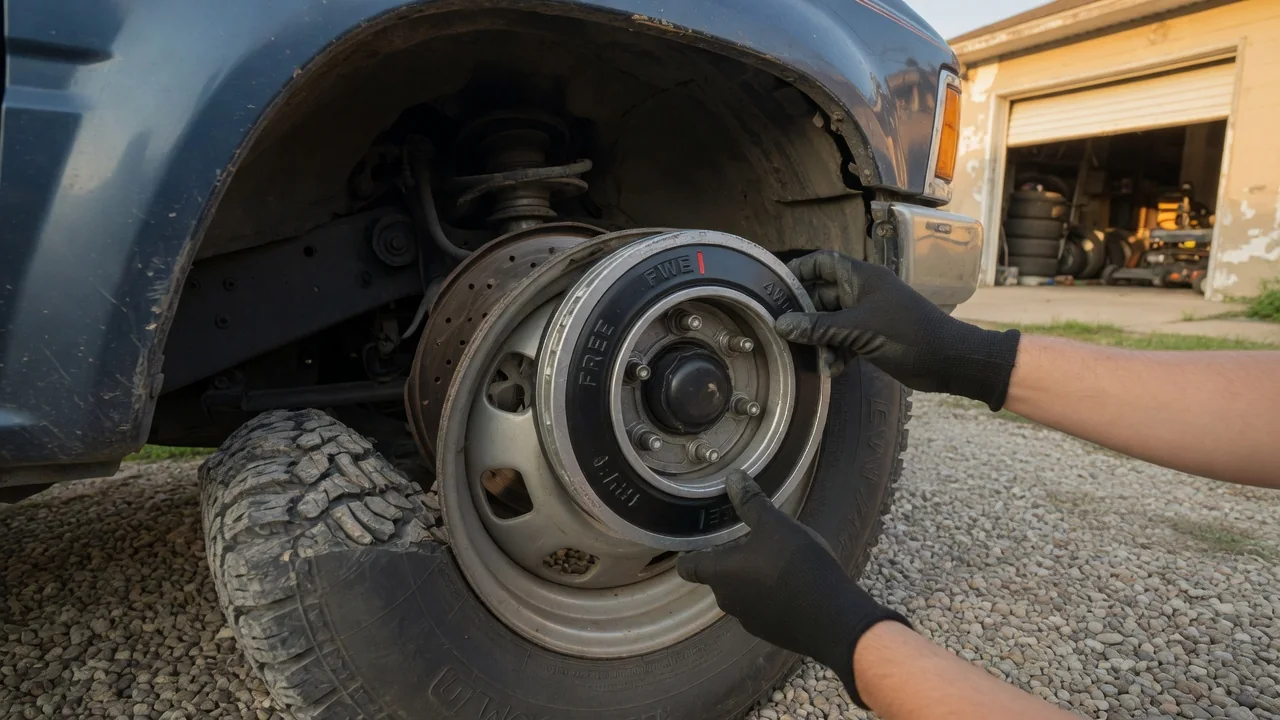
If you have ever asked what is a manual locking hub, the short answer is that it is a hand-operated coupling at the center of a front wheel on some part-time four-wheel-drive trucks and SUVs. Turning its dial connects or disconnects the wheel from the axle shaft, deciding whether the front driveline can deliver power or simply rest while you drive.
Hub function
A manual locking hub sits on the outer end of the front axle, where the wheel hub rotates on its bearings around the spindle. Inside the hub body, a splined clutch ring slides toward or away from the axle shaft. In the locked position, that ring ties the shaft to the wheel hub so the two must turn together. In the free position, the ring withdraws, and the wheel spins on its bearings without turning the shaft behind it.
That disconnect matters because a part-time system has no need for front axle shafts, the differential, and the front driveshaft to rotate during two-wheel-drive travel. Leaving those parts at rest reduces drag, noise, and wear on joints and seals. Designs vary, though: some vehicles use automatic hubs, some use an axle disconnect inside the housing, and others keep the wheels permanently coupled, so the presence of a dial on the wheel center is the clearest sign of a manual setup.
Driver operation
Operating the hubs means stopping the vehicle, stepping out, and turning the dial on each front wheel by hand. Most dials are marked with wording such as lock and free, and both sides should always be set the same way. With the hubs locked, the front wheels are joined to their axle shafts, but the vehicle still drives only the rear wheels until the transfer case is shifted into four-wheel drive from inside the cab.
This two-step arrangement gives the driver flexibility. Many owners lock the hubs before reaching a trail, snow-covered road, or muddy field, then shift the transfer case only when traction actually drops. Shifting the transfer case while the hubs remain free produces no front-wheel pull, a common source of confusion for new owners. The exact dial markings, turning effort, and recommended engagement procedure differ among manufacturers and aftermarket hub makers, so the owner's manual remains the right reference.
Maintenance
Because the hub mechanism lives at the wheel, it faces water, mud, road salt, and brake dust. Seals and gaskets keep contaminants away from the clutch ring, spring, and splines, while a light coating of suitable grease lets the parts slide freely. Too much heavy grease can make the mechanism sluggish, particularly in cold weather, and too little invites corrosion. Lubricant type and inspection timing depend on the hub design, so the service information for the specific vehicle should guide the work.
A hub that sits in the free position for months can stiffen, which is why many owners periodically lock the hubs and drive a short distance to circulate lubricant through the front axle. Service often coincides with front wheel bearing work, since the hub must come off to reach the bearings on many designs. A dial that feels gritty, refuses to turn fully, or shows a cracked cap or missing fastener deserves attention before the next trip that depends on four-wheel drive.
Everyday Use and Observations
On dry pavement, most drivers leave the hubs free and the transfer case in two-wheel drive. The vehicle then behaves like a rear-drive truck, with slightly lighter steering feel and less driveline hum from the front. During winter, some owners keep the hubs locked for weeks so that four-wheel drive is available with a lever pull or switch. Driving with locked hubs in two-wheel drive is generally acceptable, though it spins the front components and may nudge fuel consumption upward.
Observation tells a lot about hub condition. With hubs locked and the transfer case in two-wheel drive, the front driveshaft turns as the vehicle rolls; with hubs free, it should stay still or nearly so. If one hub fails to engage, an open front differential sends effort to the side with no resistance, and the front axle contributes little traction. Clicking, grinding, or a dial that slips back from its setting suggests worn internal parts, although axle joints and bearings can produce similar sounds.
Limits and Next Steps
Locking hubs only connect wheels to axle shafts; they do not create traction by themselves, and they are not the same as a locking differential. A part-time system with hubs locked and four-wheel drive engaged still binds on dry, high-grip surfaces because the front and rear axles are forced to turn at the same rate. That binding strains the driveline and makes tight turns feel jerky, so engagement belongs on loose, slippery, or uneven ground.
Anyone unsure whether their vehicle has manual hubs can look at the center of each front wheel for a rotating dial, then confirm the details in the owner's manual. Vehicles converted from automatic to manual hubs may carry aftermarket parts with their own instructions. When a hub will not lock, will not release, or makes noise, a professional inspection of the hub, bearings, and axle joints is the sensible path, since several components in that area share similar symptoms.