What Is a Knock Sensor?
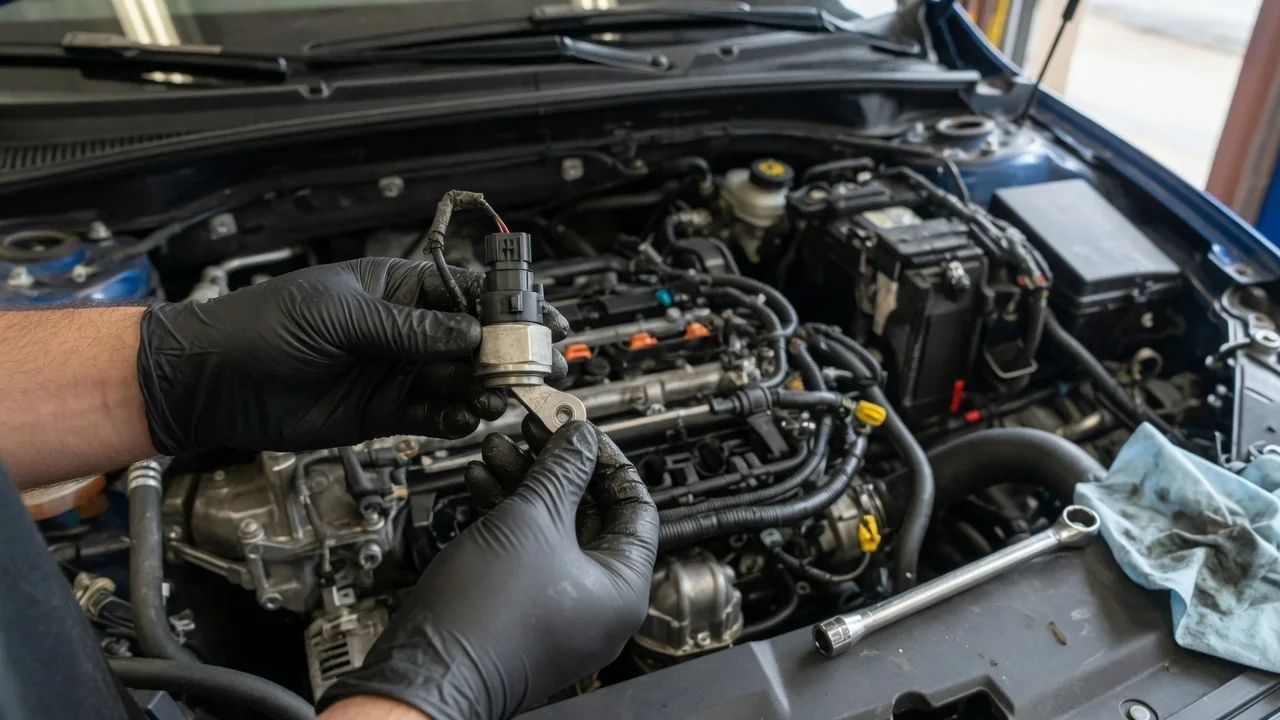
If you have ever wondered what is a knock sensor, the short answer is that it is a small listening device bolted to the engine. It picks up the vibration produced by abnormal combustion and reports it to the engine computer, which then adjusts ignition timing to protect pistons and bearings. Knowing how it works makes warning lights, noises and changes in performance easier to interpret.
Combustion knock
In a healthy combustion event, the spark plug ignites the air-fuel mixture and a flame front spreads smoothly across the cylinder. Knock occurs when the unburned mixture ahead of that flame ignites on its own because of rising heat and pressure. The resulting pressure waves collide with the cylinder walls and piston crown, producing a sharp metallic pinging or rattling. Repeated heavy knock can overheat and erode internal parts, which is why engines are designed to detect it early.
The knock sensor is usually a piezoelectric element fastened to the engine block or cylinder head, where it generates a small voltage when the metal around it vibrates. It is most sensitive to the frequency range that knock tends to produce in that engine. Drivers sometimes hear pinging when climbing a grade or accelerating in a high gear, but on many modern vehicles the correction happens before anything is audible. The number of sensors and their mounting points differ between engine designs.
Control response
The engine control module does not simply react to any vibration. It filters the sensor signal and compares it with the background noise expected at the current engine speed and load. When the signal rises above that threshold, the module retards ignition timing, firing the spark slightly later so peak cylinder pressure drops. Once the knock subsides, timing is advanced again in small steps, which lets the engine run close to its most efficient setting without crossing into damaging territory.
Many systems use crankshaft position data to work out which cylinder was firing when the vibration appeared, then adjust that cylinder alone. Turbocharged engines may also reduce boost pressure or alter fueling as part of the same protective strategy, and some store learned corrections for later use. From the driver's seat, this can feel like slightly softer acceleration after filling up with lower-octane gasoline. The exact strategy and how aggressively it intervenes depend on the manufacturer's calibration.
Fault signs
The most common sign of trouble is a check engine light with a stored code pointing to the knock sensor circuit. That code shows the computer saw a signal outside its expected range, not that the sensor itself has failed. Damaged wiring, a corroded connector, a sensor that is not seated correctly, or real mechanical noise in the engine can all produce similar results. Some codes are manufacturer-specific, so their meaning should be confirmed against information for the exact vehicle.
When the computer cannot trust the signal, it often falls back on conservative ignition timing to stay safe. Drivers may notice sluggish throttle response, reduced power under load or a drop in fuel economy. If the system cannot detect knock at all, audible pinging may appear during hard acceleration or hot weather. Other vehicles show no obvious change in drivability beyond the warning light, which is why a symptom-free drive does not rule out a circuit problem.
Everyday Use and Observations
In daily driving the sensor works quietly in the background, allowing the engine to cope with conditions that encourage knock. High ambient temperatures, towing, steep grades, carbon buildup in the combustion chambers and fuel with a lower octane rating than recommended all raise the likelihood. Without vibration detection, engineers would need to set timing cautiously for the worst case at all times. With it, the engine can use more spark advance when conditions allow and pull back only when needed.
Paying attention to when a noise occurs is useful. Pinging that appears only under load, and fades when you ease off the accelerator, fits the pattern of combustion knock. A rattle at idle or over bumps is more likely a loose heat shield, bracket or valvetrain noise, although such vibrations can sometimes be misread by the sensor as knock. On some vehicles a scan tool displays the amount of timing being removed, though available data varies by make.
Limits and Next Steps
A knock sensor is reactive, so it responds only after abnormal combustion has begun, and the computer has a limited range of timing it can remove. It manages symptoms rather than curing causes. Persistent knock usually points to something upstream, such as unsuitable fuel, a cooling system problem, a lean mixture or heavy deposits. If the engine pings despite the system working, or timing is constantly being pulled, the underlying condition deserves attention rather than the sensor alone.
A sensible first step is to check the owner's manual for the recommended fuel grade and note the conditions under which any noise or power loss appears. Having stored codes read gives a starting point, and a qualified technician can then test the wiring, connector and signal against the service information for that engine. On some designs the sensor sits beneath the intake manifold, making access involved. Replacing parts on the strength of a code alone risks missing the real fault.