What Is a Factory Paint Booth Inspection?
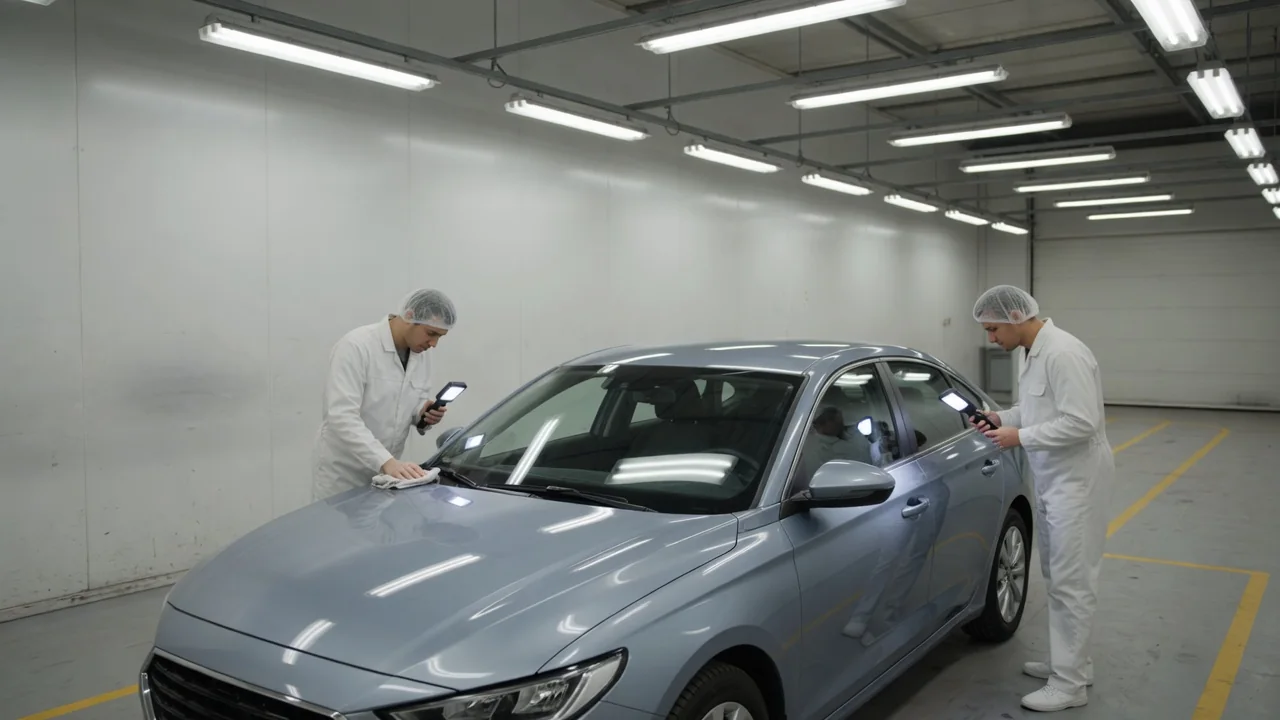
A factory paint booth inspection is the quality check a newly painted car body gets after its coating layers are applied and cured, before it moves on to final assembly. Inspectors examine the finish under controlled light, and at many plants camera-based systems do too. They look for surface flaws, decide which ones are acceptable, and send the rest to repair. The term can also refer to audits of the booth equipment itself. For most owners, though, it means the automotive paint booth quality check performed on the body.
Surface defects
Most defects found at inspection fall into a few broad families. Contamination defects come from something landing on or in the wet film. Dust or fiber specks are often called nibs or dirt inclusions. Craters, also called fisheyes, form when oil, silicone or another low-surface-tension contaminant pushes the paint away from a small spot. Application defects come from how the paint went on. Runs and sags appear where too much material collected on a vertical panel. Dry or rough spray happens when atomized droplets did not flow together. Thin areas are spots where the film did not build up enough to hide the layer underneath.
Curing and appearance defects make up another group. Solvent pop and pinholes appear when trapped solvent or air escapes after the film surface has already started to skin over, leaving tiny blisters or holes. Orange peel is a texture rather than a spot. The clear coat looks slightly dimpled, like citrus skin, because it did not level fully before curing. On metallic and pearl finishes, unevenly oriented flakes can produce mottling or cloudiness that shifts with viewing angle. Inspectors also look for color differences between panels, masking lines, overspray on areas that should not be coated, and handling marks such as scratches or fingerprints.
Not every visible flaw is a reject. Manufacturers set their own acceptance criteria, which typically weigh a defect's size and type against where it sits on the vehicle. A small speck on a lower door edge may be judged differently from the same speck in the center of the hood, where it catches the eye. These criteria are internal and vary between brands and plants, so no single public threshold applies to every car.
Lighting
Paint flaws are hard to see in ordinary light, so inspection areas are designed around their lighting. A typical inspection tunnel or deck surrounds the body with bright, diffuse fixtures. They are arranged so the inspector can see sharp reflections of light lines on every panel. Defects show up by disturbing those reflections. A nib creates a small bright point or shadow, a crater shows as a ring, and orange peel makes straight light lines look wavy. Consistent color temperature and freedom from glare help inspectors judge color and gloss the same way from one shift to the next.
Viewing angle matters as much as brightness. Inspectors usually walk along the body and view each surface from several directions. Some defects only appear at a grazing angle, and metallic mottling may only be visible when looking along a panel. Many plants supplement or partly replace visual checks with automated systems. These project light patterns onto the body, use cameras to detect distortions in the reflection, and map each defect's position. Inspectors sometimes run a gloved hand over the surface as well, since a raised inclusion can be felt before it is easy to see. Each method has blind spots, which is why plants often combine them.
Correction
Once a defect is found and marked, the next decision is whether it can be fixed on the spot or needs more work. Minor flaws in the clear coat include small nibs, light runs and isolated texture problems. These are commonly corrected in a dedicated repair area: the spot is sanded with fine abrasives and then polished back to gloss. The goal is to remove the defect while taking off as little clear coat as possible. That layer protects the color coat, and there is only so much of it to remove.
Some defects go deeper than the clear coat, cover a larger area, or cannot be polished out. Depending on the plant, the body may go to a repair booth for localized refinishing. It may instead be sent back through part or all of the paint line to be recoated. After repair, the area is inspected again under the same lighting to confirm it now meets the acceptance criteria. Bodies that pass continue to assembly, where trim, glass and other components are installed.
Correction also works backward along the process. Inspection data may show a pattern, such as repeated dirt in the same zone or recurring craters. Quality teams then investigate likely causes: booth airflow, filtration, humidity, cleanliness of the incoming body, or contaminated materials. Fixing the source reduces repairs on later vehicles. That is why defect tracking is treated as part of process control, not only a final gate.
Practical implications and limits
For an owner, the main takeaway is that a factory finish is judged against a standard, not against perfection. A new car can leave the plant with light orange peel or a tiny inclusion that met the manufacturer's criteria. A polished factory spot repair is normally a sign the system worked, not evidence of damage. The inspection also only covers the paint at that stage. Scratches, chips, transport film residue or environmental fallout can appear later during shipping, storage and dealer preparation, so a careful look at delivery is still worthwhile.
You can check your own vehicle using the same principle. Look at the panels in good, even light and from several angles, ideally outdoors on a bright overcast day or under a long, straight light source, and watch how the reflections behave. This can reveal obvious runs, dirt or mismatched panels. It cannot tell you film thickness, adhesion or long-term durability, which take instruments or time to assess. Whether a particular flaw is covered by warranty depends on the manufacturer's terms and on when and how it is reported, so take those questions to the selling dealer or the brand.