What Is a Car Factory Fit-and-Finish Check?
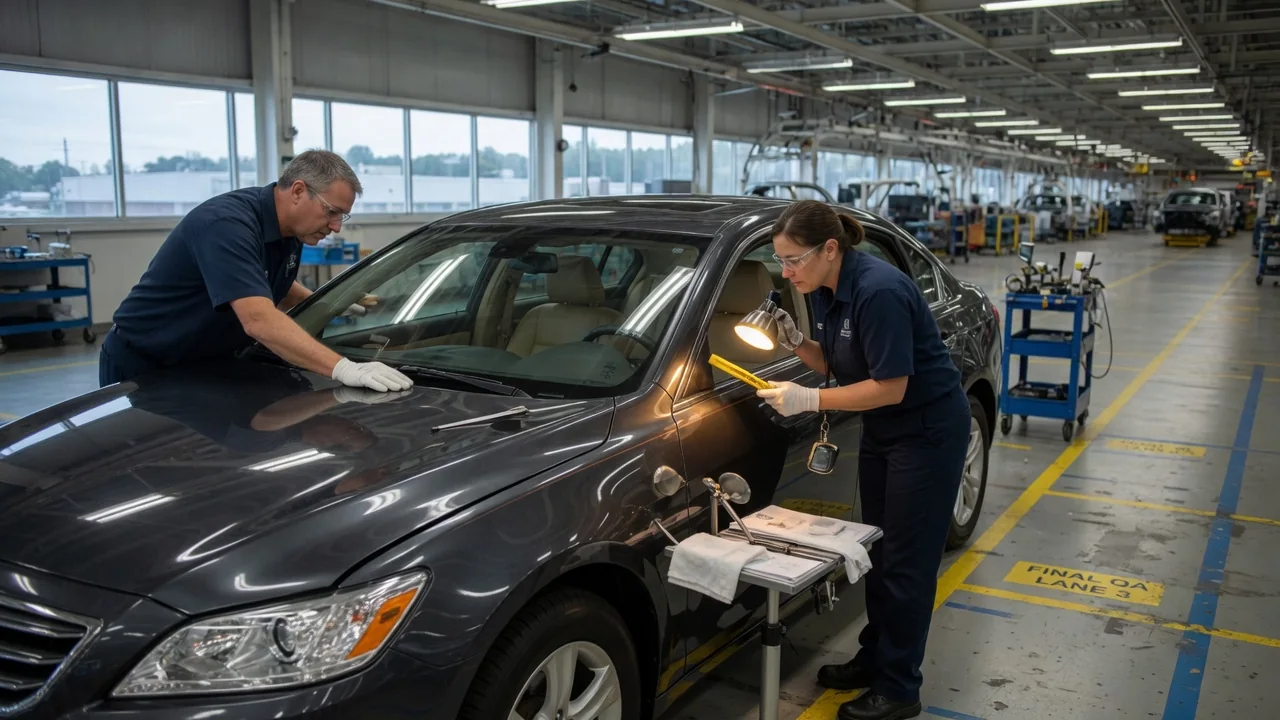
A car factory fit-and-finish check is the stage of quality control where inspectors confirm that a vehicle's visible body and interior parts sit where they should and look the way they were designed to look. It focuses on how panels, trim, seals and surfaces meet one another rather than on how the engine or electronics work. Understanding this vehicle fit and finish inspection helps owners interpret what they see on a new car and decide when an irregularity deserves attention.
Panel gaps
Panel gaps are the narrow spaces between adjoining body parts, such as the hood and fenders, the doors and the body sides, or the trunk lid and the rear quarter panels. Inspectors usually evaluate two related qualities. Gap refers to the width of the space between two panels, and it should be consistent along the entire seam. Flush, sometimes called flushness or step, describes whether two neighboring surfaces sit at the same height, so that one edge does not stand proud of the other. Each manufacturer defines its own target values and tolerances for every seam, and those figures differ between vehicles, so there is no single universal number that applies to all cars.
Checks can combine several methods. On many assembly lines, workers or automated stations use gauges, feeler tools or optical measuring systems to compare actual gaps against the specification at defined points. Visual inspection under controlled lighting remains common as well, because a trained eye can spot a seam that tapers from one end to the other or a reflection that breaks where two panels meet. Inspectors also look for symmetry: the gap on the left side of the hood should generally mirror the gap on the right. Uneven gaps can result from variation in stamped parts, in the welded body structure, or in how hinges, strikers and fasteners were adjusted during assembly.
Panel gaps matter for more than appearance. A door that sits too far in or out can press unevenly on its weatherstrip, which may contribute to wind noise or water entry. A hood or trunk lid that is misaligned may not latch smoothly. For this reason, a fit-and-finish check treats a gap problem as a possible sign of an underlying adjustment issue, not only as a cosmetic flaw.
Trim alignment
Trim alignment covers the many smaller components attached to the body and cabin after the main panels are installed. On the exterior this includes moldings, badges, grilles, lamp housings, mirror caps, window surrounds and bumper covers. Inside, it includes dashboard sections, door panels, center console pieces, pillar covers, headliner edges and seat trim. The goal is that each part sits straight, lines up with its neighbors and is fully secured by its clips, screws or adhesive.
Inspectors look at several characteristics. Design lines should continue smoothly across separate parts, for example where a character line on the door meets the fender or where a dashboard panel meets a door trim. Parallel edges should stay parallel. Clips should be fully engaged, because a partially seated clip can leave a corner lifted or allow a part to vibrate. Color and texture are also part of the evaluation: adjacent plastic, fabric or painted parts are expected to match closely under typical lighting. Plastic and painted trim can look slightly different from metal panels even when both are correct, which is why manufacturers often set acceptable appearance standards for each material.
Trim checks also involve touch and sound. An inspector may press on panels to feel for looseness, or listen for rattles and creaks during a short drive or on a test rig where a plant uses one. Loose trim is a frequent source of interior noises, so catching it at the factory can prevent complaints later.
Defect repair
When a fit-and-finish check finds a problem, the vehicle is typically marked and routed to a repair or rework area instead of continuing straight to shipping. The exact process varies by plant, but the general principle is that defects are recorded, corrected and then reinspected before the vehicle is released. Recording matters because repeated defects at the same location can point back to a specific station, tool or supplied part that needs correction upstream.
Many fit problems are corrected by adjustment rather than replacement. Doors, hoods, trunk lids and tailgates are usually mounted with hinges and strikers that allow some movement, so technicians can shift a panel to even out a gap or bring a surface flush. Bumper covers and some exterior trim can often be repositioned at their mounting points. Interior parts with loose clips can be reseated, and broken clips replaced. When a component itself is damaged or out of shape, such as a warped trim piece or a part with mismatched color, replacement is the more common remedy.
Surface finish defects follow a separate path. Minor paint imperfections such as small dust inclusions may be addressed by sanding and polishing the affected area, while larger flaws can require refinishing a panel. Because paint repairs are judged against the surrounding finish, a good repair should blend with the original color, gloss and texture. After any correction, the vehicle is checked again to confirm that fixing one area did not create a new gap, scratch or misalignment nearby.
Practical implications and limits
For an owner, the factory check explains why most new vehicles leave the plant with consistent seams and secure trim, but it does not guarantee perfection. Inspection is performed against defined tolerances, so small variations that fall within the manufacturer's limits are considered acceptable even if a careful observer can see them. Shipping, storage and dealer preparation can also introduce damage or loosen parts after the vehicle leaves the factory, so a car may arrive with an issue that did not exist when it was inspected.
When taking delivery, it is reasonable to walk around the car in good light, compare the left and right sides, open and close every door and lid, and run a hand along interior panels. If something looks clearly uneven or a part feels loose, document it and raise it with the seller before or shortly after accepting the vehicle, since many corrections are simple adjustments. Keep in mind that tolerances and appearance standards are specific to each manufacturer and model, so what counts as a defect is ultimately determined by that maker's criteria and warranty terms rather than by a general rule.