What Is a Cam Lobe? Lift Profile, Duration, and Wear Explained
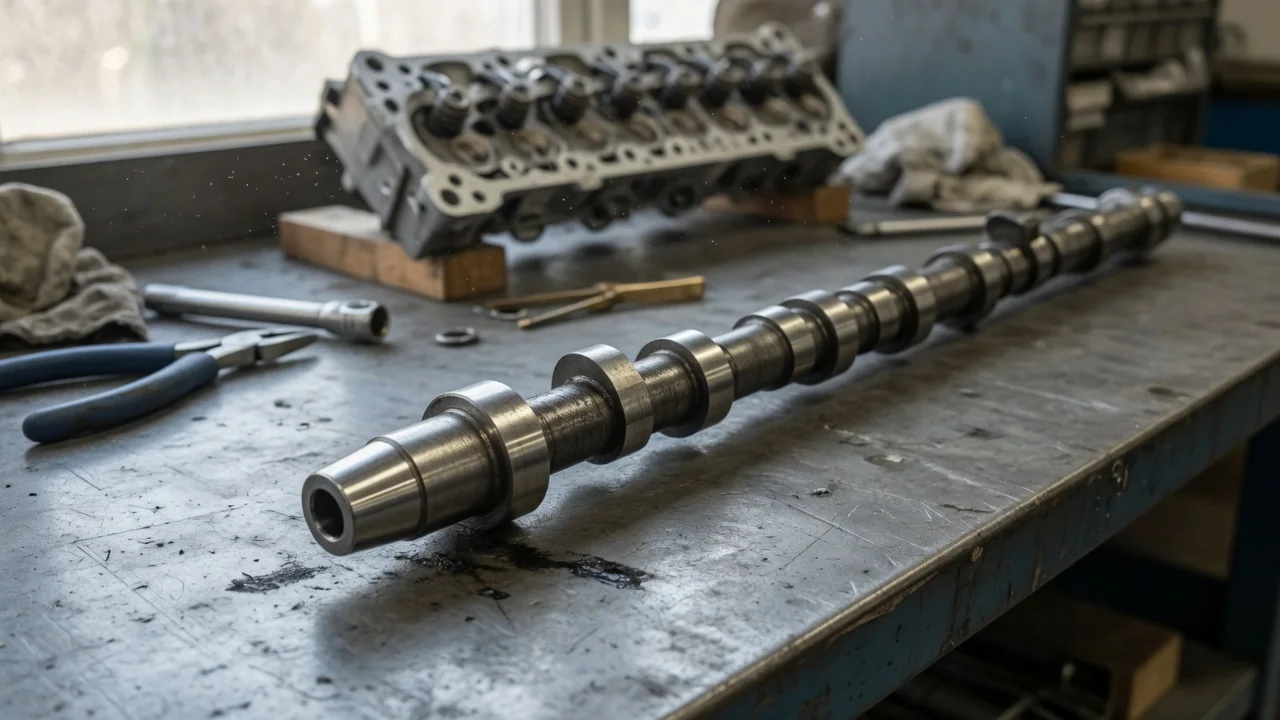
A cam lobe is the raised, egg-shaped section of a camshaft that turns the shaft's rotation into the up-and-down motion that opens and closes an engine valve. Each valve is driven by a lobe, though some designs use one lobe for a pair of valves. The lobe's shape decides how far the valve opens, how long it stays open, and how smoothly it moves. Knowing the camshaft lobe's shape and purpose makes valvetrain behavior and common wear problems easier to understand.
Lift profile: how lobe shape moves the valve
Every cam lobe can be divided into a few regions. The base circle is the round, concentric portion. While the follower rests on it, the valve stays closed. Next comes a gentle ramp that takes up valvetrain clearance or lifter preload, so the parts meet without a sharp impact. The opening flank then pushes the follower outward, and the nose marks the point of maximum lift. The closing flank and closing ramp lower the valve back onto its seat in a controlled way. When this full shape is plotted against rotation, the result is called the lift profile.
Lobe lift is the height of the nose minus the radius of the base circle. How much valve lift that produces depends on the valvetrain layout. In direct-acting overhead cam designs, the lobe presses on a bucket that sits over the valve, so valve lift is essentially lobe lift minus any running clearance. Pushrod engines and many rocker or finger-follower designs use a rocker ratio that multiplies the motion, so the valve opens farther than the lobe rises. A lift figure only makes sense once you know whether it describes the lobe or the valve.
The shape of the profile matters as much as peak lift. Steep flanks open the valve quickly and keep it near full lift for longer, which can help airflow. They also put more acceleration load on springs, lifters, and the lobe surface. The follower type limits what is practical, because flat tappets, roller lifters, and rocker followers each tolerate different flank shapes and contact stresses. Every lobe design is a compromise between airflow, noise, durability, and valve control at high engine speed.
Valve duration: how long the valve stays open
Duration is how long a valve stays off its seat, measured in degrees of crankshaft rotation. In a four-stroke engine, the camshaft turns once for every two crankshaft revolutions, so each lobe opens its valve once per combustion cycle. A wider lobe, with more of its circumference devoted to the opening and closing flanks, gives longer duration, and a narrower lobe gives shorter duration. Duration and lift are related but separate. Two lobes can reach the same maximum lift while holding the valve open for different spans of crank rotation.
The ramps begin lifting very gradually, which makes the exact moment of opening hard to pin down. Published duration figures therefore depend on where the measurement starts. Advertised or seat-to-seat duration uses a small lift threshold chosen by the manufacturer. In the United States, a common comparison figure is duration measured at 0.050 inch of lifter rise. The two methods give noticeably different numbers for the same lobe, so duration values can only be compared when they use the same checking height.
Duration also interacts with the lobe's position on the camshaft. The intake and exhaust lobes are indexed relative to each other. The angle between their centerlines is often called the lobe separation angle. Together with duration, it sets overlap, the period around top dead center when both valves are slightly open. Longer duration and more overlap tend to favor higher engine speeds at the cost of a smooth idle. Many modern engines use variable valve timing to shift lobe phasing while running, and some switch between separate lobe profiles.
Wear: when a lobe loses its shape
A cam lobe works under high contact pressure, and the pressure peaks at the nose, where valve spring force is greatest. A thin oil film keeps the lobe and its follower apart, and the contact depends on proper lubrication and compatible surface hardness. Flat tappet followers slide across the lobe, so they rely heavily on oil film strength and antiwear additives. Roller followers roll along the surface and create less sliding friction, but they still need good lubrication. If the oil film breaks down, metal-to-metal contact can polish, pit, or gradually grind away the lobe.
Several things commonly contribute to lobe wear. They include oil starvation, overdue oil changes, oil that does not meet the engine's specification, and contamination by dirt or fuel. On new flat tappet camshafts, a poor break-in procedure is another frequent cause. Excessive spring pressure for the follower type, or incorrect valvetrain adjustment, can also overload the contact area. Wear often starts on a single lobe and spreads, and the metal debris it produces circulates through the oil to other parts of the engine.
A worn lobe is shorter, so the valve it controls opens less. Possible signs include a ticking noise, a rough idle, a misfire on one cylinder, reduced power, or metal particles in the oil. All of these can also come from lifter, rocker, ignition, or injector faults. Confirming lobe wear usually means measuring lift at the valve or pushrod with a dial indicator, or measuring the lobe directly with a micrometer, and comparing the readings with the manufacturer's specification.
Practical implications and limits
Most owners will never see a cam lobe, and how long it lasts depends largely on how the engine is maintained. Using the oil type, viscosity, and change interval in the owner's manual or service information is the most direct way to protect the lobe and follower. Keep the oil level up as well, because a low level can reduce oil supply to the top of the engine. Unusual valvetrain noise deserves early diagnosis. Oil additives that only quiet the noise can hide the problem.
A confirmed worn lobe is generally fixed by replacing the camshaft, not by restoring the lobe. On flat tappet engines, the lifters are normally replaced at the same time because the mating surfaces wear together. Overhead cam engines may also need timing belt or chain work. Debris from the failure may call for further inspection of the lubrication system. Procedures, torque values, and timing marks differ from engine to engine, so the factory or a model-specific service manual should guide the job.
Lift and duration figures describe a lobe, not a guaranteed result. The same profile can behave differently depending on cylinder head flow, compression, springs, intake and exhaust design, and engine calibration. Changing to a camshaft with a different profile can affect idle quality, drivability, emissions compliance, and valve-to-piston clearance. It may also require matching springs or software changes. These are general principles only, and data for the specific engine should always take precedence.