What a battery regulator is
The short answer
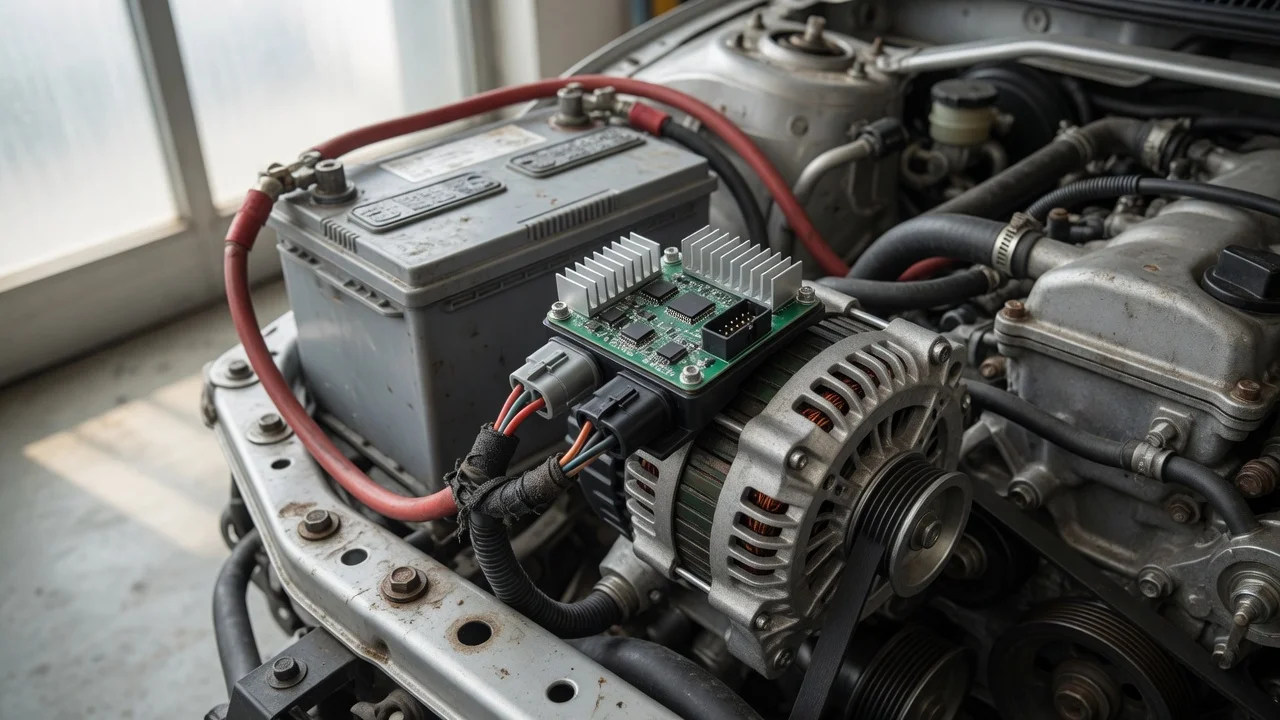
In most automotive contexts, "battery regulator" is an informal name for the voltage regulator in the charging system. It controls how much electrical output the alternator delivers so that the battery is recharged without being overcharged, and so that the rest of the vehicle's electrical system receives a steady supply voltage while the engine runs.
The term is not a formal component name. What it refers to depends on the vehicle, so it helps to identify which of these the person using the term means:
Conventional cars and trucks: the voltage regulator that controls the alternator, either built into the alternator or mounted as a separate unit. Vehicles with computer-managed charging: a control strategy inside an engine or body control module, sometimes paired with a battery sensor, that takes over the regulating role. Motorcycles, ATVs and small engines: a regulator/rectifier that converts and limits the stator's output before it reaches the battery. Campers, boats and off-grid setups: a charge controller or battery-to-battery charger that manages charging of an auxiliary battery from solar panels or the vehicle's alternator. Hybrid and electric vehicles: the high-voltage battery is managed by a battery management system, which is a different and more complex system; a separate converter typically keeps the 12-volt battery charged.
The rest of this guide focuses on the most common meaning, the charging-system voltage regulator in a combustion-engined vehicle, with notes on where the other types differ.
Why a regulator is needed
An alternator is driven by the engine, so its potential output rises and falls with engine speed. Left uncontrolled, it would produce too little at idle and far too much at higher engine speeds. Electrical demand also changes constantly as headlights, heating fans, wipers and other loads switch on and off.
A lead-acid battery is sensitive to charging voltage. Sustained overcharging can overheat it, cause excessive gassing and loss of electrolyte, and shorten its life. Chronic undercharging leaves the battery partly discharged, which also shortens its life and can lead to starting problems. Vehicle electronics likewise expect supply voltage to stay within a defined range. The regulator sits between these competing demands and keeps system voltage within the target band set by the vehicle manufacturer.
How it works
A typical automotive alternator generates electricity by spinning an electromagnet, the rotor, inside a set of fixed windings, the stator. The strength of the rotor's magnetic field depends on the current flowing through its winding, called the field current. More field current means a stronger field and more alternator output; less field current means less output.
The regulator continuously senses system voltage and adjusts the field current to match. When voltage falls below its target, for example because the battery has just supplied power to the starter or a large load has been switched on, the regulator increases field current and the alternator works harder. When voltage climbs toward the upper limit, it reduces field current. Modern electronic regulators do this by rapidly switching the field current on and off, varying the proportion of time it is on to control average output.
The practical effect is that the battery is recharged after starting, electrical loads are supplied mainly by the alternator once the engine is running, and voltage stays reasonably stable regardless of engine speed.
Internal, external and computer-controlled designs
On many older vehicles the regulator was a separate box mounted in the engine bay and wired to the alternator. On most modern vehicles it is built into the alternator itself, so it is usually replaced together with the alternator or as a sub-assembly of it, depending on design.
Many newer vehicles add a layer of computer control. An engine or body control module may command the alternator's output, and some vehicles use a sensor on the battery terminal to estimate the battery's state of charge, temperature and condition. This allows charging to be varied, for instance reducing alternator load to save fuel when the battery is well charged, or charging harder during deceleration. On some of these vehicles a replacement battery must be registered with the vehicle's computer so the charging strategy matches the new battery. Whether this applies depends on the make, model and model year, so it should be confirmed against the manufacturer's information for the specific vehicle.
How the other types differ
Motorcycle and small-engine systems often use a permanent-magnet stator whose output cannot be turned down at the source. Their regulator/rectifier converts the alternating current to direct current and limits voltage, commonly by diverting surplus output rather than reducing generation, which is one reason these units can run hot.
Solar charge controllers and battery-to-battery chargers used for auxiliary batteries regulate charging to suit the battery chemistry, typically moving through charging stages as the battery fills. Their settings depend on the battery type and the controller, so the battery and controller makers' guidance applies rather than the vehicle's.
Term | Typical application | What it regulates; Voltage regulator | Cars and trucks with an alternator | Alternator field current, and therefore charging voltage; Regulator/rectifier | Motorcycles, ATVs, small engines | Converts stator output to DC and limits voltage; Charge controller | Solar charging of auxiliary batteries | Charging current and voltage from panels to battery; Battery-to-battery charger | Auxiliary batteries in campers and boats | Charging of a second battery from the vehicle's system; Battery management system | Hybrid and electric vehicle traction batteries | Cell voltages, temperature, charging and discharging limits
What this guide does not specify
No manufacturer specifications were available for this guide, so it does not state target charging voltages, regulator part numbers or test values. Correct charging voltage varies with the vehicle, the battery type and, on many systems, battery temperature and the charging strategy in use. For a specific vehicle, the manufacturer's service information is the reliable source for those figures. Diagnosing a suspected regulator fault is also outside the scope of this explanation; charging-system faults can stem from the battery, wiring, belt, alternator or control module as well as the regulator itself.
Key takeaway
A battery regulator, in everyday automotive use, is the voltage regulator that keeps the alternator's output matched to the battery's and the vehicle's needs. It works by varying the alternator's field current in response to system voltage, protecting the battery from overcharging and undercharging and keeping electrical supply stable. Where the term is used for motorcycles, auxiliary battery setups or electrified vehicles, it refers to related but distinct devices, so the vehicle type determines which one is meant.