What Is a Voltage Regulator in a Classic Car?
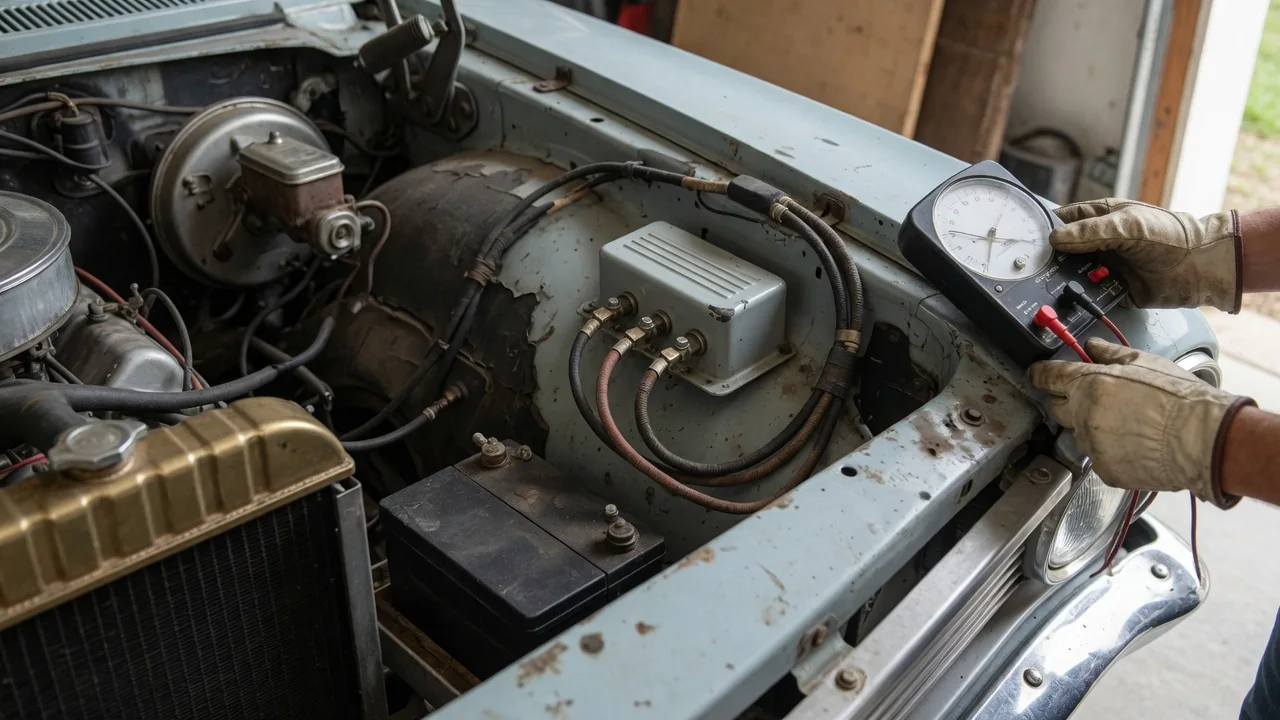
A voltage regulator in a classic car keeps the charging system from undercharging or overcharging the battery. On many older vehicles, especially those with a DC generator, it is a small electromechanical box on the fender or firewall. Instead of electronics, it uses coils, springs and vibrating contact points. Knowing how a classic car voltage regulator works helps you read charging symptoms, respect the original design and tell whether a fault is in the regulator or somewhere else.
Charging control
A generator's output rises with engine speed. Without control, its voltage would climb too high at road speeds and too little would be available at idle. The regulator solves this by controlling the current through the generator's field winding, which creates the magnetic field the armature turns in. A stronger field means more output, and a weaker field means less. The regulator senses system voltage and cuts or reduces field current when the voltage reaches its set point. When the voltage falls, it restores the field current. This happens many times per second, so the output settles at an average level instead of rising and falling with every change in engine speed.
Regulators for generator systems often have more than one unit under the same cover. The voltage unit does the main regulating. A current limiter keeps the generator from being overloaded when the battery is deeply discharged or electrical demand is heavy. A cutout relay connects the generator to the battery only when generator voltage is high enough to charge it. At idle or with the engine stopped, the cutout disconnects them so the battery cannot discharge back through the generator windings. Not every system uses all three units. Alternators block reverse current with diodes and inherently limit their own maximum current. For that reason, early alternator systems that used electromechanical regulators usually needed only the voltage-regulating function.
Mechanical contacts
Each unit in a mechanical regulator is essentially a relay. A coil of wire is wound on an iron core. Above it sits a hinged armature, held in its rest position by a spring and carrying one or more contact points. As voltage or current rises, the coil's magnetic pull grows until it overcomes the spring. The armature then moves and opens or redirects the contacts, which changes the field circuit. Spring tension largely sets the point at which the unit acts. The air gap between armature and core affects how firmly and how consistently it moves.
The voltage unit vibrates almost continuously while the system is charging, so its contacts work hard. Each opening produces a small arc. Over time the arcs erode and pit the contact faces, and oxidation can build up, raising resistance across the points. Designers used several measures to manage this. Many regulators place a resistor in the field circuit so that opening the points reduces field current rather than cutting it entirely, which lessens arcing. Some use a second set of contacts to control the field more firmly at higher speeds. Many also include temperature compensation, such as a bimetallic hinge or spring, because a battery's charging needs change with temperature and the regulator's setting should shift with it.
Because the parts are mechanical, many of these regulators can be adjusted. Typical adjustments include bending a spring tab or turning an adjusting screw, and setting air gaps and point openings with feeler gauges. The correct values, test conditions and sequence are specific to each regulator and vehicle. They depend on the factory service information and accurate meters, not on guesswork.
Faults
Voltage-unit faults usually push the system to one extreme. If the contacts weld or stick in the position that gives full field current, the generator runs unregulated and overcharges. Signs include a battery that gasses and loses electrolyte, bulbs that fail more often, and an ammeter that stays high even after the battery should be recovered. If the contacts burn, pit badly or develop high resistance, field current drops. The result is low or no charging, dim lights and a battery that slowly runs down.
Cutout faults behave differently. A cutout that fails to close keeps generator output from reaching the battery, even if the generator itself is producing current. This often shows as a warning light that stays on or an ammeter that never moves to charge. A cutout that sticks closed is more serious. With the engine stopped, the battery can discharge back through the generator, draining it and possibly trying to drive the generator as a motor. That can overheat wiring and damage components. A current-limiter fault may let the generator overheat under heavy load, or may hold output down when the battery needs a strong charge.
Many symptoms that look like regulator failure start elsewhere. A slipping drive belt, worn generator brushes, a dirty commutator, broken or corroded wiring and loose terminals can all reduce charging. Ground connections deserve special attention, because many regulators depend on a clean ground through their mounting base or a dedicated ground wire. A poor ground can make a healthy regulator act erratically. Checking these basics before condemning the regulator avoids replacing a part that was never the problem.
Practical implications and limits
A replacement regulator has to match the system it is going into. Generators differ in how their field circuit is controlled. In some designs the regulator switches the field to ground, and in others it switches the supply side. A regulator built for one arrangement will not work correctly with the other and can damage components. Electrical polarity matters as well, since classic cars were built with either positive or negative ground. Output rating is another factor. Part numbers and the vehicle's service literature are the reliable guide to compatibility.
Generator systems also have handling rules that newer cars do not. After a generator or regulator has been replaced or disconnected, many systems need the generator polarized so its residual magnetism matches the battery's polarity before the engine is run. The correct method depends on the field circuit type. Using the wrong one can burn the regulator contacts, so the procedure in the service manual is the one to follow. Running a generator with its output disconnected, or briefly bridging regulator terminals as a test, is also risky unless the service procedure specifically calls for it.
Owners can now choose between rebuilt mechanical units and solid-state regulators housed in original-style cases. Solid-state units avoid contact wear and adjustment drift. Mechanical units preserve originality and can be serviced in the traditional way. Either choice still has to suit the generator type, polarity and wiring. This article explains general principles shared by many classic charging systems. Terminal labels, wiring layouts, settings and test values vary by manufacturer and era, so the specific vehicle's documentation governs any real diagnosis or adjustment.