What Does Unsprung Mass Mean? Wheel-Side Weight Explained
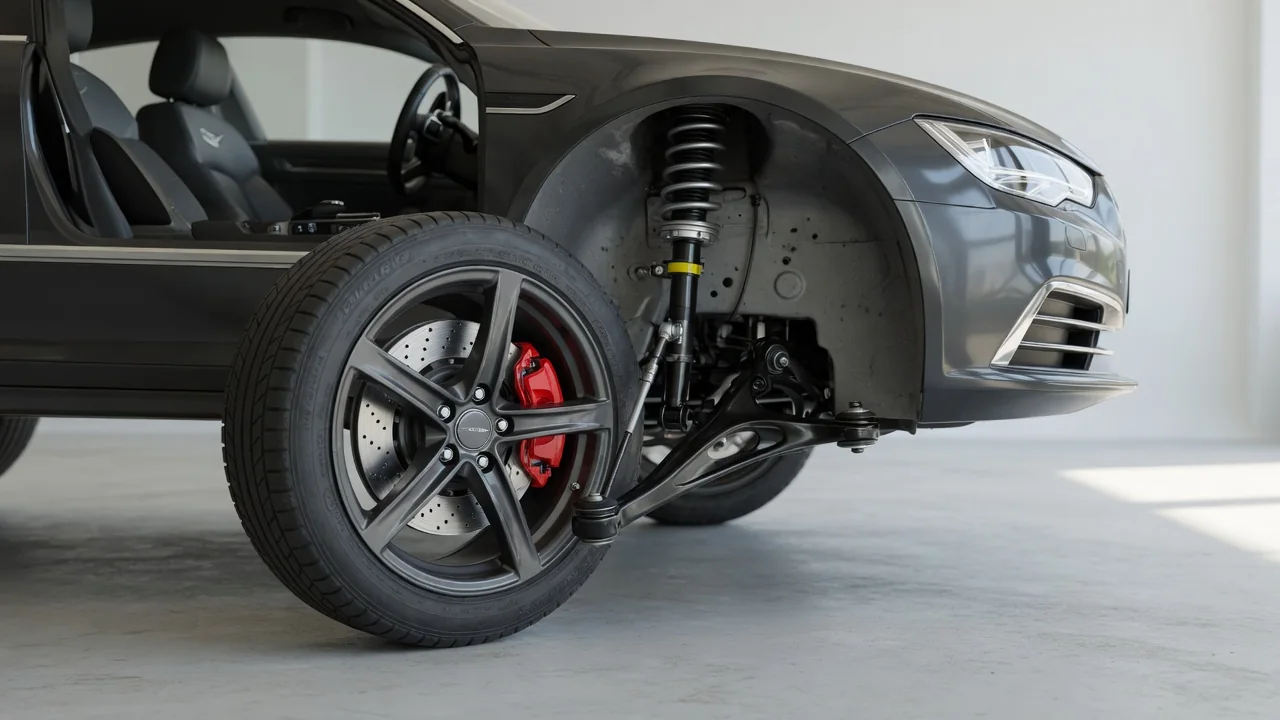
Unsprung mass is the portion of a vehicle's weight that is not carried by its suspension springs. In plain terms, it is everything that moves up and down with the wheel when the tire rolls over a bump, rather than riding on top of the springs with the body. The short answer to what unsprung mass means for a car is this: it is the wheel-side load the suspension has to control, and that load influences ride comfort, grip, and how the car reacts to rough pavement.
Wheel-side parts
The components usually counted as fully unsprung are the ones bolted directly to the wheel or moving with it as a single unit. On a typical car this includes the tires, the wheels, the lug nuts, the wheel hubs and bearings, the brake rotors or drums, and the brake calipers when they are mounted at the wheel. The steering knuckle or suspension upright that holds the hub is also unsprung. On vehicles with a solid rear axle, the entire axle housing, along with the differential inside it, rides with the wheels and therefore adds to the unsprung total.
Some parts sit between the wheel and the body, so they are partly sprung and partly unsprung. Control arms, coil springs, shock absorbers, struts, anti-roll bar links, and drive shafts connect at one end to the moving wheel assembly and at the other end to the chassis. Engineers often treat a share of these parts, commonly about half, as unsprung, because one end moves with the wheel while the other stays nearly still with the body. The exact share depends on the suspension geometry, so it is an approximation rather than a fixed rule.
Everything supported by the springs is sprung mass. That includes the body shell, the engine and transmission, the interior, the fuel, the cargo, and the passengers. Components such as a differential mounted to the chassis on an independent suspension, or brakes placed inboard near the differential, become part of the sprung mass even though they still serve the wheels.
Ride effect
When a tire hits a bump, the road pushes the wheel assembly upward. A heavier assembly has more inertia, so it resists changing direction and carries more energy once it is moving. The spring then has to absorb that energy and push the wheel back down, while the shock absorber has to calm the motion. The more mass involved, the more force passes through the suspension mounts into the body, which occupants can feel as harshness, impact noise, or a busier ride over broken pavement.
Unsprung mass also affects how well the tire stays in contact with the road. After a wheel rises over a bump, it needs to come back down quickly to keep pressing the tire onto the surface. A lighter wheel assembly can follow dips and ridges more closely, so the load on the tire's contact patch stays more consistent. A heavier assembly is slower to respond and is more prone to bouncing or skipping on rippled surfaces, sometimes called wheel hop. Because steering, braking, and cornering all rely on the tire's grip, keeping the contact patch loaded matters for control as well as comfort.
What counts is not just the unsprung weight on its own but how it compares with the sprung mass above it. A heavy body is disturbed less by a given wheel motion, because the wheel's inertia is small relative to the mass it is pushing against. The same wheel and brake hardware on a lighter vehicle has a larger relative effect. This is why engineers talk about the ratio of sprung to unsprung mass rather than treating unsprung weight as an isolated number.
Design
Material choice is one of the most common ways to keep unsprung mass down. Aluminum alloy wheels are widely used partly because they can weigh less than comparable steel wheels, and forged wheels can be lighter still for a given strength. Suspension knuckles and control arms may be made from aluminum instead of steel, and some high-performance brake systems use lighter rotor materials or aluminum calipers. Each of these choices removes weight from the part of the car the suspension must keep under control.
Suspension layout matters as well. An independent suspension usually carries less unsprung weight than a solid axle, because the differential and much of the drivetrain can be mounted to the chassis instead of moving with the wheels. Some designs have placed brakes inboard, next to the differential, for the same reason. Electric vehicles show the opposite pressure: placing motors inside the wheels saves space in the body but adds unsprung mass, which is one reason most designs mount motors on the chassis instead. Solid axles remain common on many trucks and off-road vehicles because of their strength, articulation, and simplicity, even though they carry more unsprung weight.
Reducing unsprung mass always competes with other goals. Lighter materials can raise cost, and parts still need enough strength to survive potholes, curbs, and heavy loads. Brakes need enough thermal capacity to resist fade, and tires need enough structure to carry the vehicle's weight. Designers settle on a balance, then tune spring rates, damper settings, and bushings around the unsprung mass the final design ends up with.
Practical implications and limits
For owners, the concept matters most when changing wheels, tires, or brakes. Moving to a larger wheel diameter or a wider tire often adds weight at each corner, and a bigger aftermarket brake kit can do the same. Even if those parts look like upgrades, they shift the balance the original suspension tuning was built around. When choosing replacement parts, comparing the published weights of the actual wheel, tire, and brake components gives a better picture than size or appearance alone. If a manufacturer does not list a weight, the effect on unsprung mass is simply unknown.
There are limits to how much any single change will be noticed. The result depends on the specific vehicle, its damping, its suspension geometry, and the road surface, so a small weight difference may be hard to detect from the driver's seat. Tire construction, sidewall height, inflation pressure, alignment, and worn shock absorbers can each change ride and grip in ways that are easier to feel. It also helps to keep a related but separate idea in mind: wheels and tires are rotating parts, so their weight affects acceleration and braking through rotational inertia, apart from how it affects suspension motion.
Unsprung mass is best used as a lens for understanding trade-offs rather than as a guarantee of a particular result. Lower wheel-side weight generally helps the suspension do its job, but it is one factor among many, and the way a vehicle was engineered as a whole determines how much any given change will matter on the road.