What AGM Means on a Battery
The short answer
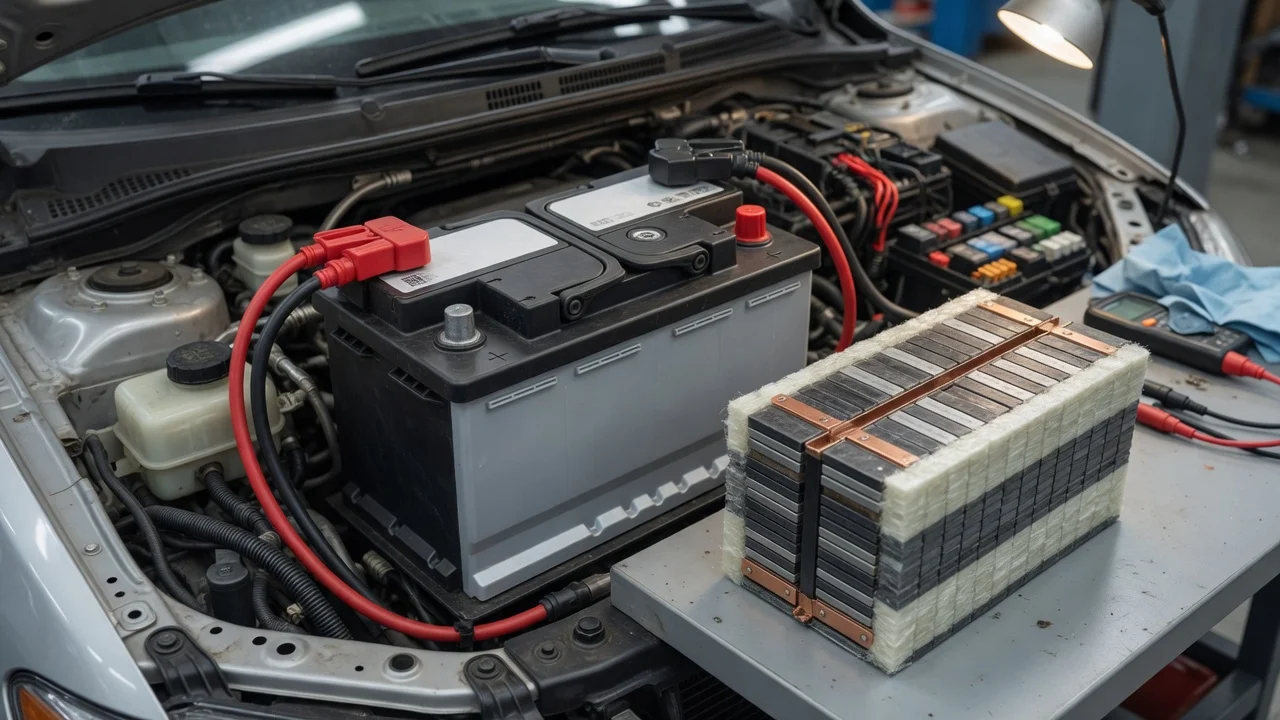
AGM stands for Absorbent Glass Mat. When you see AGM on a car battery label, it identifies the battery's internal construction: a lead-acid battery in which the liquid electrolyte is held in thin fiberglass mats packed between the lead plates, rather than sloshing freely inside the case.
One qualification matters: AGM describes how a lead-acid battery is built, not a different battery chemistry. An AGM battery is still lead-acid, so it is not a lithium battery. It is also not the same as a gel battery, even though both are sealed designs.
Where AGM fits among battery types
AGM batteries belong to a group called valve-regulated lead-acid (VRLA) batteries. The name reflects that the case is sealed and fitted with pressure-relief valves instead of removable filler caps. Gel batteries are the other main VRLA design. Here is how AGM compares with the common lead-acid alternatives found in vehicles.
Type | How the electrolyte is held | Maintenance access; Flooded (conventional wet cell) | Free liquid acid surrounding the plates | Often has removable caps for topping up with water; Enhanced Flooded Battery (EFB) | Free liquid acid, with construction upgraded for more frequent cycling | Typically sealed or low-maintenance; AGM (Absorbent Glass Mat) | Acid absorbed into fiberglass mat separators | Sealed; not refillable; Gel | Acid thickened into a gel with an additive | Sealed; not refillable
How an AGM battery works
Like any lead-acid battery, an AGM battery stores and releases energy through a chemical reaction between lead plates and sulfuric acid electrolyte. The difference lies in the separators. Each separator is a mat of very fine glass fibers that soaks up the electrolyte much like a sponge. The mats are pressed tightly against the plates, holding the acid in close contact with them while leaving almost no free liquid in the case.
Charging a lead-acid battery produces oxygen and hydrogen gas. In a conventional flooded battery, much of that gas escapes, which is why water is gradually lost and may need replacing. In an AGM battery, the gas can travel through tiny channels in the glass mat and recombine into water inside the battery. Under normal operating conditions this recombination keeps water loss low, which allows the case to stay sealed. The valves open only to release excess pressure, for example if the battery is overcharged.
What that design means in practice
Spill resistance: because the acid is absorbed into the mats, an AGM battery is far less likely to leak if the case is tilted, which is one reason it is sometimes fitted in locations other than the engine bay, such as under a seat or in the trunk. No topping up: the sealed design means there is no electrolyte level to check or water to add. Vibration tolerance: the tightly packed mats support the plates, which helps the battery cope with vibration. Suitability for demanding electrical use: AGM batteries are widely used in vehicles with engine start-stop systems and heavy electrical loads, where the battery is discharged and recharged frequently.
Performance figures such as cold cranking amps, reserve capacity and expected service life vary by manufacturer, battery size and operating conditions, and no specific test data was supplied for this article. Check the label and the manufacturer's specifications for the exact battery you are considering rather than assuming every AGM battery performs the same way.
Why the label matters to owners
The AGM marking tells you more than how the battery is built; it signals that the battery may need different handling from a conventional flooded unit. Many battery chargers offer a dedicated AGM setting because sealed batteries can be damaged by charging profiles intended for flooded types. Vehicles designed around an AGM battery, particularly those with start-stop systems, generally expect an AGM replacement, and some models also require the new battery to be registered with the vehicle's electronics. These requirements depend on the make, model and model year, so the owner's manual or the vehicle manufacturer's guidance is the reliable reference before charging or replacing an AGM battery.