What Is an AGM Car Battery? Absorbed Electrolyte, Construction, and Fit
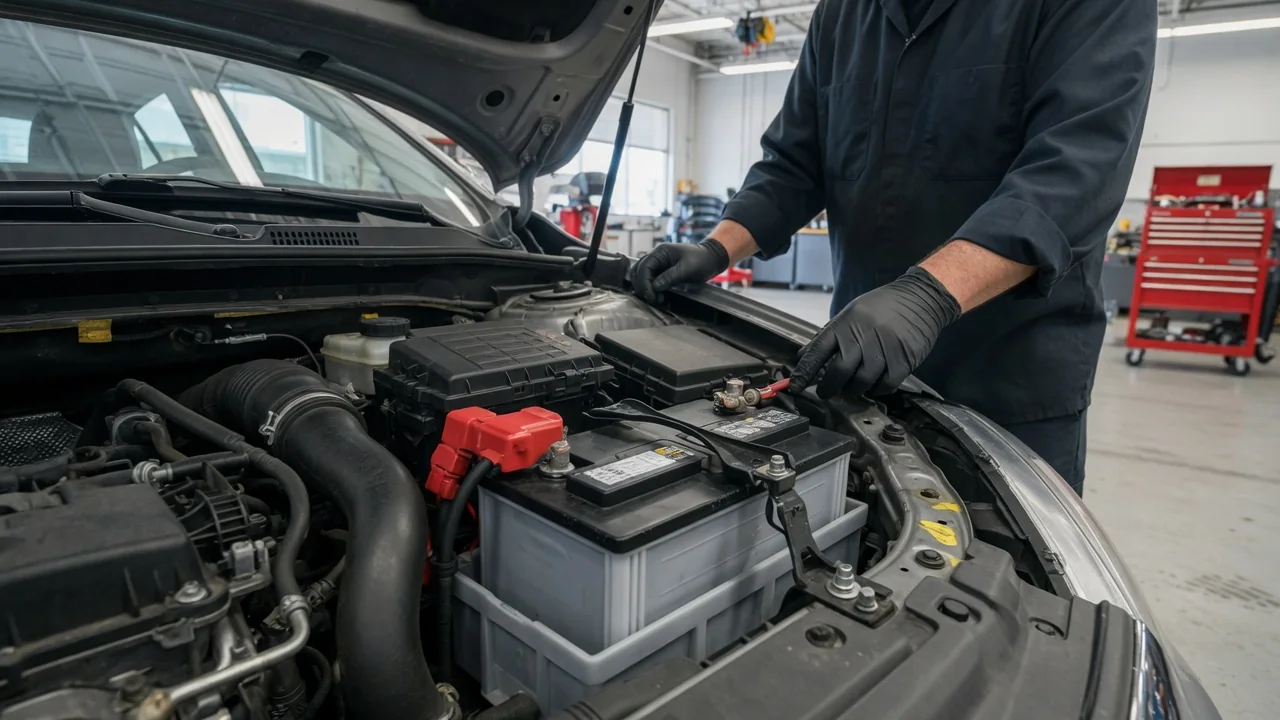
An AGM car battery is a type of lead-acid battery in which the liquid electrolyte is held in thin mats of fine glass fiber instead of moving freely around the plates. AGM stands for absorbent glass mat. The chemistry that stores and releases energy is the same as in a conventional flooded battery. The way the electrolyte is contained changes how the battery is sealed, how it handles charging, and which vehicles it suits. Here are the AGM automotive battery basics that matter for owners.
Absorbed electrolyte
Every lead-acid battery stores energy through the same basic reaction. Positive plates coated with lead dioxide and negative plates made of spongy lead react with an electrolyte of dilute sulfuric acid. They form lead sulfate as the battery discharges and convert it back when the battery is charged. In a conventional flooded battery, the plates sit in a pool of free liquid. In an AGM battery, the electrolyte is soaked into a fine glass-fiber mat pressed between the plates. Capillary action holds it there, much like water held in a sponge.
The mat is intentionally not filled to the point of saturation. The small amount of open pore space gives the oxygen produced at the positive plate during charging a path to the negative plate. There it reacts and is converted back into water. This internal recombination sharply reduces water loss, which is why AGM batteries can be sealed and never need topping up. They belong to the family of valve-regulated lead-acid, or VRLA, batteries. Each cell is closed by a pressure relief valve that stays shut in normal use. The valve opens only to release excess gas when internal pressure builds, typically from overcharging.
Because there is little free liquid, an AGM battery resists spills and leaks far better than a flooded design. The electrolyte also stays in contact with the plates even under strong vibration. That does not make the battery dry or harmless. It still contains sulfuric acid, and a cracked case should be handled with the same caution as any damaged lead-acid battery.
Construction
Inside an AGM battery, positive and negative plates are stacked alternately with glass mat separators between them. The whole stack is squeezed tightly as it goes into the case. That compression keeps the active material pressed against the grids, which helps limit shedding and improves resistance to vibration. The close plate spacing and firm contact also give AGM batteries low internal resistance. This lets them deliver high current for cranking and accept charge more readily than many flooded batteries.
The case and lid are built around the sealed design. There are no removable cell caps for adding water. Instead, the valves sit beneath the lid, and many automotive AGM batteries include a vent port that can connect to a tube that carries released gas outside the vehicle. The case walls must be sturdy enough to hold the plate stack under constant pressure. Most automotive AGM batteries use flat plates in a rectangular case built to the same standard group sizes as flooded batteries. Some designs use spiral-wound cylindrical cells instead.
Grid alloys in sealed lead-acid batteries are generally chosen to limit gassing, and lead-calcium formulations are common. AGM is also different from gel. Both are VRLA designs, but a gel battery thickens its electrolyte with silica into a paste. An AGM battery keeps a liquid electrolyte absorbed in glass fiber. The two types behave differently on charge, and the names are not interchangeable.
Vehicle fit
Automakers often specify AGM batteries as original equipment in vehicles with automatic start-stop systems, regenerative charging strategies, or heavy electrical loads. When the engine shuts off at every stop, the battery repeatedly powers the electrical system and then restarts the engine, often while below full charge. AGM construction tolerates that kind of repeated cycling better than a standard flooded battery. Some start-stop vehicles instead use an enhanced flooded battery, or EFB, which sits between the two. The correct type therefore depends on the manufacturer's specification, not just on whether the vehicle has start-stop.
Battery location also plays a role. AGM batteries are often used where the battery is mounted under a seat, in the trunk, or elsewhere inside the body. In those spots, the sealed construction and venting provisions limit exposure to gas and acid. If a vehicle has a vent tube attached to the battery, reconnect it to the replacement.
The general rule for replacement is to match what the vehicle was designed for. If a vehicle left the factory with an AGM battery, replace it with an AGM battery of the specified group size and ratings. A flooded battery in its place can shorten battery life and may affect start-stop operation. Putting an AGM battery in a vehicle that originally had a flooded one is often physically possible. However, the charging system may not be tuned for it, so check the owner's manual or manufacturer guidance first. Some vehicles also use a battery monitoring sensor and require the new battery to be registered or configured so the charging strategy matches its type and capacity. The procedure varies by vehicle.
Practical implications and limits
The sealed design that makes AGM convenient also makes it less forgiving of charging mistakes. Sustained overcharging produces gas faster than recombination can handle, the valves vent, and the lost electrolyte cannot be replaced. Over time the mat dries and capacity falls permanently. For that reason, an external charger should have an AGM mode or a voltage profile suited to AGM, and older unregulated chargers are best avoided. The same applies to testing. Many battery testers ask for the battery type, and the wrong setting can produce misleading results.
AGM batteries are often described as maintenance-free, which only means there is no water to add. Terminals still need to be clean and tight, and the hold-down still needs to be secure. High under-hood temperatures still speed up aging, as they do for any lead-acid battery. Better cycling tolerance does not protect an AGM battery from deep discharge either. Draining it flat again and again, for example by leaving lights on or storing the vehicle without a maintainer, promotes sulfation and shortens its life.
Finally, an AGM battery cannot fix problems elsewhere in the electrical system. A failing alternator, a parasitic drain, or corroded cables will undermine any battery type. AGM batteries also generally cost more than comparable flooded batteries. In an older vehicle with modest electrical demands and a flooded battery as standard, switching may bring little practical gain. Where the manufacturer specifies AGM, it is part of how the electrical system was designed to work, and choosing the correct type is the simplest way to keep that system performing as intended.