Westair Propane Distribution Center: LPG Refueling Availability Explained
The Short Answer
If you are searching for the Westair Propane Distribution Center to fill an LPG (liquefied petroleum gas, or propane) vehicle, the key qualification is that a propane distribution center is not automatically a public autogas station. No confirmed details were available about this site's services, hours, pricing or vehicle-dispensing equipment. Before you drive there to refuel a car, truck or fleet vehicle, contact the facility directly and confirm three things: whether it dispenses propane into vehicle tanks, whether that service is open to the public or limited to account customers, and whether its dispenser fitting matches your vehicle's fill valve.
The rest of this guide explains why that distinction matters, what the different kinds of propane service look like, and what an LPG vehicle owner should check so a trip to a Westair propane location ends in a full tank rather than a wasted drive.
What a Propane Distribution Center Usually Is
In the US propane trade, a distribution center is typically a storage and dispatch facility. It holds bulk propane in large stationary tanks and supplies delivery trucks, cylinder filling, and commercial or residential customers. Some distribution centers also have a dispenser that can fill vehicle tanks, but many do not, and some that do reserve it for fleet accounts or for their own vehicles.
That means the name alone does not tell you whether the Westair propane distribution center can refuel an LPG vehicle. It may focus on bulk delivery and cylinder service, it may offer autogas dispensing, or it may offer vehicle filling only under certain conditions. Treat any assumption either way as unconfirmed until the site tells you otherwise.
How the Main Types of Propane Service Differ
Service type | What it does | Useful for an LPG vehicle? Bulk delivery | A truck fills a stationary tank at a home, farm or business | No, unless you operate an on-site fleet fueling tank; Cylinder refill | Staff fill portable cylinders, such as grill or forklift tanks | Generally no; vehicle tanks are permanently mounted and filled through a dedicated valve; Cylinder exchange | You swap an empty cylinder for a full one | No for road vehicles; possibly yes for forklifts that use exchangeable cylinders; Autogas dispensing | A metered dispenser fills a vehicle's mounted tank through its fill valve | Yes, if the nozzle fits and the service is available to you
Forklift and industrial equipment owners are a partial exception. Many forklifts run on swappable propane cylinders, so a distribution center that handles cylinder exchange may serve that need even if it has no road-vehicle dispenser.
What to Confirm Before You Go
Vehicle dispensing: ask specifically whether they fill propane vehicles at a dispenser, not just whether they sell propane. Public or account-only access: some sites fuel only contracted fleets or require a card or account. Operating hours: distribution facilities often keep business hours rather than extended retail hours, and dispensing may require an attendant. Nozzle and fill valve type: US autogas dispensers commonly use either a traditional threaded ACME connector or a newer quick-connect style nozzle. Confirm which the site uses and whether your vehicle has the matching fill valve or an adapter. Payment and pricing: autogas pricing is often quoted differently from cylinder or bulk pricing, so ask for the vehicle-fuel rate rather than assuming. Staffed filling rules: in some areas propane dispensing must be performed or supervised by trained staff, so self-service may not be possible.
Why Fitting Compatibility Matters for LPG Vehicles
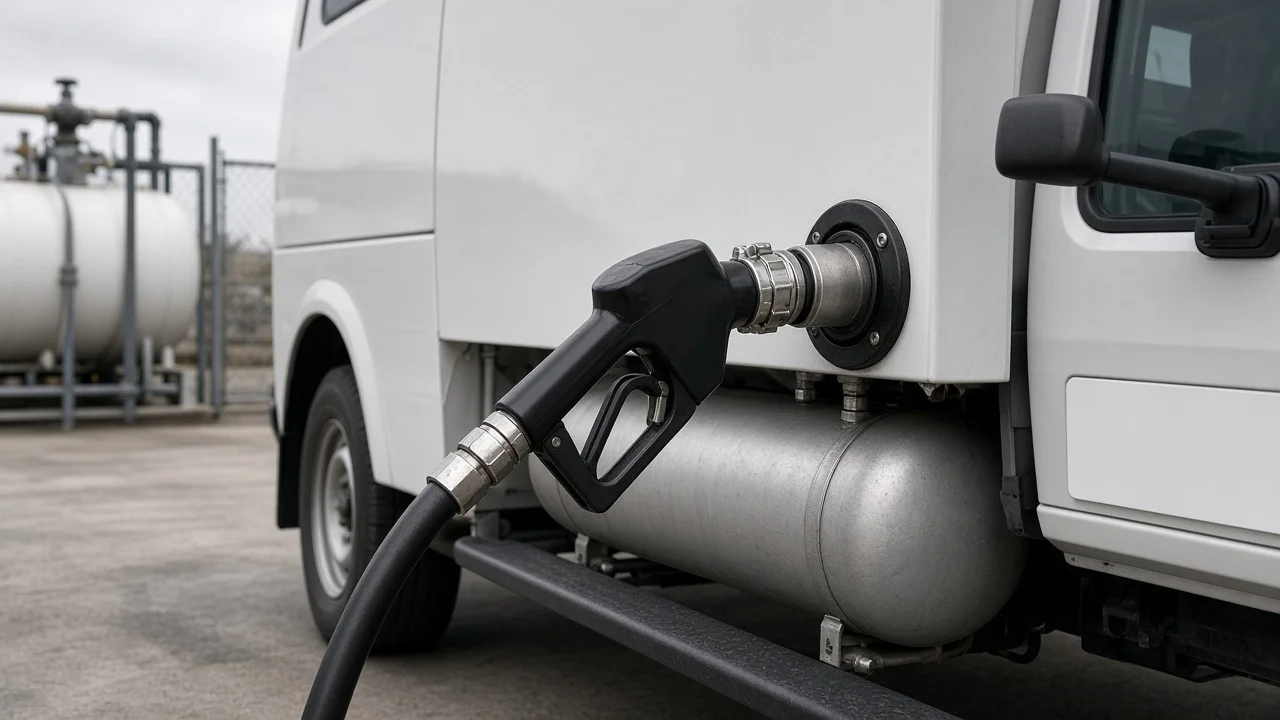
An LPG vehicle stores propane as a liquid under pressure in a mounted tank. Refueling connects the dispenser nozzle to the vehicle's fill valve and transfers liquid propane until an automatic stop limits the fill, leaving vapor space for expansion. If the nozzle and fill valve do not match, the transfer cannot happen safely without the correct adapter. Vehicles converted overseas or by aftermarket installers sometimes use fill fittings that differ from common US dispensers, so owners of imported or converted vehicles should be especially careful to confirm compatibility first.
Vehicle-Side Checks for LPG Owners
Finding a fill point is only half of reliable LPG ownership. The fuel system itself needs to be in good condition, and a few terms come up often when owners and technicians discuss it.
Fuel pressure: liquid-injection systems often use an in-tank fuel pump to keep propane liquid under pressure up to the injectors, while vapor-injection systems use a vaporizer and regulator to deliver gas at a controlled pressure. Pressure that drifts out of the system's normal range can cause hard starting or poor running. Injector: LPG injectors meter fuel into the intake or cylinder. Sticking or contaminated injectors can cause misfires or rough idle. Fuel filter: LPG systems typically include filters in the liquid and/or vapor stages to trap residue. Service intervals depend on the system and are set by its installer or manufacturer. Fuel trim: the engine computer adjusts mixture through short-term and long-term fuel trim. On bi-fuel vehicles, trims that differ sharply between gasoline and LPG operation can point to a calibration, pressure or injector issue on the LPG side. Engine configuration: the number of cylinders, injection layout and whether the engine was designed for LPG or converted later all affect which components the system uses and how it should be serviced. Leak check: propane is heavier than air and has an added odorant. If you smell gas around the tank, lines or engine bay, do not refuel or start the vehicle; move away and have the system inspected. Periodic leak checks by a qualified technician are a normal part of LPG ownership.
If This Site Cannot Refuel Your Vehicle
If the Westair propane location turns out to handle only bulk or cylinder service, look for a dedicated autogas dispenser in the area. Alternative-fuel station locators, propane retailers that list vehicle fueling, and fleet fueling providers are the usual places to start. When you find a candidate, apply the same checklist: confirm vehicle dispensing, public access, hours and nozzle compatibility before you rely on it, especially if your vehicle runs on LPG only and has no gasoline backup.
Bottom Line
The Westair Propane Distribution Center may be a useful propane source, but its availability for LPG vehicle refueling could not be confirmed from the information at hand. Distribution centers commonly prioritize bulk delivery and cylinder service, so call ahead and ask directly about vehicle dispensing, access rules and fitting type. Pair that with a well-maintained fuel system, and an LPG vehicle can be refueled with confidence wherever a compatible dispenser is available.