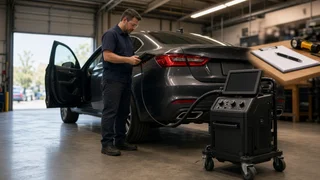
Vehicle Emissions Inspection: What It Is, How It Works and How It Differs From a Safety Inspection
A vehicle emissions inspection checks whether your car or truck's emission control systems are working well enough to meet the standards set where the vehicle is registered. In the US, whether you need one depends on your state and often your county or metro area. The test method depends mostly on the vehicle's model year and powertrain. For most gasoline cars and light trucks from the 1996 model year onward, the test reads data from the onboard diagnostic system (OBD-II) rather than measuring exhaust directly. Older vehicles, some diesels and certain other categories may still get a tailpipe or visual test.
The Short Answer: Who Needs an Emissions Test
There is no single national emissions test that every driver must pass. The federal Clean Air Act sets air quality goals, and states with areas that do not meet those goals generally run vehicle inspection and maintenance programs to help close the gap. As a result, requirements vary widely. Some states test vehicles statewide, some test only in specific counties or urban regions, and some have no emissions testing at all.
Even inside a testing area, not every vehicle is covered. Programs commonly exempt certain groups of vehicles, though the exact rules differ by jurisdiction. Typical exemption categories include:
Fully electric vehicles, which have no tailpipe emissions; New vehicles during an initial period after purchase; Older or collector vehicles above a certain age, sometimes with mileage or registration limits; Motorcycles in many programs; Some diesel or heavy-duty vehicles, which may be handled under a separate program
Hybrids are usually still tested because they have a gasoline engine. The most reliable way to confirm your obligation is your registration renewal notice or your state's motor vehicle or environmental agency. Many renewal notices state outright whether an emissions test is due.
How an Emissions Inspection Works
Most inspections follow a similar sequence. The exact equipment and the order of the steps depend on the program and the station.
Vehicle Identification
The inspector first confirms which vehicle is being tested. This usually means recording or scanning the vehicle identification number (VIN) and checking it against registration records. Accurate identification matters because the VIN tells the system which test procedure and standards apply to that model year, vehicle type and fuel.
OBD-II Test (Most 1996 and Newer Light-Duty Vehicles)
Gasoline cars and light trucks sold in the US from the 1996 model year onward have a standardized OBD-II system. This system continuously monitors engine and emissions components. For these vehicles, the inspector plugs a connector into the diagnostic port, which is usually under the dashboard near the steering column. The test equipment then reads several things:
Malfunction indicator lamp (check engine light) status: whether the light is commanded on, and whether the bulb itself works; Stored diagnostic trouble codes: faults the computer has recorded; Readiness monitors: self-tests the computer runs on systems such as the catalytic converter, oxygen sensors, evaporative system and EGR system, and whether enough of them have completed
Because the computer has already been watching these systems during normal driving, the OBD test is fast and does not usually require running the engine under load.
Tailpipe and Other Tests
Vehicles that predate OBD-II, or that a program does not test by OBD, may get a tailpipe test. A probe in the exhaust measures pollutants such as hydrocarbons, carbon monoxide and, in some tests, nitrogen oxides. Some programs measure at idle. Others run the vehicle on a dynamometer, a set of rollers that lets the car simulate driving while stationary. Diesel vehicles, especially heavier ones, may get an opacity test, which measures how much smoke blocks light passing through the exhaust.
Some programs add other checks. These can include a gas cap pressure test to detect fuel vapor leaks, or a visual check that required emissions equipment such as the catalytic converter is present and has not been tampered with.
Inspection Criteria: What Typically Causes a Failure
Pass and fail thresholds are set by each program, so specific limits vary. The common failure reasons are similar almost everywhere:
Check engine light illuminated, or a stored code that commands it on; Too many readiness monitors showing incomplete; No communication between the test equipment and the vehicle's computer; Tailpipe readings above the applicable limits, on vehicles tested that way; Missing, removed or modified emissions components; A failed gas cap or evaporative system test, where that test is performed
Incomplete readiness monitors cause many surprise failures. Monitors reset when the battery is disconnected, when the vehicle loses power during a repair, or when someone clears trouble codes with a scan tool. They become ready again only after the car completes certain driving conditions. These conditions vary by manufacturer and can take a number of days of normal mixed driving. Clearing a code right before an inspection usually leads to a rejection or failure, not a pass.
How to Check Your Vehicle's Emissions Readiness Before the Test
You can't replicate an official test at home, but you can catch the most common problems in advance:
Check the dashboard. If the check engine light is on, have the cause diagnosed and repaired first. Use an inexpensive OBD-II scan tool, or ask a repair shop, to read stored codes and readiness monitor status. If the battery was recently replaced or codes were recently cleared, drive normally for a while, including both city and highway driving, before testing. Make sure the gas cap seals properly and isn't cracked or missing. Fix obvious exhaust leaks, heavy smoke or a strong fuel smell, which suggest a problem a test may detect. On older vehicles that get a tailpipe test, arriving with a fully warmed-up engine can help the test reflect normal operation.
Emissions Test vs. Safety Inspection
People often confuse the two because some states combine them into one visit and some require only one or neither. They check different things:
Aspect | Emissions Inspection | Safety Inspection; Purpose | Limits air pollution from vehicles | Confirms the vehicle is safe to drive; What is checked | OBD-II data, exhaust output, emissions equipment, fuel vapor system | Brakes, lights, tires, steering, suspension, wipers, horn and similar items, depending on the state; Typical driver | Air quality requirements, often focused on specific regions | State vehicle safety law; Where required | Varies by state and often by county | Varies by state; many states have none; Can pass one and fail the other | Yes | Yes
A vehicle with excellent brakes and tires can still fail an emissions test because of a faulty oxygen sensor. A car with a clean emissions result can still fail a safety inspection because of worn brake pads. Where both are required, each must be passed on its own terms.
Test Certificate and Proof of Compliance
After a passing result, you receive proof of compliance. Depending on the program, this may be a printed test certificate or report, a windshield sticker, or an electronic record sent directly to the motor vehicle agency. In states with electronic reporting, you may not need to show paperwork at registration, but keeping the printed report is still useful if a record fails to transfer. Passing results are generally valid only for a limited period, so the timing of your test relative to your registration renewal matters.
What Happens if You Fail: Repairs and Retest
A failed emissions test is not a penalty in itself. It is a notice that the vehicle needs attention before it can be registered or renewed. The usual path:
Review the failure report, which normally lists the reason, such as specific trouble codes, incomplete monitors or out-of-range readings. Have the problem diagnosed and repaired. Common culprits include oxygen sensors, catalytic converters, evaporative system leaks, ignition misfires and loose or faulty gas caps. After repairs, drive the vehicle enough for readiness monitors to complete, especially if codes were cleared during the repair. Return for a retest within the period your program allows. Some programs offer a free or reduced-cost retest within a set window.
Some states offer repair cost waivers, extensions or assistance programs for owners who have spent a qualifying amount on legitimate emissions repairs without achieving a pass, or who meet income criteria. The rules and dollar figures differ by state, so ask the testing station or the program agency what applies to you.
Key Takeaways
Emissions inspection requirements in the US are set by states and often apply only in certain counties or regions. Most 1996 and newer gasoline light-duty vehicles are tested by reading OBD-II data, not by measuring exhaust directly. An illuminated check engine light or incomplete readiness monitors are among the most common reasons for failing. An emissions test and a safety inspection are separate checks, even when performed in the same visit. If your vehicle fails, repair the listed problem, allow the monitors to reset through normal driving, and schedule a retest within your program's deadline.