Ultrasonic Parking Sensor System
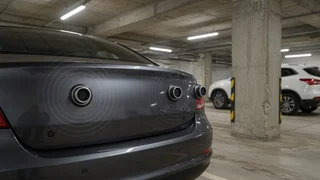
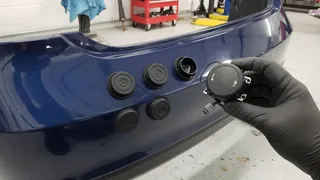
An ultrasonic car parking sensor helps a driver judge tight spaces by sending out high-frequency sound waves and timing the echo that returns from nearby objects. A small transducer mounted in the bumper cover emits pulses that are inaudible to the human ear, then listens for the reflection. The time delay is converted into an approximate distance reading, and a control module turns that information into audible beeps, visual bars, or voice alerts. This gives useful feedback when maneuvering space is limited. The system is a near-field aid, not a replacement for checking mirrors, posted signs, available clearance, vehicle dimensions, and local rules before entering a parking restriction.
Essential answer
An ultrasonic car parking sensor is a proximity-warning device that detects obstacles behind or ahead of a vehicle during low-speed parking maneuvers. It measures the time required for an ultrasonic pulse to travel from a bumper-mounted sensor to an object and return. Because the speed of sound in air is relatively stable under normal conditions, the control module can estimate the gap between the vehicle and that object. The output is usually a series of warning tones that become faster as the available clearance shrinks, although some systems also show colored segments or numeric distance on a display.
The scope of an ultrasonic sensor car parking system is intentionally narrow. It works best when the vehicle is moving slowly and the obstacle is solid enough to reflect sound effectively. Soft, angled, thin, or very low objects may not return a strong echo, so the driver should still use visual checks and consider vehicle dimensions. The system is not designed to interpret a parking restriction or tell the driver whether a space is legal. It is a maneuvering tool that supports the driver's judgment when the vehicle is close to walls, poles, curbs, or other vehicles.