Tire Sidewall Damage and Bubbles: How to Decide Whether to Replace a Tire
The Short Answer
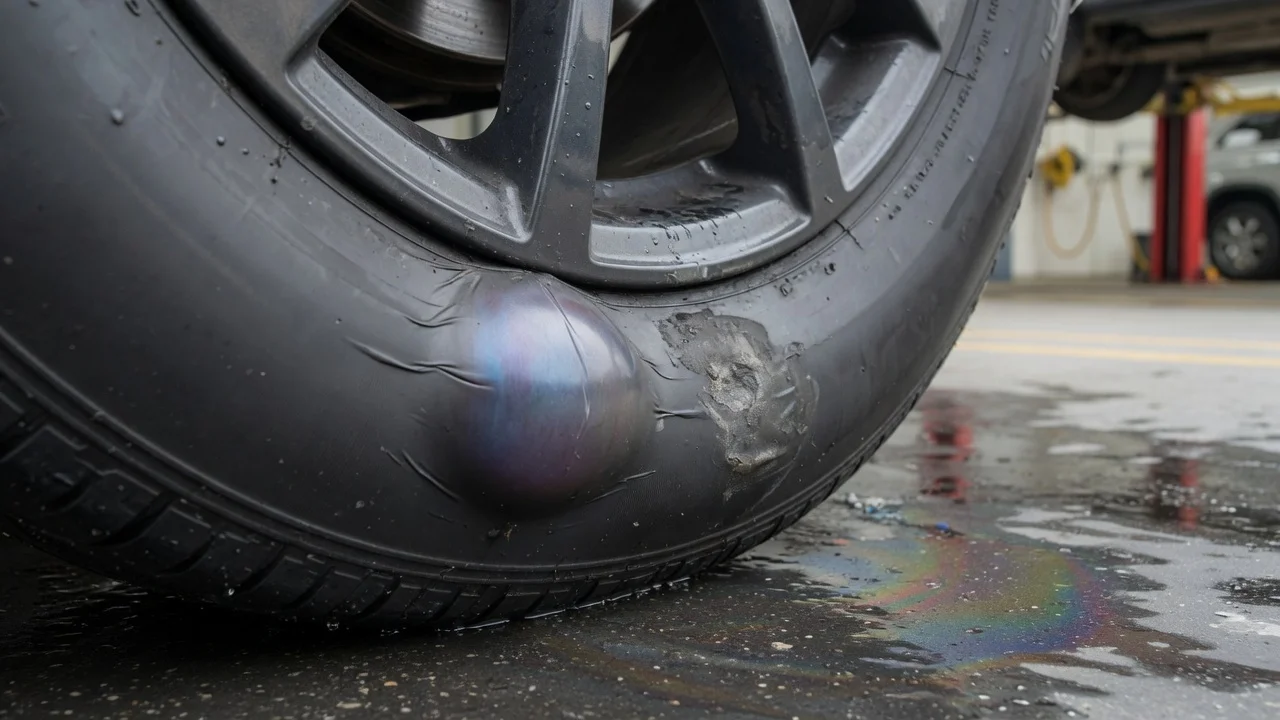
If a tire has a bubble, also called a bulge, on its sidewall, replace it. The sidewall is the flexible side wall of the tire between the tread and the wheel rim. A bubble forms when the internal structure, the layers of cord fabric (plies) that give the tire its strength, has been damaged, often by a pothole, curb strike or similar impact. Air then pushes into the weakened area and raises a lump on the outside. That damage cannot be seen fully from outside and is not considered repairable, so a tire with a sidewall bubble is at elevated risk of sudden failure and should be taken out of service.
Not every mark on a sidewall means replacement. Light surface scuffs and some shallow, uniform indentations can be harmless, while cuts, deep cracks, exposed cords and punctures in the sidewall are generally treated as reasons to replace. The deciding question is whether the tire's internal structure may be compromised. When there is doubt, a qualified tire technician should inspect the tire before it is driven on again.
Bubble Versus Indentation: An Important Distinction
A bubble sticks out from the sidewall. A small inward dip or narrow depression, sometimes seen on new or healthy tires, is often a normal result of how the internal plies overlap during manufacture and is generally regarded as cosmetic. An outward bulge is the warning sign. If you cannot tell which you are looking at, treat it as a bulge until a tire professional confirms otherwise.
Common Types of Sidewall Damage and What They Usually Mean
Condition | What it suggests | Usual outcome; Outward bubble or bulge | Internal ply or cord damage, typically from impact | Replace; Cut or gash, especially with cords or fabric visible | Structural layers breached | Replace; Puncture or nail in the sidewall | Damage outside the area normally considered repairable | Replace; Deep cracking that reaches into the rubber or exposes underlying material | Age or ozone deterioration, or damage weakening the casing | Have inspected; replacement is likely; Fine, shallow surface cracking (weather checking) | Rubber aging at the surface | Have inspected; monitor or replace depending on depth and tire age; Light scuff or curb rash with no cut, bulge or exposed material | Cosmetic surface abrasion | Usually serviceable, but confirm if unsure; Small inward dip or depression | Often a normal manufacturing characteristic | Usually cosmetic; confirm if unsure
This table is general guidance. No specific depth, length or size limits for acceptable cracks or cuts are given here, because those thresholds come from tire manufacturers and inspection standards that vary. A technician can apply the criteria relevant to your tire and jurisdiction.
Why Sidewall Bubbles Cannot Be Repaired
Standard tire repairs, such as a combined plug and patch, are designed for small punctures in the tread area, the part of the tire that contacts the road. The sidewall flexes constantly as the tire rolls and carries much of the load, and a bubble means the reinforcing cords beneath the rubber are already broken or separated. A patch on the inside cannot restore that structure. Tire industry guidance generally excludes sidewall damage from repair for this reason.
How to Inspect a Tire and Decide What to Do
Prerequisites and equipment: the vehicle parked on firm, level ground away from traffic, the engine off, the parking brake applied, and good light. A flashlight helps. A tire pressure gauge is useful. If you need to fit the spare, use the jack, wheel wrench and procedure specified in your owner's manual, since jacking points and spare tire types differ between vehicles.
1) Park safely before looking closely. Do not crouch beside a tire on the traffic side of a road. If the vehicle is on a highway shoulder and a bulge is visible, move to a safer location only if it can be done slowly and over a very short distance, or call for roadside assistance. 2) Look at both sidewalls of each tire. Check the outer face, then the inner face as far as you can see with a flashlight, turning the steering wheel to expose the front tires. Many impact bulges appear on the inner sidewall, which is easy to miss. 3) Run your eyes, and carefully your hand, along the sidewall to feel for raised areas. Do not press hard on a suspected bulge and keep your face away from it; a damaged tire can fail without warning. 4) Note any cuts, punctures, embedded objects, exposed cords or fabric, and deep cracks. Do not remove an object lodged in the sidewall, as this can cause rapid air loss. 5) Check tire pressure against the figure on the vehicle's door jamb placard or in the owner's manual, not the maximum figure molded on the sidewall. Low pressure can contribute to sidewall damage, and a pressure warning light may indicate an air leak. Stop and do not inflate a tire that shows a bulge, cut or exposed cords. 6) Inspect the wheel rim near any damage. A bent rim edge can accompany an impact bubble and may need separate assessment. 7) Decide. If you find a bubble, cut, sidewall puncture or exposed material, stop using the tire. Fit the spare if you are able to do so safely, or arrange roadside assistance or towing. If you find only light scuffing or fine surface cracking, you may continue but should have the tire checked by a technician soon. 8) If you fit a spare, follow its limitations. Temporary compact spares typically carry speed and distance restrictions printed on the spare or stated in the owner's manual; observe them and check the spare's pressure before relying on it.
Completion check: the damaged tire is no longer in use, the replacement or spare is correctly mounted and inflated to the specified pressure, wheel fasteners are tightened to the manufacturer's specification, and any tire pressure warning has cleared or has been explained by a technician.
Work That Should Be Left to a Qualified Technician
Confirming whether a borderline mark, crack or dip is cosmetic or structural. Mounting and balancing a new tire on the wheel. Inspecting the wheel for bends or cracks after an impact. Checking wheel alignment and suspension if the damage came from a hard pothole or curb strike. Advising whether one, two or all tires should be replaced, which can depend on remaining tread depth on the other tires and on the drivetrain. Some all-wheel-drive vehicles have manufacturer guidance on how closely tire sizes and tread depths must match, so check the owner's manual or ask the dealer for your specific model.
Choosing the Replacement Tire
Use the tire size, load index and speed rating specified for your vehicle, which are listed on the door jamb placard or in the owner's manual. Matching the brand and model of the remaining tires helps keep handling consistent, especially on the same axle. Whether a single replacement is acceptable or a matched pair or full set is advised depends on your vehicle and the wear on the other tires, so confirm this for your model rather than assuming.
Reducing the Chance of Future Sidewall Damage
Keep tires at the specified pressure, since underinflated tires flex more and are more easily pinched against the rim on impact. Slow down for potholes and avoid them where it is safe to do so, approach curbs gently when parking, and include a quick look at both sidewalls in routine checks, particularly after any hard impact.
Limits of This Guide
This guide does not provide numerical limits for crack depth, cut size or tire age, and it does not cover legal roadworthiness requirements, which differ by country and region. It also cannot account for specialty tires such as run-flat designs, whose inspection and repair rules are set by their manufacturers. For those details, rely on your tire manufacturer, your vehicle's owner's manual and a qualified tire professional.