Tell bad brake drums from bad shoes
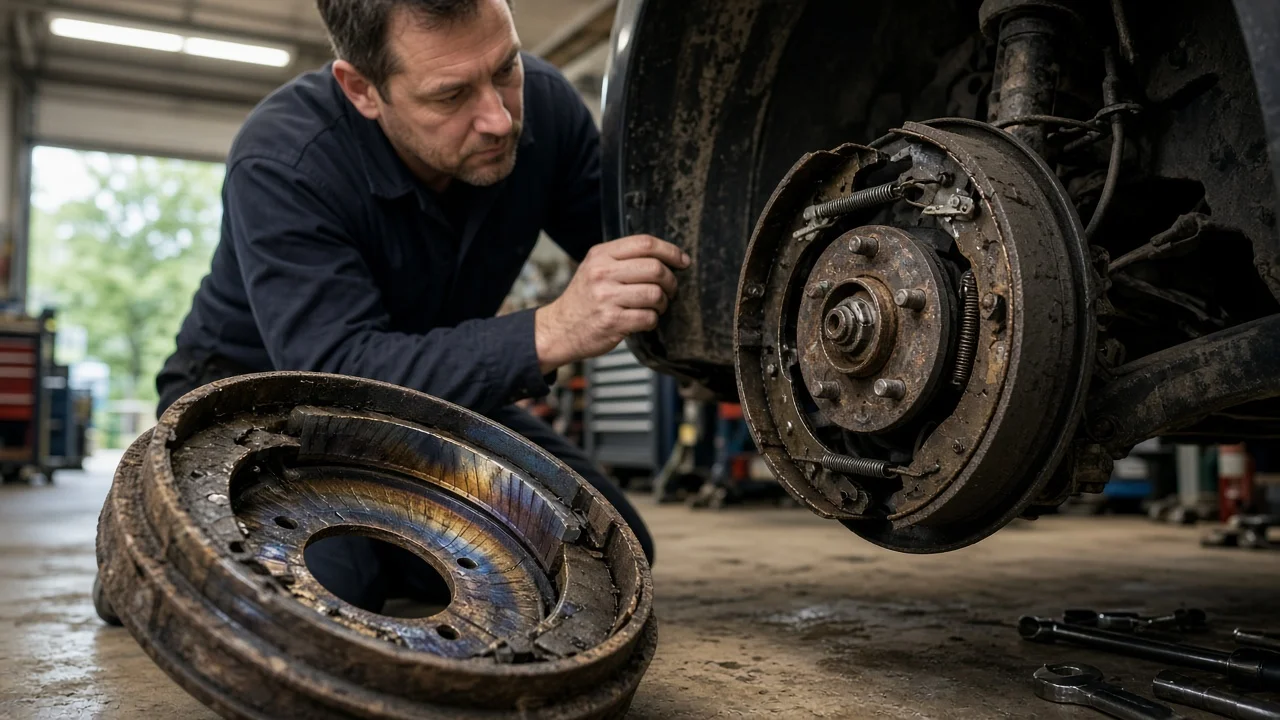
When a rear brake complaint appears, drivers often wonder whether the trouble lives in the drum or the shoe. Both parts wear and degrade, yet they fail in different ways and leave different clues. Drums can distort, groove, or crack, while shoes lose friction material, harden, or separate from their backing. Reading the noise, pedal feel, parking brake behavior, and visual condition helps isolate the likely source. That distinction matters because replacing only a brake shoe when a drum surface is damaged can quickly ruin the new parts and leave the same symptom behind.
Essential answer
The most reliable way to separate a bad brake drum from a bad shoe is to inspect both surfaces and interpret the symptom pattern. A shoe fault usually produces noise that changes when the lining wears thin or when friction material transfers unevenly onto the drum. A drum fault more often appears as a pedal pulsation, a grabbing release, or a visible groove and hot-spot pattern around the braking surface. Because the parts operate as a matched pair, damage on one frequently accelerates wear on the other, so the first visible defect is not always the only one.
Drivers can begin with the parking brake. If the lever or pedal holds firmly and the vehicle resists rolling, the shoes and drum are still making adequate mechanical contact. A weak or sinking parking brake can point to worn shoes, stretched hardware, or a drum that is out of round. If the service brake pulses lightly while stopping, suspect drum distortion or thickness variation. If a scraping sound appears only when braking, the shoe friction material is often the source. A constant rotational scrape that changes while cornering may instead point to a rust lip on the drum edge or a backing plate contact.