Diagnose Subaru check engine light with cruise control off
The short answer
On many Subaru models, cruise control turning off when the check engine light comes on is usually intended behavior, not a second failure. When the engine control module detects an emissions or engine-management fault, it often disables cruise control as a precaution. On models equipped with EyeSight, the same fault commonly switches off adaptive cruise control and related driver-assistance functions, and additional warning lights may appear on the dashboard.
The real question is therefore what triggered the check engine light. Once that underlying fault is fixed and the stored code is cleared, either by a scan tool or by the system confirming the problem is gone, cruise control normally returns.
An important qualification is that exactly which systems shut down, and which lights accompany the check engine light, varies by model year, generation, market and whether the vehicle has EyeSight. Your owner's manual is the authoritative reference for your specific vehicle. No model-specific service documentation was supplied for this article, so the guidance below is general rather than tied to a particular Subaru.
Why a Subaru disables cruise control with a fault present
Cruise control depends on the engine management system to hold a steady speed. When that system has logged a fault, it may not be able to guarantee consistent throttle response. Disabling cruise prevents the car from automatically holding speed while it is operating outside normal parameters.
On EyeSight-equipped Subarus, the camera-based systems also rely on accurate engine and drivetrain data. A fault elsewhere in the vehicle can therefore cause EyeSight warnings, even when the cameras themselves are working properly.
First check: is the check engine light flashing or steady?
Flashing check engine light: This generally indicates an active, severe misfire that can overheat and damage the catalytic converter. Reduce speed, avoid hard acceleration, and stop driving as soon as it is safe to do so. Have the car diagnosed before driving further. Steady check engine light: This indicates a stored fault that is usually less urgent. You should still diagnose it promptly rather than ignore it.
Signs that you should stop driving
Some conditions call for pulling over or arranging a tow instead of continuing to drive:
A flashing check engine light. An oil pressure warning or a temperature gauge reading high. Noticeable loss of power, rough running, stalling or hesitation. A burning smell, smoke, or fuel odor. A charging-system or brake warning appearing at the same time.
If none of these are present and the car drives normally, it is usually reasonable to drive carefully to a place where the code can be read.
Simple checks you can do yourself
1) Check the fuel cap
A loose, damaged or missing fuel cap is a common trigger for a steady check engine light. It allows the evaporative emissions (EVAP) system, which traps fuel vapor, to detect a leak.
Remove the cap and inspect the seal for cracks or debris. Refit the cap and tighten it until it clicks. If the light came on shortly after refueling, this is a strong lead.
Even after you fix the cap, the light usually does not go out immediately. The system has to re-test itself over several drive cycles, so cruise control may stay disabled until that happens or until the code is cleared.
2) Note every warning light
Write down or photograph every warning on the dashboard. Several lights appearing together with the check engine light, such as stability control, EyeSight or X-Mode indicators, often point to one engine-management fault rather than several separate failures. This is useful context for whoever diagnoses the car.
3) Consider recent work or events
Recent events can provide useful clues. Ask whether the battery was recently disconnected, replaced or run flat, whether you just refueled, whether the car went through deep water, or whether it was recently serviced. A weak battery or low system voltage can produce unusual warning combinations on modern vehicles, so the battery's condition is worth checking if the lights appeared after slow starting.
4) Read the diagnostic trouble code
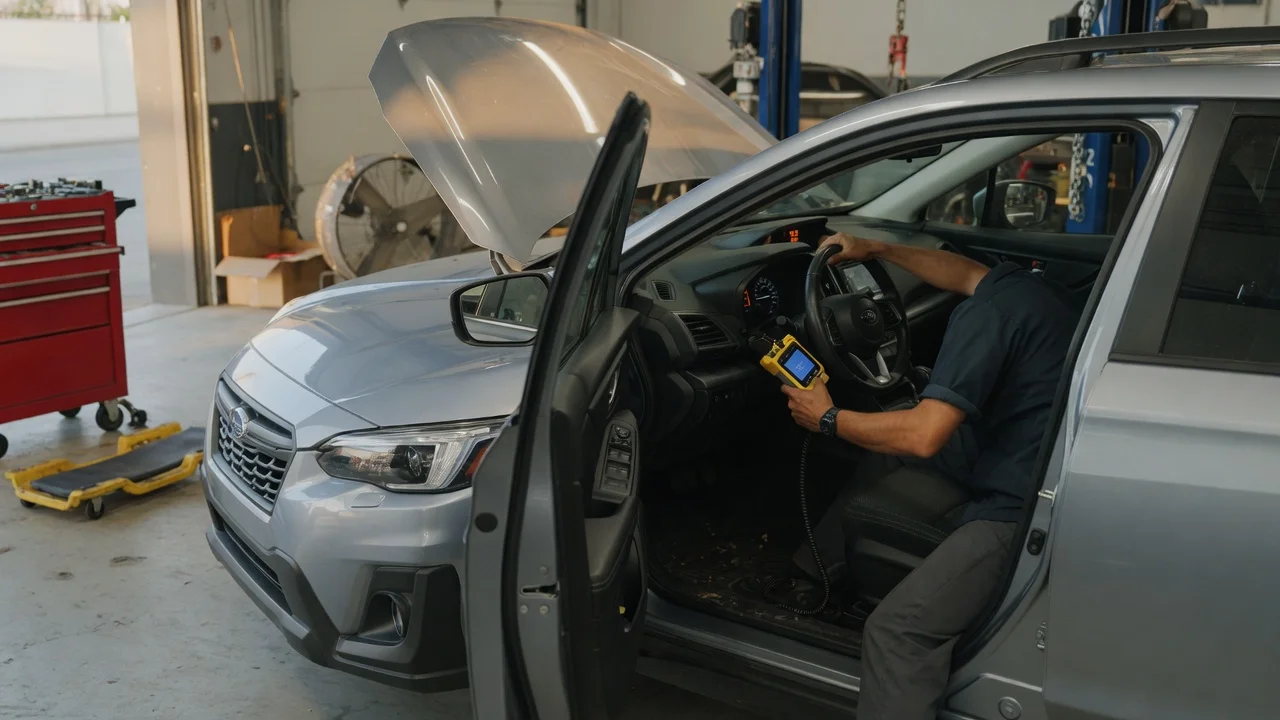
An inexpensive OBD-II scanner plugs into the diagnostic port under the dashboard and reads the stored trouble code. Many auto parts retailers will also read codes. The code tells you which system detected the problem. For example, codes in the P0440 to P0457 range relate to the EVAP system, P0300-series codes relate to misfires, and P0420 relates to catalytic converter efficiency.
What the code tells you and what it does not
Treat a trouble code as a starting point for investigation, not proof that a specific part has failed. A code records that a monitored value went out of range. Several different faults can produce the same code. An oxygen sensor code, for instance, can result from an exhaust leak or a wiring problem rather than a bad sensor, and an EVAP leak code might be caused by the fuel cap, a hose or a valve.
Result | What it suggests | Next step; EVAP leak code and fuel cap was loose | The cap is a likely cause | Tighten or replace the cap, then drive normally and see whether the light clears; EVAP code and cap is secure | Leak elsewhere in the vapor system | Professional smoke test or inspection; Misfire code, especially with a flashing light | Ignition, fuel or mechanical issue | Limit driving and get professional diagnosis; Multiple unrelated codes, often after battery issues | Possible voltage or electrical issue | Test the battery and charging system first; No code stored but warnings present | Possible module or communication fault | Dealer-level scan tool may be needed
Should you clear the code yourself?
Clearing the code with a scanner will usually restore cruise control right away. However, if the underlying fault is still there, the light will come back. Clearing codes also erases information that a technician could use. It is best to record the code first and clear it only once you are confident the cause has been addressed, such as after fixing a loose fuel cap.
When to get professional diagnosis
Seek a Subaru dealer or qualified technician in the following situations: the light is flashing, the car drives abnormally, the code points to misfire, catalytic converter, transmission or sensor faults, the light returns after you clear it, or EyeSight warnings remain after the check engine light is resolved. A dealer can also check for technical service bulletins or software updates relevant to your model year. Because no such bulletins were supplied here, this article cannot say whether any apply to your car.
Key takeaway
In most cases, cruise control shutting off is a symptom of the check engine light, not a separate problem. First rule out urgent conditions such as a flashing light, overheating or loss of power. Then check the fuel cap and read the trouble code. Use that code as a guide for diagnosis rather than as a verdict on which part to replace. Cruise control should come back once the root fault is fixed and cleared.