Starter or Battery? How to Tell Which One Is Keeping Your Car From Starting
When a car refuses to start, the first question is usually whether the starter or the battery is at fault. The two share one job, getting the engine turning, so their symptoms overlap. They fail in different ways, though, and a few simple observations can usually point you in the right direction before you buy any parts.
The Short Answer
The battery is the more common cause, especially when the engine cranks slowly, the dash lights dim or flicker, or the car starts normally after a jump. A failing starter is more likely when the battery is confirmed healthy but you hear a single loud click, grinding or whirring, or nothing at all while the lights stay bright. Neither part may be at fault: corroded cables, a bad ground, the ignition switch, a security immobilizer or a starter relay can produce the same no-start. If the engine cranks at normal speed but never fires, both the battery and the starter are probably doing their jobs, and the problem lies elsewhere, such as fuel delivery, ignition or engine management.
How the Starting System Works
The starter circuit links the battery, the ignition switch (or push-button start module), a starter relay or solenoid, and the starter motor. When you turn the key or press the button, a small control current energizes the solenoid. The solenoid pushes the starter's drive gear into the engine's flywheel or flexplate and closes a heavy-duty contact that sends high current from the battery to the motor. The motor then spins the engine until it starts.
The battery's role is to deliver that high current on demand. Its battery state of charge (how full it is) and its overall health (its ability to hold voltage under load) decide whether enough power reaches the starter. A battery can show reasonable voltage at rest and still collapse when the starter draws current. That is why a simple voltage reading alone is not always conclusive.
Symptom Comparison: What Each Sign Usually Points To
Symptom | More likely cause | Notes; Slow, labored cranking speed | Weak or discharged battery, poor cable connections | Cold weather makes this worse; a dragging starter can also cause it; Rapid clicking or chattering, dash lights dim | Low battery or bad connection | The solenoid engages and drops out repeatedly because voltage collapses; Single loud click, lights stay bright, no cranking | Starter motor or solenoid, or a high-resistance connection | Check cables and the starter main terminal before replacing the starter; No sound, no dash lights | Dead battery or disconnected/corroded terminal | Also check the main fuse or fusible link; No sound, but dash lights are normal | Ignition switch, neutral safety or clutch switch, relay, immobilizer, starter control wire | The battery is probably fine; Grinding or whirring with no engine rotation | Starter drive gear or flywheel/flexplate teeth | Stop trying to start it to avoid further damage; Cranks normally but will not start | Fuel delivery, ignition, sensors, immobilizer | Battery and starter are probably functioning; Starts after a jump, then fails again later | Battery not holding charge or charging system problem | Test the battery and alternator output
Diagnostic Checks You Can Do in Order
Work from the simplest and most common causes toward the less common ones. These diagnostic checks require little equipment beyond a basic digital multimeter, and several need no tools at all.
1) Observe the Dash and Lights
Turn the key to the run position, or press the start button without your foot on the brake, and watch the instrument cluster and interior lights. Then try to start the engine while watching them. If the lights are dim from the start, or fade sharply or go out when you try to crank, the battery or its connections are the prime suspects. If the lights stay bright and steady while nothing happens, the battery is probably delivering power, and attention shifts toward the starter circuit.
2) Inspect the Battery Terminals and Cables
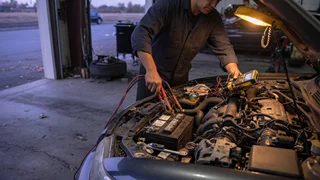
Look for white, green or bluish corrosion on the terminals, loose clamps, frayed cables and a loose or corroded ground strap where the negative cable meets the body or engine. A connection can look acceptable and still have enough resistance to stop the starter from drawing current. If a terminal moves by hand, it is too loose. Cleaning and tightening the connections is a low-cost step that resolves a surprising number of no-starts.
3) Measure Battery Voltage at Rest
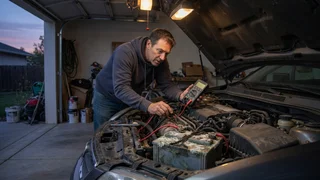
With the engine off and the car sitting for a while, so any surface charge has dissipated, measure across the battery posts with a multimeter. As a general guide for conventional 12-volt lead-acid batteries, a fully charged battery reads roughly 12.6 volts or slightly higher. Readings that drop toward the mid-12-volt range indicate partial discharge, and readings near or below 12 volts indicate a substantially discharged battery. These figures are approximate, and AGM or other battery types may differ slightly. A low reading tells you to charge the battery and retest before suspecting the starter.
4) Check Voltage While Cranking
Have a helper attempt to start the engine while you watch the meter on the battery posts. A healthy, charged battery dips during cranking but should not collapse. A commonly used rule of thumb is that voltage staying around 10 volts or above during cranking suggests the battery is coping, while a drop well below that points to a weak battery. If voltage barely changes while the starter does nothing, current is not reaching the starter. That suggests an open circuit, a failed solenoid or a control-side problem rather than a weak battery.
5) Try a Jump Start or a Charged Battery
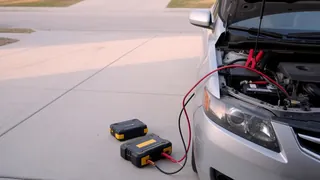
A jump start is one of the most informative tests. If the engine cranks briskly and starts with a jump, the original battery, its connections or the charging system is the likely culprit. If the engine still clicks once or does nothing with a known-good power source connected, the starter, solenoid or starter circuit is more likely. Follow the vehicle's owner's manual for jump-starting. Some vehicles specify remote jump points under the hood instead of the battery itself, especially when the battery sits in the trunk or under a seat.
6) Rule Out Control-Side Causes
If the battery checks out and the lights stay bright, consider the components that tell the starter to engage:
Shifter position: on automatics, try starting in Neutral as well as Park, because a misadjusted or failing range sensor can block cranking. Clutch switch: on manuals, make sure the clutch pedal is fully depressed. Ignition switch: a worn switch may power the dash but fail to send the start signal. Intermittent behavior that changes with key position or wiggling is a clue. Security or immobilizer light: a flashing security indicator or a key-related message may mean the system is blocking the start. Starter relay and fuses: a failed relay or blown fuse in the start circuit can stop the solenoid from receiving its signal. Push-button start: a weak key fob battery can stop the car from recognizing the key, which can look like a starter failure.
7) Consider the Starter Itself
Once the battery, cables and control circuit have been ruled out, the starter becomes the leading suspect. Typical signs of a failing starter include a single solid click with full battery voltage available, intermittent no-cranks that come and go, grinding noises, a whirring sound without engine rotation, or smoke or a burning smell from the starter area. A professional can confirm the diagnosis by checking for voltage at the starter's control terminal and main terminal during a start attempt, and by measuring voltage drop across the cables and grounds.
When the Battery Keeps Going Flat
A battery that tests weak may be the symptom, not the cause. If a new or recharged battery goes flat again, look at two possibilities. The first is an undercharging alternator: a battery or charging warning light while driving, dimming headlights or electrical glitches point toward the charging system. The second is a parasitic drain, where a module, light or accessory keeps drawing current after the car is shut off. Replacing the battery without addressing either problem usually leads to the same no-start a few days or weeks later.
If It Cranks but Won't Start
Normal cranking speed with no start shifts the investigation away from both the starter and the battery. Likely areas include fuel delivery (a failed fuel pump, relay or filter, or an empty tank despite the gauge reading), ignition components, crankshaft or camshaft position sensors and immobilizer faults. Listening for the fuel pump's brief hum when the ignition is switched on can be a useful clue on many vehicles, although not all pumps are easily audible.
What About Warning Lights and Fault Codes?
A scan tool can reveal stored codes related to the charging system, the starter control circuit, the immobilizer or engine sensors. Treat a fault code as a starting point for investigation, not proof that a specific part has failed. A low-voltage code, for example, can result from a weak battery, a bad connection or an alternator problem. Codes are most useful alongside the physical checks described above.
Vehicle Differences That Change the Diagnosis
Diagnosis varies by powertrain and equipment, so check what applies to your vehicle's model year and configuration:
Start-stop systems often use AGM or enhanced flooded batteries and may require battery registration or a specific replacement type. A weakening battery can show up first as the start-stop feature stopping working. Many hybrids do not use a conventional starter motor in the same way; the hybrid system typically starts the engine. A no-start there often traces to the 12-volt auxiliary battery, which powers up the vehicle's electronics. Electric vehicles have no starter motor, but a weak 12-volt battery can still stop the vehicle from powering on. Diesel engines generally place higher demands on the battery and starter, and glow plug systems add another factor in cold-weather starting. Battery location matters for testing and jump-starting. Trunk- or under-seat-mounted batteries usually have designated remote terminals.
When to Stop and Get Professional Help
Stop repeated start attempts and seek professional diagnosis in these situations:
You smell burning, see smoke, or notice that cables or the starter are very hot. You hear grinding, which can damage the flywheel or flexplate teeth if it continues. The battery is swollen, cracked, leaking or emits a rotten-egg smell, which can indicate overcharging or internal failure. The starter is hard to reach, which is common on many modern engines, or reaching it requires lifting the vehicle. Your checks are inconclusive, or the problem is intermittent and hard to reproduce.
Basic battery safety applies throughout: batteries can release flammable hydrogen gas, so avoid sparks and flames nearby, wear eye protection, and connect and disconnect cables in the order specified for your vehicle. Many parts stores and repair shops can load-test a battery and check the charging system, which is a practical next step if you lack a meter or the results are unclear.
Putting It Together
To decide between the starter and the battery, start with what you can see and hear. Dim lights, slow cranking or rapid clicking point toward the battery or its connections, especially if a jump start fixes the problem. Bright lights with a single click or silence, after the battery and cables check out, point toward the starter or its control circuit. Normal cranking without a start points away from both. Cleaning connections, measuring voltage and trying a jump will settle most cases. Anything involving burning smells, grinding or a damaged battery belongs with a professional.