Side-by-Side VIN Lookup: How to Find, Decode and Verify a UTV's VIN
A side-by-side VIN lookup uses the vehicle identification number stamped on a UTV's frame to confirm its manufacturer, model year, model family and production serial, and to check its title, theft and recall status. Most modern side-by-sides carry a 17-character VIN in the same general format used on cars, so you can partly decode one yourself. Detailed model information usually comes from the manufacturer or a dealer, because many car-focused VIN decoders return incomplete results for off-highway vehicles. Older machines, and some smaller or imported brands, may use shorter serial numbers that do not follow the 17-character pattern. For those, only the manufacturer can reliably interpret the number.
VIN, Engine Number and Model Number Are Different
A side-by-side can carry several identifying numbers, and mixing them up is the most common reason a lookup fails.
VIN (frame number): identifies the whole vehicle. It is the number used for titles, registration, insurance, theft reports and recalls. Engine serial number: stamped on the engine case. It identifies the engine only and may not match any part of the VIN. Model number or product code: often printed on a decal. It identifies the trim and configuration for parts ordering, but it is not unique to one machine. Key, emissions and other labels: useful for confirming details, but they are not substitutes for the VIN.
Where to Find the VIN on a Side-by-Side
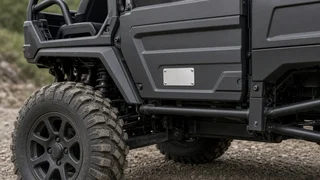
The location varies by manufacturer and model year. On most machines the VIN is stamped directly into a frame member, and some also have a matching decal or plate. Common locations include:
On a front frame rail, often visible near a front wheel or behind the front bumper area; Under or behind the driver or passenger seat; On the frame near the rear suspension or below the cargo bed; On a decal or plate on the frame, the dash area or the vehicle certification label; On the title, registration, bill of sale and insurance documents
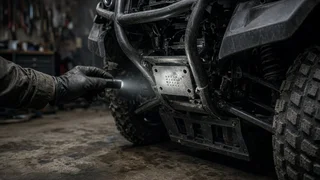
Frame stampings are often covered by mud, paint or undercoating. Clean the area gently and use a flashlight at a low angle to read the characters. Photograph the stamping so you can compare it with paperwork later. The owner's manual usually shows the exact location for that model.
How a 17-Character VIN Is Structured
When a side-by-side uses the standard 17-character format, each position has a defined role. The letters I, O and Q are never used, so they cannot be confused with 1 and 0. Positions 4 through 8 are coded differently by each manufacturer.
Position | Section | What it tells you; 1–3 | World Manufacturer Identifier (WMI) | Manufacturer and country or region of origin; 4–8 | Vehicle Descriptor Section | Manufacturer-specific codes, often for model line, engine, body style or other attributes; 9 | Check digit | A calculated value used to catch transcription errors (required on North American-market VINs); 10 | Model year | A coded letter or number for the model year; 11 | Plant code | Assembly plant; 12–17 | Sequential serial | Production number unique to that vehicle
Reading the Model Year (Position 10)
The year code cycles every 30 years and never uses I, O, Q, U, Z or the digit 0. For recent model years:
Code | Model year; A | 2010; B | 2011; C | 2012; D | 2013; E | 2014; F | 2015; G | 2016; H | 2017; J | 2018; K | 2019; L | 2020; M | 2021; N | 2022; P | 2023; R | 2024; S | 2025; T | 2026
The model year is not always the calendar year in which the machine was built or sold. A unit can be produced or sit on a dealer floor in a different year from the one its VIN shows.
Step-by-Step: Running a Side-by-Side VIN Lookup
1) Read the VIN from the frame stamping itself, not only from a decal or document, and write down all 17 characters. 2) Check the format. Confirm the VIN has 17 characters and contains no I, O or Q. If it is shorter, treat it as a manufacturer serial and go straight to step 6. 3) Identify the manufacturer from the first three characters. A general VIN decoder or the manufacturer can confirm what the WMI means. 4) Decode the model year from position 10 using the table above. 5) Validate the check digit (position 9). A mismatch usually means a misread or typo. On a vehicle that should comply, it can also indicate an altered number. 6) Ask the manufacturer or an authorized dealer to look up the VIN. Dealers can typically confirm the exact model, trim, original build configuration, warranty status and any open service campaigns. 7) Check recalls. In the US, recalls on off-highway recreational vehicles such as side-by-sides are generally handled through the Consumer Product Safety Commission and the manufacturer, not the road-vehicle recall system. A dealer lookup by VIN is often the most direct route. 8) Check theft and title status. Ask local law enforcement, your state titling agency or a theft-check service whether the VIN has been reported stolen. Off-road coverage in commercial history reports varies, so a clean result is not proof on its own. 9) Compare everything. The frame VIN, title, registration, bill of sale and any dealer records should all show the same number.
Checking the Check Digit Yourself
On North American-market VINs, position 9 is calculated from the other 16 characters. You can verify it by hand or with a short script:
1) Convert letters to numbers: A=1 B=2 C=3 D=4 E=5 F=6 G=7 H=8; J=1 K=2 L=3 M=4 N=5 P=7 R=9; S=2 T=3 U=4 V=5 W=6 X=7 Y=8 Z=9; (digits keep their own value); 2) Multiply each position by its weight: Position: 1 2 3 4 5 6 7 8 9 10 11 12 13 14 15 16 17; Weight: 8 7 6 5 4 3 2 10 0 9 8 7 6 5 4 3 2; 3) Add the products and divide the total by 11. 4) The remainder is the check digit (a remainder of 10 is written as X). It should match position 9.
Some off-highway manufacturers, especially for machines built for markets outside North America, may not follow the check-digit rule. A mismatch on such a vehicle is a reason to ask the manufacturer, not an automatic sign of fraud.
What a VIN Lookup Can and Cannot Tell You
A VIN identifies the machine, but it is not a full specification sheet. What you can learn depends on how the manufacturer codes positions 4 through 8 and on what its records hold.
Usually available: manufacturer, model year, assembly plant, production serial and, through a dealer, the specific model and trim. Sometimes encoded or available from the manufacturer: engine type, seating configuration, and drive configuration (such as two-wheel drive versus selectable four-wheel drive). This is manufacturer-specific. Rarely in the VIN itself: tire specification, ground clearance, suspension setup and factory accessories. These come from the model's published specifications once you know the exact model and trim. Never in the VIN: current condition, aftermarket modifications, changed tires or lift kits, or how the machine has been used.
Once the lookup confirms the exact model, use that model's specifications to check whether the machine in front of you is still stock. Look at tire size, ride height, wheels and accessories such as winches or added recovery points. Modifications can affect traction, handling on different terrain, warranty coverage and parts compatibility, so it helps to know what changed from factory.
Verifying the Result Before You Buy
For a used side-by-side, a clean lookup is only useful if the number belongs to the machine you are inspecting. Watch for these warning signs:
The frame stamping looks ground down, re-stamped, welded over, or uneven in character depth or spacing; A VIN decal is missing, replaced or peeling over a different number; The VIN on the title or bill of sale does not match the frame exactly; The decoded model year or model does not match the machine's styling, engine or features; The seller cannot produce a title or registration where your state requires one; The check digit fails on a machine that should comply with North American VIN rules
If something does not match, pause the purchase. Ask the manufacturer or a dealer to confirm what the VIN should correspond to, and contact local law enforcement if you suspect the number has been altered. Titling and registration rules for off-highway vehicles differ by state, so confirm with your state's titling or natural resources agency what paperwork the vehicle should have.
When the Lookup Comes Back Empty
Empty or partial results are common for side-by-sides. Many free decoders are built around cars and trucks, so they may recognize the manufacturer and year but not the model. Older machines and some brands may not use a standard 17-character VIN at all. In these cases:
Re-read the stamping to rule out misreading similar characters such as 8 and B, or 5 and S; Confirm you are using the frame VIN rather than the engine or model number; Contact the manufacturer's customer service or an authorized dealer with the VIN and clear photos of the stamping; Use the model number decal, if present, to narrow down the configuration; Keep copies of all responses with your purchase or ownership records