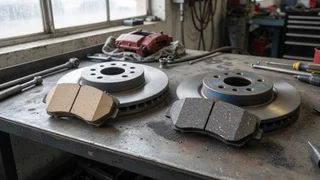
Shop for Replacement Brake Pads: What to Check Before You Buy
The short answer
The right brake pads are the ones that exactly match your vehicle's brake hardware and suit how you drive. Fitment comes first. Confirm the year, model, trim, engine and brake package, and whether you need front or rear pads. Then choose a friction material. Ceramic pads are usually quieter and cleaner for daily driving. Semi-metallic pads are usually better for towing, heavy loads and repeated hard stops. Brand and price tier come last, and only among parts that already fit.
Two conditions can change that answer. If your rotors are worn, warped or scored, new pads alone may not fix noise, vibration or a weak pedal. If the pedal feels soft or sinks, or the car pulls hard to one side, the problem may be in the hydraulic system or calipers, and pads will not solve it.
Step 1: Confirm exact fitment
Many vehicles were sold with more than one brake setup in the same model year. Pad shape, size, backing plate design and wear-sensor provisions can differ between trims, engines, drivetrains, towing packages and performance packages. A pad listed for the right model name can still be the wrong part.
Model year, make and model, plus the production date if the catalog splits the year; Trim level and engine, because higher-output versions often get larger brakes; Drivetrain (FWD, RWD, AWD or 4WD) and any towing, heavy-duty, sport or performance brake package; Front or rear axle, since the two almost always take different pads; Rear brake type on older or base models, because some use drums rather than discs; Whether the vehicle uses electronic pad wear sensors or an electronic parking brake
The most reliable shortcut is your VIN (vehicle identification number). Many parts catalogs and dealer parts counters can decode it to your vehicle's original equipment. If you already have the old pads off, compare their shape, size, clip locations and sensor tabs against the new set before installing anything. A part number stamped on the old pads can also help you cross-reference.
Step 2: Choose a pad material
Brake pads are named for their friction compound, the material that presses against the rotor. Each type trades noise, dust, bite, heat tolerance and rotor wear differently. Exact behavior varies by brand and formulation, so treat these as general tendencies rather than guarantees.
Type | Typical strengths | Typical trade-offs | Usually suits; Ceramic | Quiet, low visible dust, smooth feel, gentle on rotors | Often costs more; may have less initial bite when cold; not always the best fit for sustained heavy-duty heat | Daily commuting, most sedans, crossovers and light SUVs; Semi-metallic | Strong bite, good heat tolerance, consistent under hard use | More noise and dark dust; faster rotor wear | Towing, hauling, trucks, larger SUVs, spirited or mountain driving; Low-metallic NAO | Good bite with some metal content for heat transfer | More dust and noise than ceramic | Many European vehicles where this is the original design; Organic (NAO) | Quiet, soft, inexpensive | Wears faster; less heat tolerance; more dust than ceramic | Light vehicles with gentle use
Matching the original compound type is a safe default, because the brake system was tuned around it. Switching is reasonable when your needs differ from the original design. For example, you might move from a dusty semi-metallic to ceramic on a commuter car, or from ceramic to semi-metallic on a vehicle that now tows regularly.
Step 3: Know what comes in a brake pad set
A brake pad set normally covers one axle, meaning both wheels on the front or both on the rear. Always replace pads in axle pairs so braking stays balanced side to side. What else comes in the box varies widely, so read the listing before comparing prices.
Hardware kit: abutment clips, springs or anti-rattle clips. Some sets include them; others expect you to reuse or buy them separately. Shims: thin layers on the pad backing that reduce vibration and noise. They may be pre-attached or loose. Wear indicators: mechanical squealer tabs or electronic sensors. Electronic sensors are often sold separately. Lubricant: some sets include a small packet of brake-specific grease for contact points. Chamfers and slots: angled pad edges and grooves that help with noise and bed-in. These are design features, not extras.
A cheaper set that omits hardware may cost the same or more once you add the parts it leaves out. Reusing corroded or fatigued clips is a common cause of noise and uneven wear on otherwise good pads.
Step 4: Compare OE, OE-equivalent and aftermarket brands
Pads generally fall into three groups. Genuine OE (original equipment) pads come through the automaker's dealer network. OE-supplier and OE-equivalent pads come from companies that make original brakes for automakers and also sell to the public. Aftermarket pads are designed independently to fit, sometimes with different priorities such as low dust or extra bite. Most brands also sell several tiers, from economy to premium, so brand name alone does not tell you much. Compare the specific product line.
ACDelco: General Motors' parts brand, offering pads for GM vehicles and many other makes across several tiers. Advics: a brake manufacturer that supplies original equipment to automakers, notably in the Toyota group, and also sells replacement pads. Akebono: an OE brake supplier widely known in the replacement market for ceramic pads aimed at quiet, low-dust daily driving. Bendix: a long-running aftermarket brake brand with lines for passenger cars and heavier-duty trucks and SUVs. Bosch: a large automotive supplier whose aftermarket brake pads cover a broad range of domestic, Asian and European vehicles.
Parts-store house brands, such as those sold at AutoZone and Advance Auto Parts, are often made by established brake manufacturers and sold in good-better-best tiers. The useful comparison is not "name brand versus store brand." Compare compound type, included hardware, whether shims and chamfers are present, and warranty terms.
There is no single "best" brake pad for every car. The best choice for a quiet commuter sedan differs from the best choice for a loaded SUV towing a trailer. Start from your vehicle's original design and your driving pattern, then pick the most suitable line from a reputable brand.
Vehicle-specific considerations
BMW and Audi
Many BMW and Audi models use electronic pad wear sensors, and those sensors are commonly replaced along with the pads. Many also have an electronic parking brake. On those models, servicing the rear pads may require putting the system into service mode with a scan tool or a specific procedure, and the pad wear warning may need to be reset afterward. These vehicles often came with low-metallic pads that produce noticeable dust. Aftermarket ceramic options exist for drivers who want cleaner wheels, though pedal feel and bite may change. Brake sizes vary a lot across engines and sport packages, so fitment checks by VIN matter especially here.
Nissan Altima
Pads for the Altima can differ by generation, engine and, in some years, trim or package. Confirm the model year and engine before ordering. Check the rear brake type as well, since rear setups have not been identical across every version. Most Altima owners use the car as a daily commuter, so a ceramic pad is usually a sensible match unless the original specification says otherwise.
Jeep Grand Cherokee
The Grand Cherokee has been offered across several generations with a wide range of engines, drivetrains and brake packages. Performance-oriented trims may use substantially different calipers and pads from standard versions. Owners who tow, carry heavy loads or drive off-road often lean toward semi-metallic or heavy-duty formulations for heat tolerance. Owners who mostly commute may prefer ceramic for lower noise and dust. Matching the exact trim and brake package is essential before buying.
If your brakes squeak
Pads marketed as quiet, usually ceramic with good shims and chamfered edges, can help with noise. Still, a squeak has several possible causes, and not all of them are fixed by a new pad compound.
Wear indicator contact: a high-pitched squeal from a metal tab touching the rotor means the pads are near the end of their life. Replace them soon. Missing, worn or dry hardware: worn clips, missing shims or unlubricated contact points let pads vibrate. Replace the hardware and lubricate the correct points with brake grease. Rotor condition: glazed, grooved or uneven rotors can cause noise with any pad. Compound and design: semi-metallic pads tend to be noisier than ceramic by nature. Improper bed-in: new pads that were not bedded in may leave uneven deposits on the rotor and cause noise or vibration. Morning squeak after rain or humidity: brief surface rust on rotors often clears after a few stops and is usually not a fault.
A grinding sound is different from a squeak. Grinding often means the friction material is gone and metal is contacting the rotor. In that case the rotors likely need replacement too, and the vehicle should be serviced promptly.
Pads only, or pads and rotors?
Pads alone are often fine if the rotors are smooth, within the manufacturer's minimum thickness, and not warped. The minimum is usually stamped on the rotor or listed in service information. Plan on new rotors, or resurfacing where thickness allows, if you notice a pulsing pedal or steering wheel vibration while braking, deep grooves, a pronounced lip at the rotor edge, heat discoloration, or thickness at or below the minimum. Many retailers sell pad-and-rotor kits for one axle, which simplifies matching parts.
Some symptoms point beyond pads and rotors. A soft or sinking pedal, a brake fluid leak, a low fluid warning that is not explained by normal pad wear, one wheel much hotter than the others, or a strong pull to one side can indicate a caliper, hose, master cylinder or fluid problem. Those need diagnosis before you spend money on friction parts.
Where to buy and what to compare
Local parts stores make it easy to compare old and new pads at the counter, return a wrong part the same day, and sometimes borrow specialty tools. Online sellers may offer wider selection and catalog filters, but returns take longer, so double-check fitment before ordering. Dealer parts counters are the most direct route to genuine OE pads and can look up parts by VIN.
Fitment confirmation tied to your exact year, trim, engine and brake package; Front or rear axle, and whether the set covers both wheels on that axle; Compound type and whether it matches your driving needs; Included hardware, shims and wear sensors versus parts sold separately; Warranty terms; read what a "lifetime" warranty actually covers, since it often replaces the pads only, not labor or rotors; Return policy, especially for online orders and opened packaging
Installing them yourself or using a shop
Pad replacement is a common do-it-yourself job on many vehicles with basic tools, a torque wrench and a safe way to support the car. Key steps include cleaning and lubricating the caliper slide pins and pad contact points, retracting the piston correctly, torquing fasteners to specification, and bedding in the new pads according to the pad maker's instructions. Some rear calipers require rotating the piston rather than pushing it. Electronic parking brakes may need a scan tool.
Brakes are safety-critical. If you are unsure about any step, if your vehicle needs electronic service procedures you cannot perform, or if you suspect a hydraulic problem, a professional brake inspection is the better next step. Even if a shop does the work, knowing the right fitment, compound and hardware lets you compare quotes and ask informed questions.